Category: Direct Mail

  • Target Search Term: AI For Direct Mail Personalization

    Target Search Term: AI For Direct Mail Personalization

    Using AI to Personalize Direct Mail: Increasing ROI 4X Over Standard Campaigns

    Direct mail isn’t what it used to be. We are way past the “Hey [First Name]” thing. Brands now use AI for direct mail personalization to pull off things that feel eerie in a good way. Timing is spot on. The message is freakishly relevant. And that is how ROI just multiplies.

    Intrigued? We thought so, and that is why we put this guide together. We will show you how AI connects online behavior to offline outreach and how you can use it to create moments that feel too perfect to be a coincidence.

    Why Is Direct Mail Still Effective For Brands & Consumers
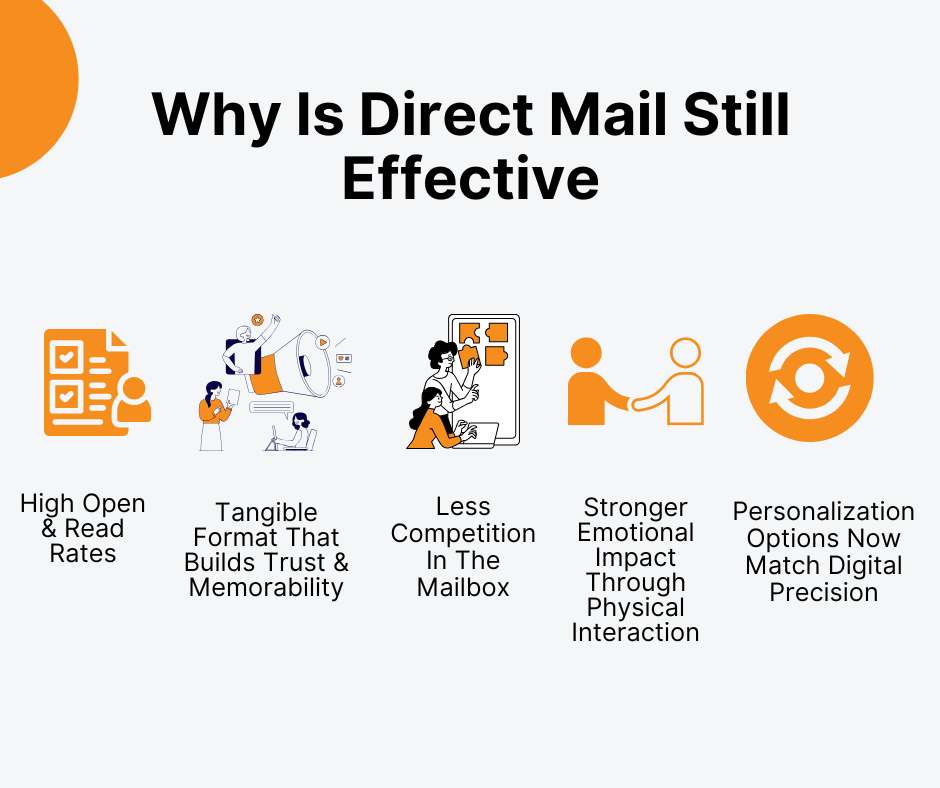
    AI For Direct Mail Personalization - Why Is Direct Mail Still Effective

    People keep predicting the “death” of direct mail, but it is quietly outperforming in places where digital marketing channels are hitting a wall. It is not nostalgia, and it is not about being “old-school.” Let’s break down why it is still a heavy hitter for both brands and consumers.

    1. High Open & Read Rates Compared To Email Marketing

    Most marketing emails are lucky to get opened by 20% of recipients. But around 90% of direct mail gets opened, and people actually read it. There is no spam folder for your mailbox, and most people at least glance at every piece of mail they get. 

    For brands, that is a massive visibility advantage. For consumers, it means they are not bombarded with hundreds of competing messages at once.

    2. Tangible Format That Builds Trust & Memorability

    Holding something gives it weight – literally and figuratively. A postcard or brochure feels more “real” than a pop-up ad. Studies show people trust printed material more, and they are 70% more likely to remember it longer than an online ad. That tangibility makes the brand feel established and worth paying attention to.

    3. Less Competition In The Mailbox Means Higher Visibility

    Email inboxes are overflowing. Social feeds are endless. Your physical mailbox has a handful of items a day. That scarcity works in your favor. Fewer competitors in the mailbox means your marketing content is seen and, more importantly, noticed.

    4. Stronger Emotional Impact Through Physical Interaction

    There is a sensory experience in opening an envelope or flipping through a catalog. The texture, the colors, even the smell of fresh print – it is a different kind of engagement that triggers stronger emotional and meaningful connections. When something feels personal and crafted, people are more likely to form a bond with the brand.

    5. Personalization Options Now Match Digital Precision

    This is where it gets exciting. With AI tools for direct mail personalization, brands can target as sharply as they do online. Names, purchase history, browsing behavior, even life events – these can all be used in direct mail marketing that is perfectly timed and highly relevant. 

    The result is a stronger response rate and ROI that can blow past standard direct mail marketing campaigns.

    How AI Enhances Every Stage Of A Direct Mail Campaign
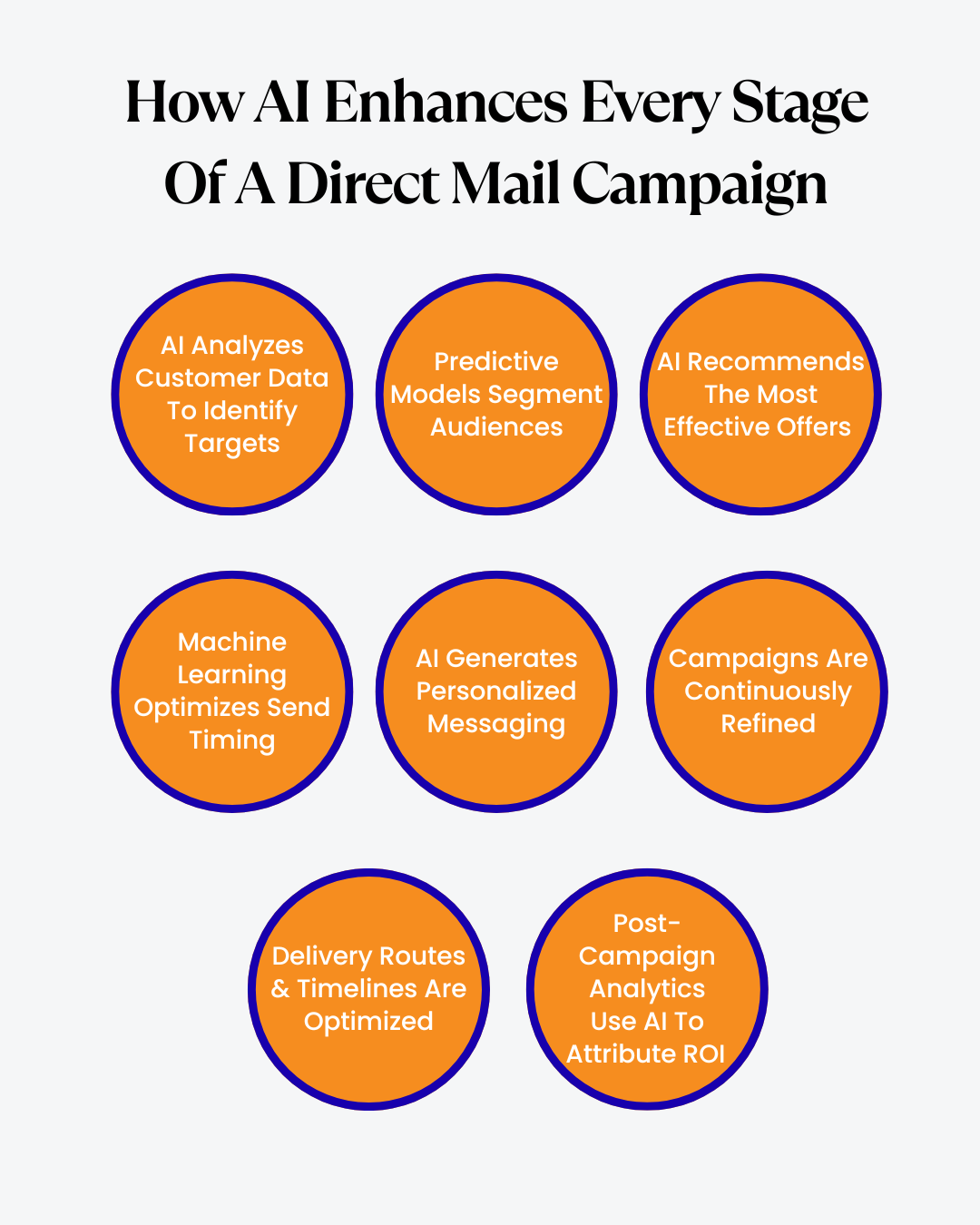
    Artificial intelligence rewires the entire direct mail process. Instead of treating a campaign like one big blast to everyone on a list, AI turns it into a series of precise steps that make every piece of mail count. Here’s how AI in direct mail works at each stage.

    1. AI Analyzes Customer Data To Identify High-Value Targets

    Before any direct mail piece even hits a printer, AI is already at work going through massive amounts of historical data. We are talking purchase history, browsing patterns, loyalty program activity, email engagement, demographic details  – basically, every digital breadcrumb someone leaves behind.

    AI looks for deeper signals that separate casual customers from those who are likely to deliver serious, long-term value. For example, it can pick up on repeat purchase cycles or the kind of engagement that suggests a customer is about to move into a higher-spending bracket.

    Instead of guessing who should be on your mailing list, AI integration helps pinpoint the exact people who are statistically most likely to spend and keep buying. That means your print budget isn’t wasted on people who barely remember your brand.

    2. Predictive Models Segment Audiences Based On Behavior & Interests

    Once the high-value targets are identified, predictive analytics sorts them into smaller, more accurate audience segments based on how they think and interact with your brand.

    Behavior is a huge factor here. Someone who frequently engages with eco-friendly products isn’t going to react the same way as someone who always buys the latest tech. AI algorithms pick up on these patterns automatically and create segments that go far beyond basic age or location demographics.

    It also factors in interests that might not be obvious at first glance. For instance, maybe a customer hasn’t directly bought running gear from you, but their browsing activity shows they have spent time looking at it. Predictive models notice those past interactions and group people accordingly, so you end up with more precise targeting from the start.

    3. AI Recommends The Most Effective Offers For Each Customer Profile

    Here’s where it gets interesting. It analyzes what each customer profile is most likely to respond to, then recommends the exact offers that will get the best reaction.

    This isn’t just “send a discount to everyone.” AI considers how sensitive a customer is to price drops and whether they respond better to free shipping or early access. It can even show what product bundles might feel irresistible to them.

    The perfect example here is a two-audience marketplace like BusinessForSale. They cater to two very different groups through direct mail – sellers who want maximum exposure for their listing, and buyers searching for the right investment opportunity.

    Those two mindsets require completely different mail offers. A seller might respond to a postcard promoting a free premium listing upgrade, while a buyer might be swayed by a direct mail flyer offering early access to newly listed businesses in their preferred category. AI detects these differences instantly, so each mailing feels timely and relevant.

    Even within one audience, AI uncovers micro-patterns. One buyer might only open direct mail about hospitality businesses under $500k, while another engages with anything related to manufacturing opportunities over $2M.

    Instead of sending the same generic mailer, AI ensures each recipient gets an offer that matches their exact investment criteria. That is how a two-audience marketplace avoids wasted mailings and turns every single piece into a direct path toward conversion.

    4. Machine Learning Optimizes Send Timing For Maximum Engagement

    Even the most perfect offer can flop if it is sent at the wrong time. This is where machine learning figures out exactly when each segment or even each individual customer is most likely to engage with your physical mail piece.

    It looks at past customer engagement patterns and timing of past successful responses to pinpoint optimal send windows. For example, some customers might be more receptive right before payday, while others respond better to weekend deliveries when they have time to browse and shop.

    Over time, machine learning keeps refining its timing recommendations based on what actually works, so each new campaign gets sharper and more in tune with your audience’s real-world habits. That way, your mail arrives when people are most ready to act on it.

    5. AI Generates Personalized Messaging For Each Recipient
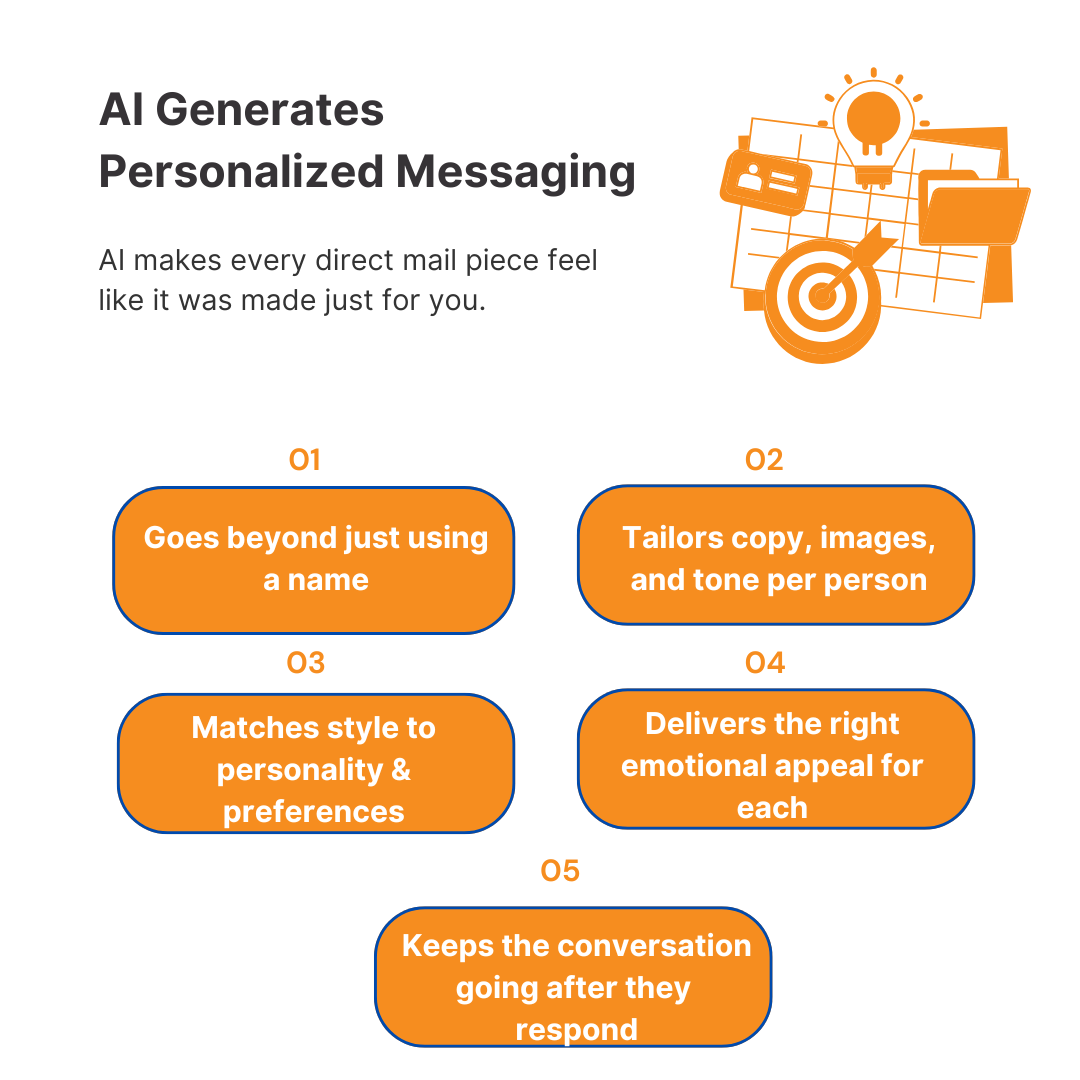
    When people hear “personalized,” they usually think, Oh, you mean putting my name at the top? Yeah… AI is working on a whole different level. It pulls in every scrap of insight it has on a person and then uses it to create highly personalized messages that are unique to them.

    Two people could get mail about the exact same product, but the way it is written, the images shown, the headline, and even the tone could be completely different. One person might get a bold, high-energy pitch with short sentences and bright visuals. Another might see a calmer, story-driven piece that leans into quality and craftsmanship.

    And the use of AI in personalization is just the starting point. When the customer responds to your direct mail offer, AI can keep the conversation alive and moving toward a conversion.

    To understand it better, let’s consider Rosie. Through its AI-integrated call services. Rosie answers calls 24/7, even after hours, with a natural, human-like tone that is trained on your product and offer

    Every call is handled in context, so if someone is responding to a specific direct mail promotion, AI can capture that information and ask qualifying questions you have set in advance. It can even route the lead to the right next step.

    This way, AI makes it easy to connect offline responses from direct mail to your online sales process without adding more workload to your team.

    6. Campaigns Are Continuously Refined Through Automated A/B Testing

    Old-school A/B testing was slow. You would pick two versions, send them out, wait weeks, and then maybe learn something for next time. AI isn’t that patient.

    With automated A/B testing, the system is running dozens of micro-tests in the background the moment your campaign starts – all without you sitting there swapping things manually.

    The second it sees one version pulling ahead, it shifts the rest of your active campaign toward the winning version right away. That means people who haven’t gotten your mail yet are already going to get the stronger, more effective version before the ink on the first batch has even dried.

    7. Delivery Routes & Timelines Are Optimized Using AI Logistics

    Once your mail is printed, it still has a journey to make, and that journey can be full of delays and inefficiencies.

    AI handles the boring-but-critical logistics side and figures out the fastest, most reliable way to get each piece from printer to mailbox. It can pull in data from postal services and outside factors like weather forecasts or known bottlenecks in certain regions.

    If that means rerouting through a different sorting facility or adjusting the mailing sequence so certain regions get priority, it will make the call. The result is more mail landing when it is supposed to and fewer “Where is my package?” complaints.

    8. Post-Campaign Analytics Use AI To Attribute ROI & Guide Next Steps

    Once it is all over, AI can analyze campaign performance and piece things together between someone receiving your mail and them taking action, even if that action happens weeks later. It can separate the people who bought because of your campaign from those who would have bought anyway. 

    And you can use it for identifying patterns, like a certain product unexpectedly driving a spike in repeat purchases.

    This isn’t just about patting yourself on the back for a good ROI. It is about having a crystal-clear picture of what is working, so the next campaign is built on connected data that direct mail automation has already pieced together for you.

    How To Use AI for Direct Mail Personalization: 6 Strategies Proven To 4X Your ROI
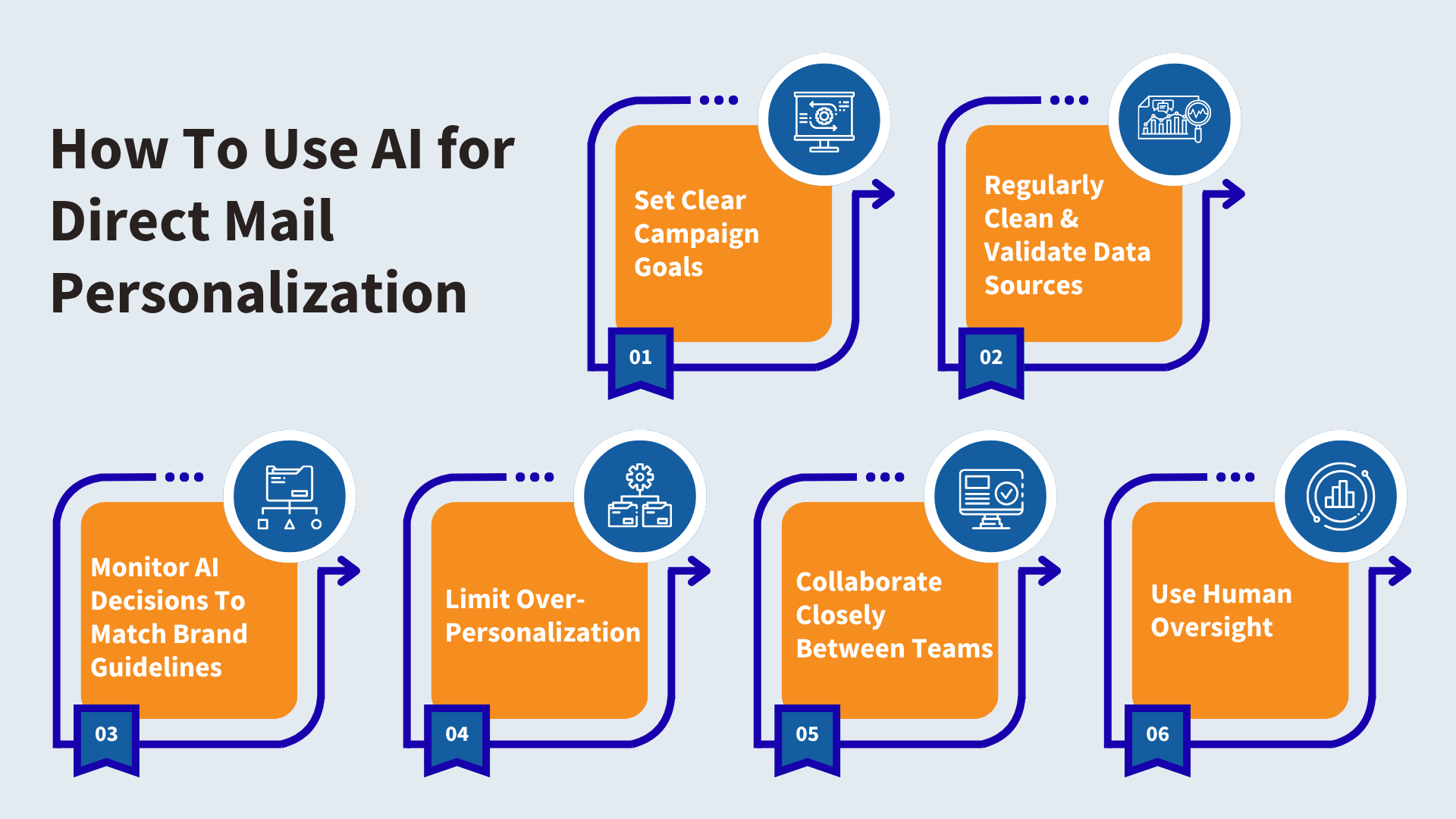
    Here are 6 strategies to get the right mix of brains and brawn so your direct mail marketing campaign feels like it was written in the recipient’s head before it landed in their hands.

    1. Set Clear Campaign Goals To Shape AI Optimization From The Start

    AI is powerful, but it is not a mind reader. If you don’t tell it the purpose, it will just optimize based on whatever it assumes is important, and that can be completely different from what you actually want. Are you aiming for sales? Repeat purchases? Store visits? Newsletter signups?

    When you firm up your goals before launch, AI can train its models on the right patterns and avoid wasting resources chasing the wrong outcomes. 

    What to Do:

    • Lock in the one outcome that matters most for this campaign – not three, not five, just one.
    • Put an actual number on it. “Better engagement” isn’t a goal; “30% lift in store redemptions” is.
    • Feed the AI past campaign data so it has a reference point for what is good vs. great.
    • Make sure every tweak or test ties back to that goal.
    • Revisit the goal mid-campaign process to confirm it is still the right target.

    2. Regularly Clean & Validate Data Sources Before Feeding Into AI Models

    AI can’t magically turn bad data into good results. If the data you are giving it is outdated or full of holes, your “personalization” will feel off, sometimes embarrassingly off.

    And cleaning data isn’t just deleting duplicates once in a while. It is making sure addresses are correct, names are spelled right, and you are not mailing to people who haven’t engaged with you in years. The cleaner the data, the sharper the AI’s decisions.

    What to Do:

    • Schedule data cleanups quarterly – fixed and non-negotiable.
    • Scrub out dead addresses, unsubscribes, and serial non-responders.
    • Run addresses through a validation tool before printing a single label.
    • Standardize how your fields are named and formatted so the AI doesn’t choke on it.
    • Keep a log of every cleaning cycle so you know when and what was done.

    While it is important for all industries, it becomes even more critical for high-consideration investments. To put it in perspective, let’s consider the example of Nordvik’s outdoor saunas. These aren’t impulse purchases you pick up on a random afternoon. 

    That means your audience pool is smaller and the buying cycle is longer. One wrong name, outdated address, or irrelevant offer, and you have just burned a lead that took months (or even years) to warm up.

    For this kind of product, you can’t afford to have AI crunching through messy, outdated data. If your records say someone is still at an address they moved away from two years ago, or that they are still in the market when they already bought elsewhere, your personalization efforts will actively erode trust.

    3. Monitor AI Decisions To Ensure They Align With Brand Guidelines
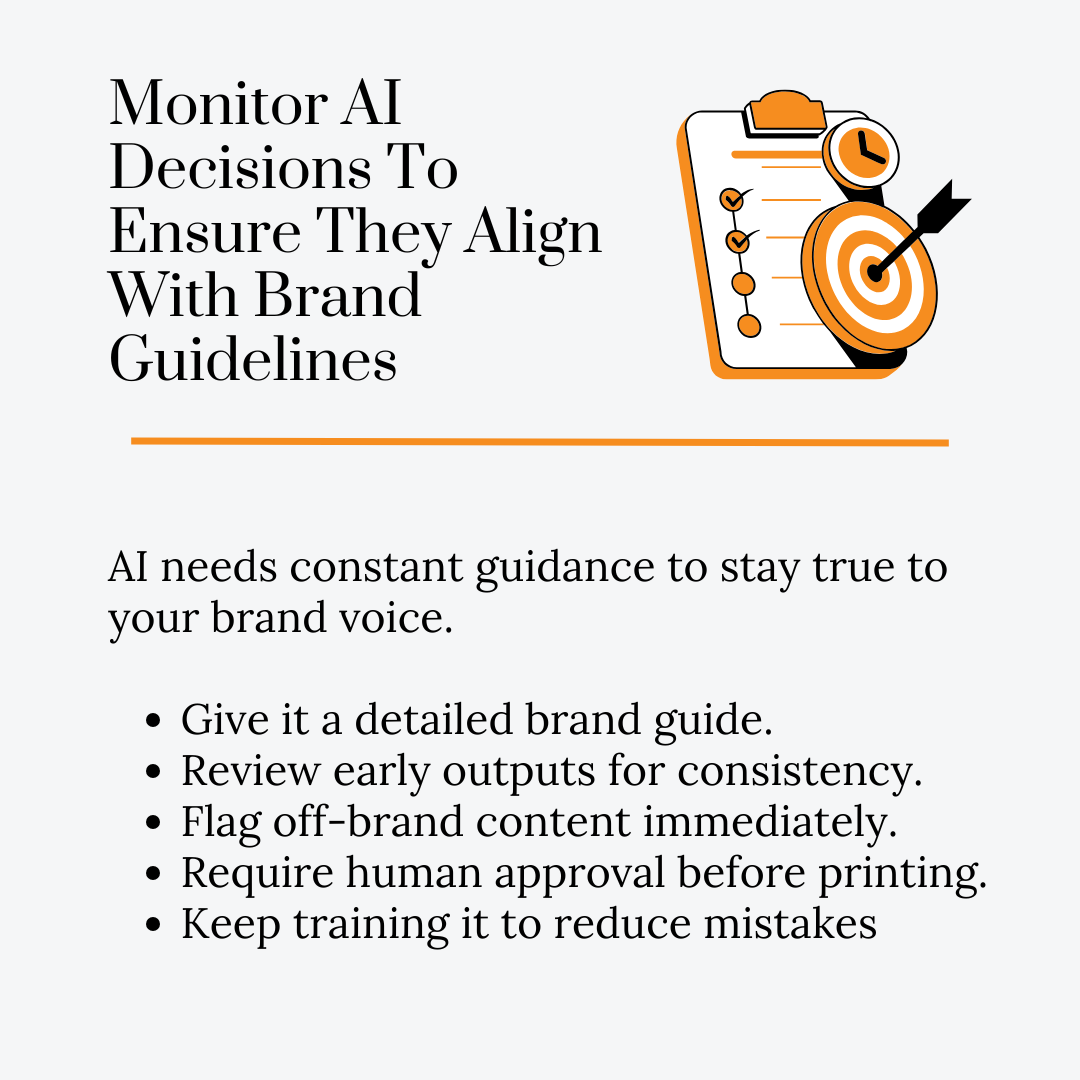
    AI can be clever… and also completely miss the direction you want. Left unchecked, it might write something that technically “works” but makes your brand sound like a stranger at its own table.

    You don’t want that. You want the AI to learn your brand’s pacing and style so it feels consistent no matter what it spits out. That only happens if you watch what it is doing and push it back on track when it drifts.

    What to Do:

    • Give the AI a brand bible – tone, words you love, words you ban, style rules, all of it.
    • Skim early outputs before anything goes live so you can spot weirdness fast.
    • Flag anything that sounds wrong so the AI’s feedback loop can course-correct.
    • Lock in a human approval step before mass printing – always.
    • Train it over time so those off-brand moments happen less and less.

    Keeping AI on-brand is a constant watch with a lot of micro-decisions. That kind of vigilance takes time you probably don’t have when you are already stuck planning campaigns and approving creatives. 

    You need someone who notices the subtle things you might miss. The best solution is to bring in a virtual assistant who is experienced in AI workflows and data management.

    Contrary to popular perception, a virtual assistant in this setup isn’t just “extra help.” They are the human layer that AI can’t replace. They remember the tiny details AI tends to forget, like a seasonal nuance or a cultural cue, and make sure those land exactly how you want. 

    And because they are embedded in the process, they quietly keep the whole thing on track – campaigns go out sharper and more in sync with your brand’s actual voice.

    4. Limit Over-Personalization To Avoid Creeping Out Recipients

    Yes, AI can know an insane amount about your customers. But just because you can use all that customer information doesn’t mean you should.

    The goal is for people to feel seen, not stalked. Overdo it, and they will be wondering why you know so much about their Tuesday night browsing habits. Keep personalization to what feels natural and relevant, and they will stay engaged instead of suspicious.

    What to Do:

    • Personalize around broad customer preferences, not intimate details.
    • Don’t reference actions they never directly shared with you.
    • Test different levels of hyper-personalization to find the sweet spot.
    • Lead with relevance, not with proof of how much you know.
    • Ensure data privacy compliance and always make opting out simple and clear.

    Some industries can get away with more personalization than others. In fashion retail, for example, customers expect a certain level of tailored recommendations. But for niche, tool-driven industries, the line between helpful and “too much” is razor thin. 

    This sewing machine parts business is a great example. A customer might browse replacement bobbins or motor belts for a specific model, but that doesn’t mean a direct mail piece should open with, “We noticed you viewed the replacement hook race for your Singer 201 on Wednesday afternoon.” 

    Instead, their direct mail could group preferences into broader categories – “parts to keep your vintage Singer running smoothly” or “most-requested upgrades for home quilting” – and show a curated selection that matches that interest.

    The smart move for a brand like this is to make the personalization feel industry-savvy, not invasive. For example, rather than referencing the exact presser foot or bobbin case someone viewed, they could send a mailer featuring “5 most-used Singer accessories for garment construction” or “replacement parts every vintage Singer owner should keep on hand.” 

    This way, the content is still highly relevant but leaves enough breathing room so it doesn’t feel like you have been peering over their shoulder.

    5. Collaborate Closely Between Data, Creative, & Marketing Teams

    AI can be the most advanced tool in the room, but it still works best when the humans around it are actually talking to each other

    The data team might know the target audience inside out. The creative team knows how to make that audience feel something. The marketing team knows the timing and the bigger campaign goals. If those three groups don’t sync up, AI ends up getting pulled in different directions, and your personalization will feel disjointed.

    What to Do:

    • Hold joint planning sessions so every team understands the campaign’s personalization goals.
    • Share AI insights with creatives in plain language instead of raw data tables.
    • Let direct mail marketers guide priorities so AI recommendations stay aligned with campaign timing and channels.
    • Keep feedback channels open – if AI results feel off, all three teams should review together.
    • Document what worked in past collaborations so each project gets smoother.

    While collaboration is a no-brainer for every industry, there are some niches where it is the difference between making a sale and losing a customer

    For example, in the workout supplements space, the audience is chasing specific performance goals – muscle growth, faster recovery, endurance, or fat loss. If you send a generic message, you signal that you don’t get their discipline or routine.

    To understand it better, consider Transparent Labs. Their lineup includes pre-workouts, proteins, amino acids, and more, each catering to a specific fitness outcome. 

    Their data team could flag customers who just purchased protein powder but haven’t tried a pre-workout. Creative could then develop a mailer headlined “Fuel the Set Before the Shake,” with visuals showing the synergy between the two products. Marketing would schedule this drop to hit during a common “training recommitment” window, like the post-holiday gym rush.

    When those three groups collaborate instead of working in silos, AI becomes the muscle behind direct mailing campaigns that feel like they were made for that athlete’s exact training phase.

    6. Use Human Oversight To Spot Irrelevant Or Biased AI Recommendations

    AI doesn’t always understand context. It might spot a correlation that is technically correct but completely useless, or worse, base recommendations on biased data without realizing it. Left unchecked, that can lead to personalization that is tone-deaf or even alienating.

    Human oversight is your safeguard. A person can look at an AI-generated offer or message and immediately see if it is off-base or insensitive. That gut check is something AI can’t do, because it doesn’t know your audience’s lived reality – it only knows the numbers.

    What to Do:

    • Review AI recommendations for cultural fit, tone, and audience appropriateness before approval.
    • Watch for patterns that suggest bias, like favoring certain demographics disproportionately.
    • Gut-check whether the personalization actually adds value for the recipient or just feels forced.
    • Have a small panel (marketing + creative + customer-facing roles) sign off on final AI-driven assets.
    • Feed corrections back into the AI system so it can identify the most promising prospects.

    Conclusion

    When you use AI for direct mail personalization, you stop gambling on who might bite and start sending the exact thing, to the exact person, at the exact time they will care. So, let the AI pull the strings and stop your mail from being the stack they never open. This way, it becomes the one piece they actually act on. And that is where the money lives.

    And when you are ready to do it, do it with Catdi Printing. We have the tech that makes it personal and the print quality that makes it impossible to ignore. This way, you can send out mail that feels like it was made for one person at a time, even if you are sending it to thousands. That is the formula that gets your mail opened, read, and acted on – exactly how you planned it.

    Get your free quote and start transforming direct mail campaigns.

  • Understanding Direct Mail Success Rates

    Understanding Direct Mail Success Rates

    Direct mail remains a powerful tool in the marketing arsenal, with success rates that often surpass digital channels. At Catdi Printing, we’ve seen firsthand how well-executed direct mail campaigns can drive impressive results for businesses across various industries.

    In this post, we’ll explore the factors that influence direct mail success rates, share strategies to boost your campaign performance, and provide insights on measuring ROI effectively.

    How Effective Are Direct Mail Response Rates?

    Direct Mail Outperforms Digital Channels

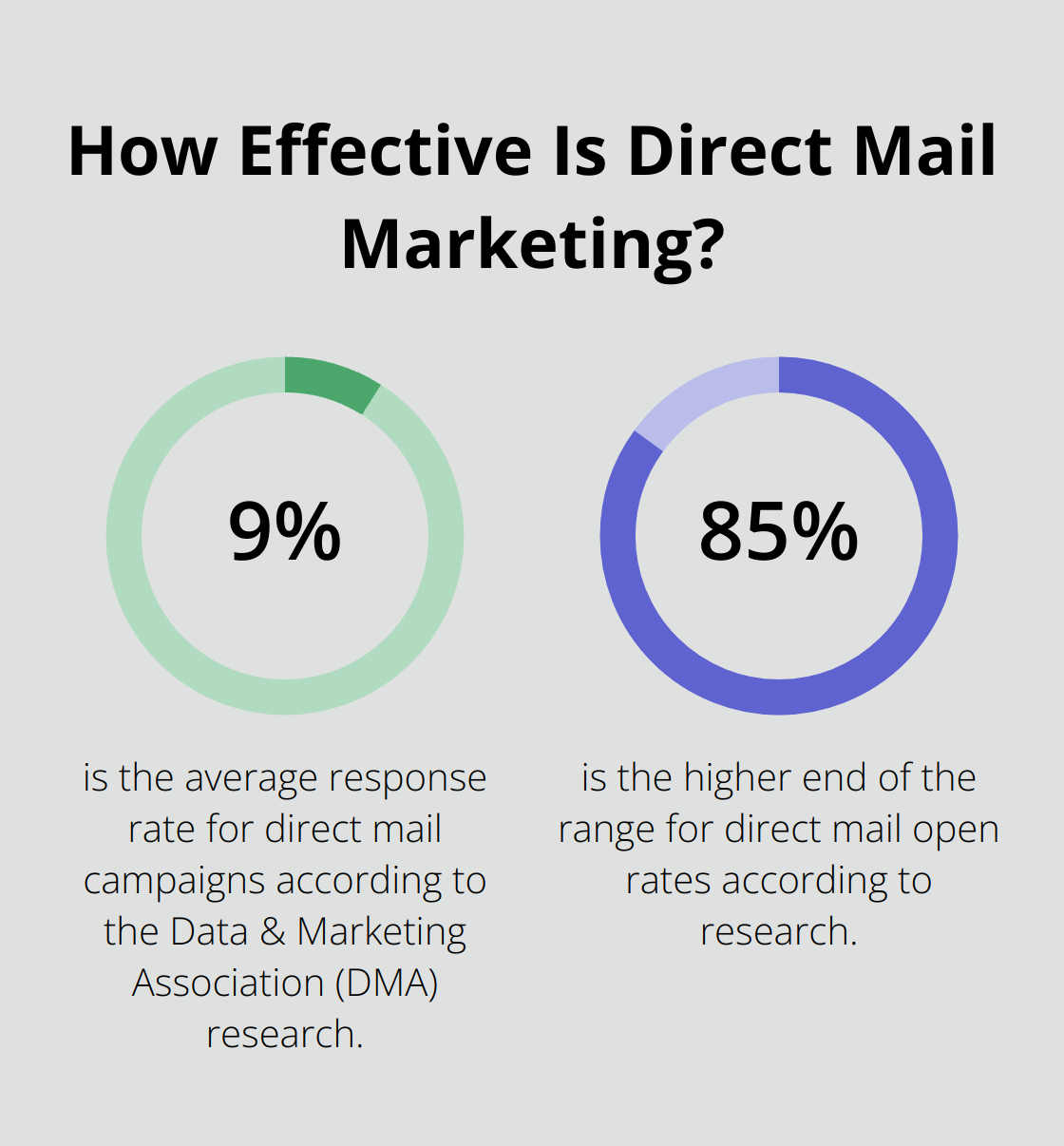
    Direct mail response rates consistently surpass digital marketing channels, making it a valuable tool for businesses aiming to boost their marketing ROI. The Data & Marketing Association (DMA) research shows a 9% average response rate for direct mail campaigns. This impressive performance underscores the enduring power of physical mail in an increasingly digital world.
    Industry-Specific Response Rates

    Response rates vary across industries, reflecting differences in target audiences and campaign objectives. The financial services sector often sees higher response rates due to the personal nature of their offerings. Retail and e-commerce businesses also benefit from direct mail, with the tactile experience of catalogs driving online and in-store purchases.

    Digital vs. Direct Mail Engagement

    When compared to digital marketing channels, direct mail’s effectiveness becomes even more apparent. Email marketing, often considered a cost-effective alternative, typically achieves open rates of 20-30%. In contrast, research shows that direct mail gets better response rates than email marketing, with open rates varying between 57.5 and 85 percent. This stark difference in engagement levels translates to higher conversion rates for direct mail campaigns.

    Key Factors Influencing Response Rates

    Several factors play important roles in determining the success of a direct mail campaign:

    1. List Quality: A well-targeted mailing list is fundamental. The more accurately you can pinpoint your ideal audience, the higher your response rates will be.
    2. Offer Relevance: Tailoring your offer to the recipient’s needs and interests significantly boosts engagement. Personalization goes beyond just using the recipient’s name; it involves crafting messages that resonate with their specific circumstances.
    3. Timing: Sending your direct mail at the right time can dramatically impact its effectiveness. For example, seasonal promotions or life event-triggered mailings often yield higher response rates.
    4. Design and Copy: The visual appeal and messaging of your direct mail piece are critical. Clear, compelling calls-to-action and eye-catching designs increase the likelihood of recipient engagement.
    5. Multi-channel Integration: Combining direct mail with digital touchpoints can amplify your campaign’s impact. For instance, following up a direct mail piece with an email can reinforce your message and provide an additional response channel.

    Optimizing Your Direct Mail Strategy

    To maximize the effectiveness of your direct mail campaigns, you should continuously test and refine each element. Use data-driven insights to optimize your mailing list, offer, timing, design, and multi-channel approach. This iterative process (which involves analyzing results and making adjustments) will help you achieve the best possible response rates for your specific industry and target audience.

    Fact - How Effective Is Direct Mail Marketing?

    As we move forward, it’s essential to understand how to measure the success of your direct mail campaigns accurately. In the next section, we’ll explore the key metrics and tools for evaluating direct mail ROI, ensuring you can quantify the impact of your efforts and make informed decisions for future campaigns.

    How to Measure Direct Mail ROI

    Measuring the return on investment (ROI) of your direct mail campaigns is essential for understanding their effectiveness and making data-driven decisions. This chapter explores key metrics and advanced tracking techniques to evaluate campaign success and optimize future efforts.

    Key Performance Indicators for Direct Mail

    Response Rate

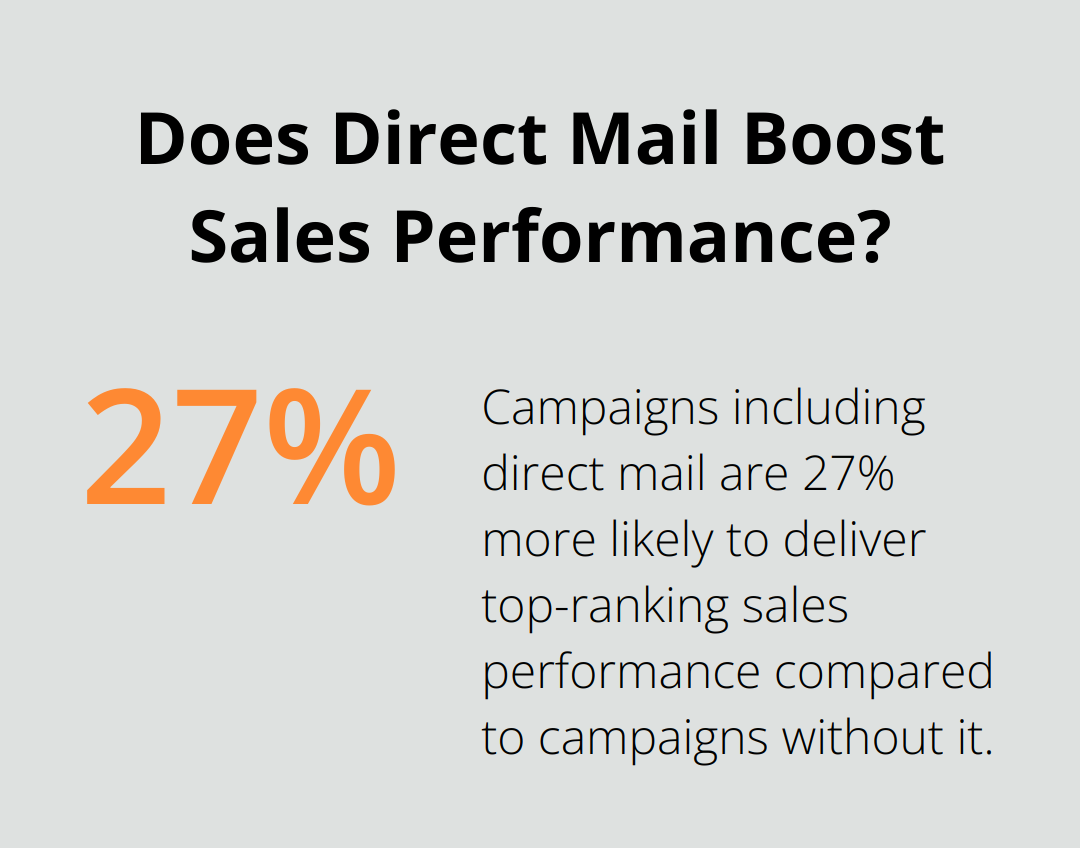
    This fundamental metric measures the percentage of recipients who took the desired action. The response rate for direct mail is more than 30 times the response rate for email. Campaigns including direct mail are 27% more likely to deliver top-ranking sales performance compared to campaigns without it.

    Conversion Rate

    While response rate is important, conversion rate tells you how many respondents actually became customers. This metric helps you understand the quality of leads generated by your campaign. Industry averages for conversion rates typically fall between 1% and 5% (depending on the product or service offered).

    Return on Investment (ROI)

    Calculate your ROI by subtracting the total campaign cost from the revenue generated, then dividing by the campaign cost and multiplying by 100. For example, if a campaign cost $5,000 and generated $15,000 in revenue, the ROI would be 200%. Direct mail consistently achieves higher response rates, better ROI, and improved brand recognition compared to many digital channels.

    Calculating Cost Per Acquisition

    Cost Per Acquisition (CPA) is a critical metric that helps you understand how much you spend to acquire each new customer through your direct mail campaign. To calculate CPA, divide the total cost (whether media spend in total or specific channel/campaign to acquire customers) by the number of acquisitions (new customers).

    Does Direct Mail Boost Sales Performance?

    For instance, if your campaign cost $10,000 and resulted in 100 new customers, your CPA would be $100. Compare this to your customer lifetime value (CLV) to ensure profitability. If your average CLV is $500, a $100 CPA indicates a healthy return on your marketing investment.

    Advanced Tracking Techniques

    Unique Promo Codes

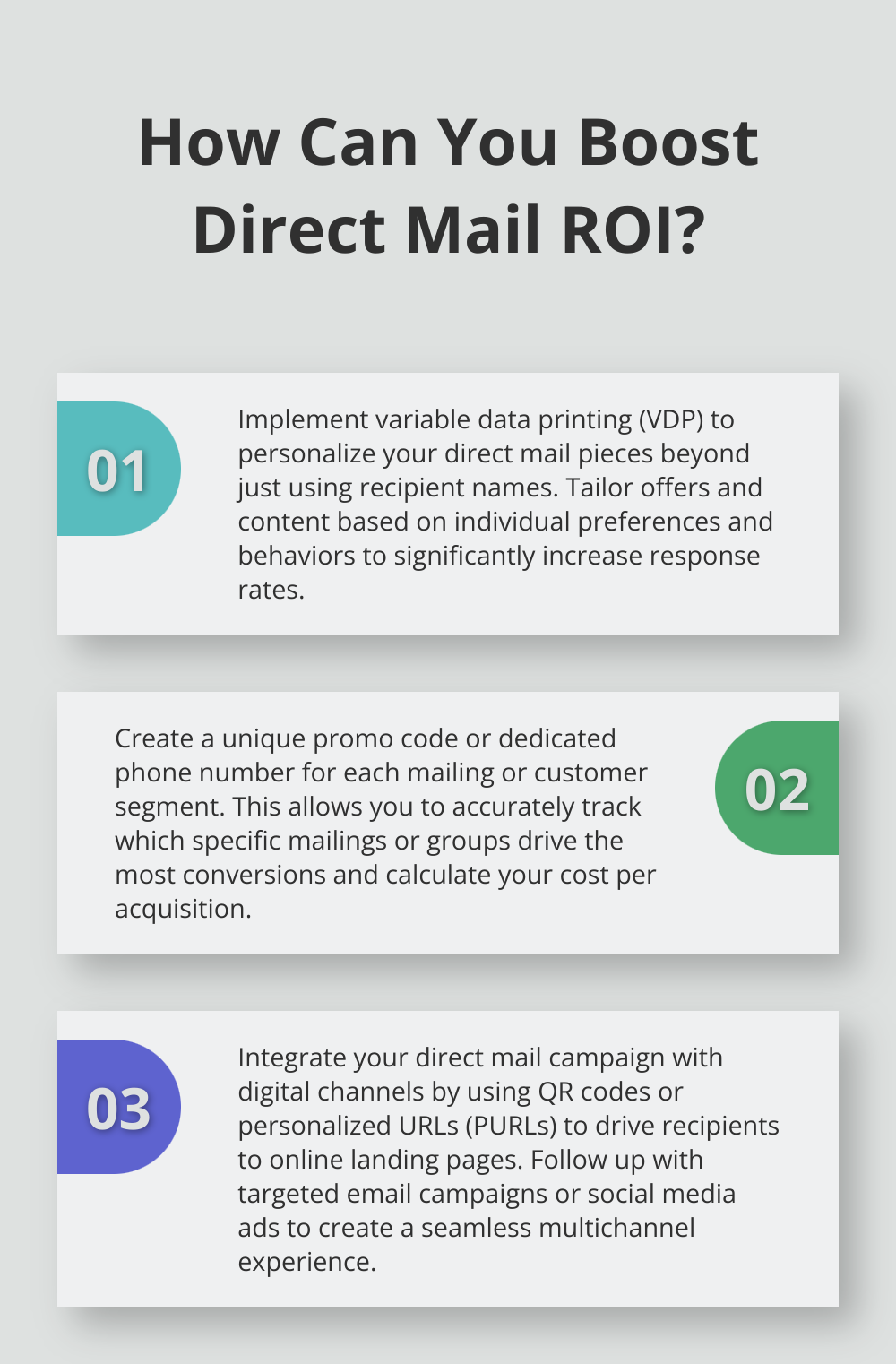
    Assign individual promo codes to each mailing or customer segment. This allows you to track which specific mailings or groups drive the most conversions.

    Call Tracking Numbers

    Use dedicated phone numbers for your direct mail campaigns. This enables you to attribute incoming calls directly to your mailings and measure their effectiveness in generating leads.
    Landing Pages

    Create custom URLs or QR codes that lead to campaign-specific landing pages. This not only helps track responses but also provides a seamless experience for recipients transitioning from physical mail to digital interaction.

    Integrating CRM Systems

    Link your direct mail data with your Customer Relationship Management (CRM) system. This integration allows for more comprehensive tracking of customer interactions across multiple touchpoints, providing a holistic view of the customer journey.

    A/B Testing

    Continuously refine your campaigns by testing different elements such as offers, designs, or mailing formats. Comparing the performance of different versions helps you identify what resonates best with your audience and improve future campaigns.

    These measurement strategies provide valuable insights into the performance of your direct mail campaigns. This data-driven approach allows for continuous optimization, ensuring that each mailing delivers maximum impact and ROI. Using unique tracking methods to evaluate the success of your campaigns is crucial for refining your direct mail strategy. Now that we’ve covered how to measure direct mail success, let’s explore strategies to further enhance your campaign performance and boost your results.
    How to Boost Direct Mail Success

    Personalize Your Message

    Personalization extends beyond addressing recipients by name. It involves tailoring your message to individual preferences and behaviors. Use data-driven insights to segment your audience and create targeted campaigns. For example, a retailer might send different offers to frequent shoppers versus occasional buyers.

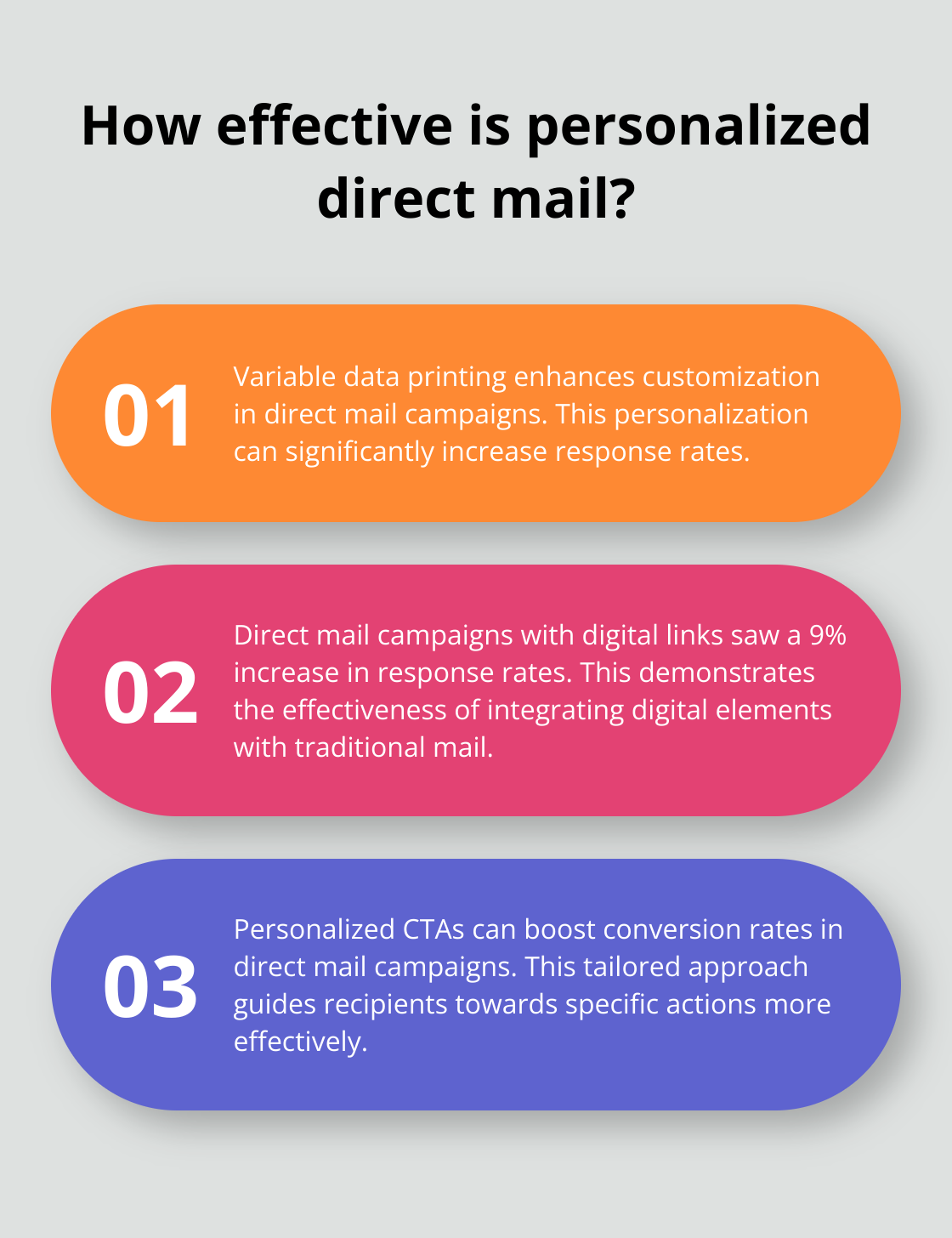
    Variable data printing (VDP) is a modern solution that elevates your direct mail campaigns to new heights of customization and effectiveness. This level of personalization can increase response rates significantly, making your campaigns more effective.

    Craft Compelling Designs

    The visual appeal of your direct mail piece plays a key role in capturing attention and driving action. Consider these design tips:

    1. Use high-quality images and graphics that align with your brand and message.
    2. Incorporate white space to make your content more digestible.
    3. Choose colors that evoke the right emotions and complement your brand identity.
    4. Try unique formats, such as die-cut mailers or 3D pieces, to stand out in the mailbox.
    Fact - How effective is personalized direct mail?

    The goal is to create a design that not only looks great but also guides the recipient towards your desired action.

    Write Persuasive Copy

    Your copy should be clear, concise, and compelling. Focus on benefits rather than features, and use action-oriented language to encourage response. Consider these copywriting tips:

    1. Craft attention-grabbing headlines that address the recipient’s pain points or desires.
    2. Use bullet points to highlight key benefits or offers.
    3. Include a clear and prominent call-to-action (CTA) that tells the recipient exactly what to do next.
    4. Create a sense of urgency with limited-time offers or exclusive deals.

    Personalized CTAs can significantly increase conversion rates, making your direct mail more effective.

    Integrate with Digital Channels

    Combining direct mail with digital marketing efforts can amplify your results. Create a seamless multichannel experience with these methods:

    1. Use QR codes or personalized URLs (PURLs) to drive recipients to online landing pages.
    2. Follow up direct mail pieces with targeted email campaigns or social media ads.
    3. Implement retargeting strategies to reach recipients who visited your website after receiving a mailer.

    Direct mail campaigns that included digital links yielded a response rate increase of nearly 9% in relation to static campaigns.

    Test and Optimize

    Continuous testing and optimization are essential to improve your direct mail success rates. Consider A/B testing different elements of your campaigns, such as:

    1. Offer types (e.g., percentage discount vs. dollar amount off)
    2. Design layouts
    3. Mailing formats (e.g., postcards vs. letters)
    4. Personalization levels

    Analyze the results of each test to inform future campaigns and refine your approach over time.

    These strategies can significantly enhance the effectiveness of your direct mail campaigns. Success in direct mail marketing often comes from a combination of data-driven targeting, creative execution, and consistent optimization. These techniques can help you achieve better results and maximize your return on investment, whether you’re a small business owner or a marketing professional.
    Final Thoughts

    Direct mail marketing proves its effectiveness in today’s digital age, offering impressive response rates and ROI that often surpass digital channels. The success of direct mail campaigns depends on strategic planning, precise targeting, and creative execution. Businesses can significantly boost their direct mail success rates through personalization, compelling design, and data-driven insights.

    Fact - How Can You Boost Direct Mail ROI?

    The future of direct mail marketing looks bright with emerging trends such as augmented reality elements in mailers and environmentally friendly printing options. These advancements will make direct mail even more engaging and effective in capturing audience attention and driving conversions. Now is the time for businesses to act and harness the power of direct mail to stand out in a crowded marketplace.

    At Catdi Printing, we offer a comprehensive range of direct mail and printing services designed to elevate your marketing efforts. Our team can bring your direct mail visions to life with high-quality, visually impactful materials (including postcards, EDDM services, business cards, and brochures). You can create powerful campaigns that resonate with your audience and drive meaningful results by combining the tangible appeal of direct mail with strategic planning and cutting-edge techniques.

  • When and When Not to Use First Class Postage for Direct Mail Campaigns

    When and When Not to Use First Class Postage for Direct Mail Campaigns

    Direct mail remains a powerful marketing tool, but the success of any campaign often hinges on choosing the right type of postage. First Class Postage, one of the premium services offered by USPS, is ideal for time-sensitive, professional, and smaller-volume campaigns. However, it’s not always the most cost-effective choice for every scenario.

    In this guide, we’ll dive into the benefits, drawbacks, and technical details of First Class Postage, compare it to other postage classes of mail, and provide insights into when to use it for your direct mail marketing strategy focuses on using first class mail for optimal delivery. Direct mail pieces are a crucial component of effective marketing campaign strategy.

    What is First Class Postage?

    First Class Postage is the USPS’s fastest standard mailing option, designed for letters, postcards, and lightweight packages. It ensures your mail is delivered quickly and professionally, making it a great choice for businesses sending time-sensitive or personalized materials.

    Technical Specifications for First Class Postage:

    • Delivery Speed: Typically delivered within 1–5 business days.
    • Weight Limits:
      • Letters: Up to 3.5 ounces.
      • Flats (large envelopes): Up to 13 ounces.
    • Size Limits:
      • Letters: Minimum 5 x 3.5 inches, maximum 11.5 x 6.125 inches.
      • Flats: Maximum 15 x 12 inches.
    • Postage Rates (2024):
      • Letters: $0.73 for the first ounce, $0.24 per additional ounce.
      • Postcards: $0.51.
      • Flats: $1.26 for the first ounce, with incremental increases for additional weight.

    When to Use First Class Postage

    First Class Postage is perfect for certain scenarios where speed and professionalism are priorities.

    1. Time-Sensitive Campaigns
      This is best reason to use First Class postage is if your mail includes limited-time offers, invitations to upcoming events, or time-sensitive promotions, First Class Postage ensures quick delivery, ensuring recipients act before deadlines pass.
    2. Targeted Audiences
      First Class Postage helps deliver a more personalized and professional touch for high-value customers or niche markets. The added priority benefits VIP customers and exclusive campaigns.
    3. Small Campaigns
      Businesses with lower-volume mailings can avoid the bulk mail thresholds required by Standard Mail, making First Class Postage a flexible choice for smaller direct mail initiatives.
    4. Official Communications
      Use First Class Postage for invoices, legal notices, and customer account updates. The return-to-sender feature ensures undeliverable mail doesn’t get lost, maintaining a professional image.

    When NOT to Use First Class Postage

    Despite its benefits, First Class Postage isn’t always the best fit for every campaign.

    1. Large-Volume Mailings
      If you’re mailing thousands of pieces of standard size postcards (bulk mail) offers significant cost savings. Though slower (delivery times range from 2–9 business days), the reduced postage rates make it ideal for broad-reaching campaigns.
    2. Local Saturation Campaigns
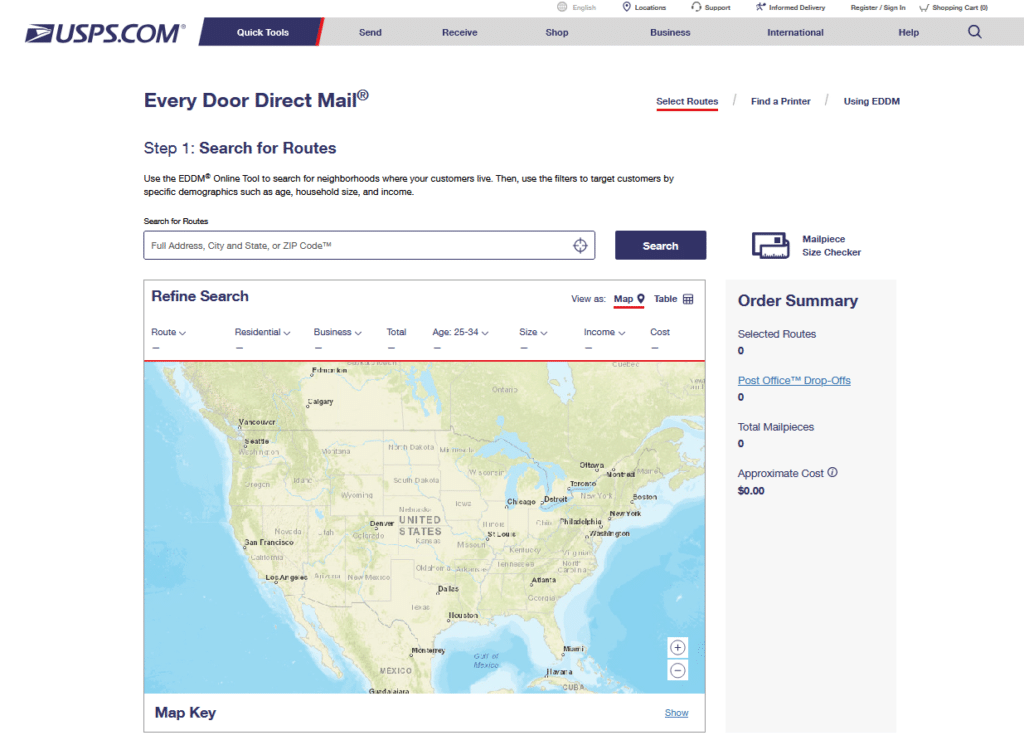
      For campaigns targeting entire neighborhoods, Every Door Direct Mail (EDDM) is a more affordable option. It allows businesses to blanket specific areas without needing a mailing list.
    3. Heavy or Oversized Mailers
      First Class Postage has strict weight limits (13 ounces for flats).

    Comparing First Class Postage to Other Mailing Classes

    Standard Mail (Bulk Mail)

    • Best For: Large-volume campaigns targeting a broad audience.
    • Cost: Lower per-piece rate but slower delivery times (2–9 business days).
    • Drawback: Requires a minimum of 200 pieces, making it less flexible for smaller campaigns.

    Every Door Direct Mail (EDDM)

    • Best For: Saturating local areas with promotional offers, such as for restaurants, gyms, or retailers.
    • Cost: Extremely affordable due to no mailing list requirements.
    • Drawback: Lacks the personalization options available with First Class or Standard Mail.

    Top Benefits of First Class Postage

    1. Speed
      First Class Postage ensures faster delivery than Standard Mail, helping you meet tight deadlines for marketing initiatives.
    2. Professionalism
      The return-to-sender service ensures undeliverable mail in your direct mail marketing doesn’t get lost, keeping your communication accurate and professional.
    3. Higher Engagement Rates
      Recipients are more likely to open and respond to First Class mail, as it often conveys importance compared to bulk mail.
    4. Flexibility
      With no minimum volume requirements, it’s perfect for businesses running smaller, targeted campaigns.
    5. Trackable Options
      Certified Mail and Registered Mail add tracking and security, making First Class Postage ideal for important communications.

    Drawbacks of First Class Postage

    1. Cost
      First Class Postage is way more expensive per piece compared to Standard Mail or EDDM. For large-volume direct mail marketing campaigns, this can significantly increase your budget.
    2. Weight and Size Restrictions
      Mail that exceeds the size and weight limits incurs additional fees, making it less suitable for heavy or oversized items.
    3. No Bulk Discounts
      Unlike Standard Mail, First Class Postage doesn’t offer cost reductions for larger volumes in direct mail pieces.

    Pro Tips for Maximizing First Class Postage

    • Target High-Value Audiences: Use First Class Postage for VIP customers or campaigns with a high ROI.
    • Optimize Design: Ensure your mail pieces meet USPS size and weight requirements to avoid unnecessary fees.
    • Combine with EDDM: Pair First Class Postage with EDDM to reach broad audiences while giving priority to select segments.

    Why Choose Catdi Printing?

    At Catdi Printing, we specialize in helping businesses create effective and impactful direct mail campaigns. When you choose us, you’re not just getting commercial printing services—you’re getting a partner dedicated to your success.
    What We Offer:

    • Custom Design: Our team creates stunning postcards, letters, and brochures that grab attention.
    • Mailing List Services: Partnering with Mailers Haven, we provide accurate and targeted mailing lists to maximize ROI.
    • USPS Expertise: We handle all the details, ensuring your mail complies with USPS regulations.
    • Integrated Campaigns are essential for a successful direct mail marketing strategy.: Combine First Class Postage with bulk mail or EDDM for a tailored strategy that fits your budget and goals.

    Pro Tip: First Class Postage is perfect for smaller, high-impact campaigns. Our team can help you design a strategy that balances speed, cost, and effectiveness.

    First Class Postage is an excellent option for direct mail marketing campaigns that demand speed, professionalism, and engagement. While it’s not always the most cost-effective choice for large-volume or broad-reach campaigns, its unique benefits make it invaluable for targeted and time-sensitive mailings.

    Need help designing and executing your next direct mail campaign? Let Catdi Printing guide you every step of the way. Learn more about our direct mail services and discover how we can help your business stand out.

  • Top 5 Mailing List Companies for Direct Mail

    Top 5 Mailing List Companies for Direct Mail

    When it comes to direct mailing, the foundation of success lies in your mailing list. A well-curated mailing list ensures your message reaches the right audience, whether you’re running a political mail list campaign or launching a local print marketing initiative. But with so many providers out there, how do you choose the right one?

    To make your decision easier, we’ve compiled a list of the top 5 mailing list companies for direct mail. These companies stand out for their accuracy, customer service, and ability to cater to unique campaign needs. And yes, Catdi Printing made the list. What can I say? We’re like the secret sauce in your grandma’s famous recipe—you don’t want to leave us out!

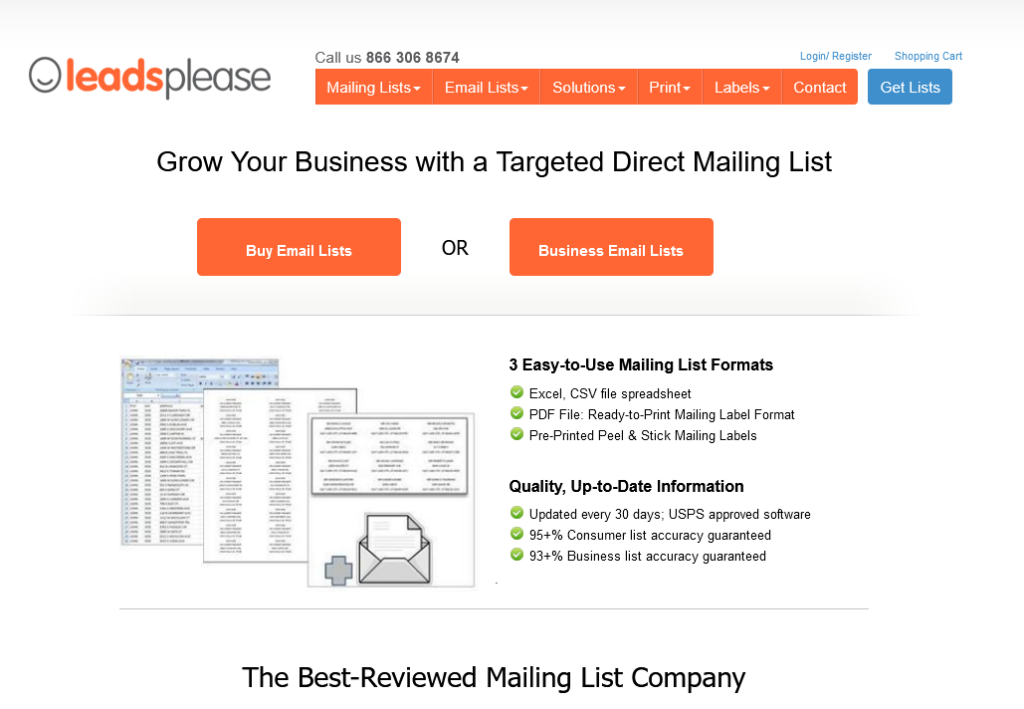
    LeadsPlease

    LeadsPlease is all about simplicity and speed, making it a favorite for businesses that need a mailing list without the hassle. Their user-friendly platform lets you create targeted mailing lists for both consumer and business audiences.

    Leads Please

    What They Offer:

    • Business Mailing Lists: Perfect for targeting specific industries, company sizes, or locations.
    • Consumer Mailing Lists: Ideal for reaching individuals based on demographics like age, income, and interests.

    Why It Matters:

    • Helps you focus your campaign on the right audience.
    • Provides quick, clear data to support marketing decisions.

    Best For: Businesses looking for a quick, no-fuss way to build a list

    Considerations: While their mailing list services are top-notch, their printing offerings are somewhat limited. However, their lists integrate seamlessly with other providers for your commercial print marketing needs.

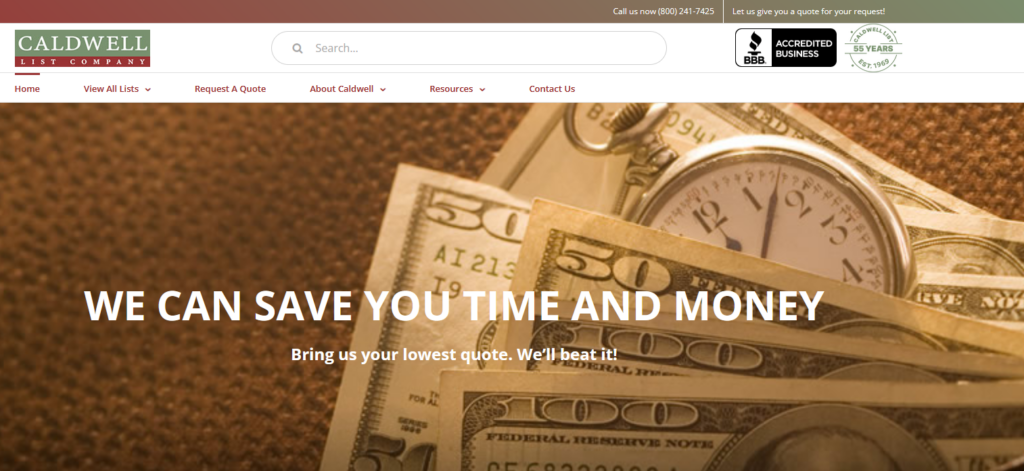
    Caldwell List Company

    Caldwell List Company specializes in creating highly customizable mailing lists tailored to specific campaign goals. Whether you’re targeting local businesses, niche markets, or crafting a political mail list, Caldwell has the tools and expertise to help.

    Caldwell Leads

    What They Offer:

    • Business Mailing Lists: Refine your audience by industry, company revenue, or employee count to enhance your prospecting.
    • Specialty Lists: Create targeted lists for niche markets, nonprofits, or high-value donors.

    Why It Matters:

    • Tailored lists improve ROI by focusing on your most relevant audience.
    • List managers guide you in making data-driven decisions.

    Best For: Organizations with unique or complex targeting needs

    Mailers Haven

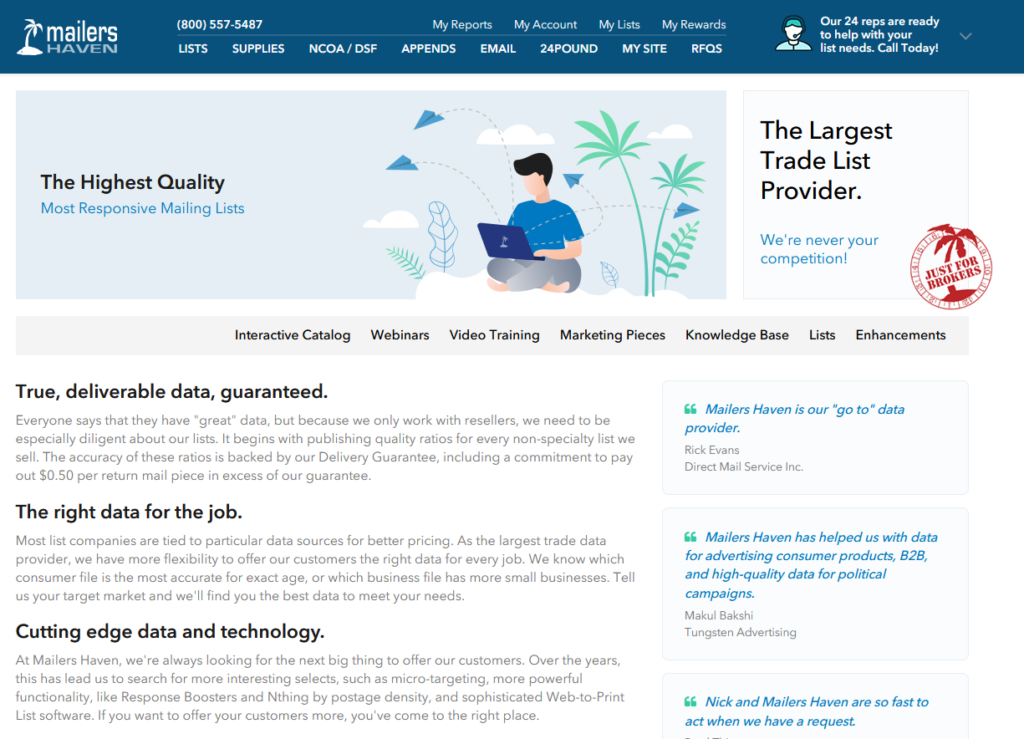
    Mailers Haven is a trade-only provider that delivers exceptional quality and reliability in mailing lists. At Catdi Printing, we use Mailers Haven to augment our own data, ensuring our campaigns are powered by industry-class information.

    Mailers Haven

    What They Offer:

    • Consumer and Business Data: Reliable and responsive lists for targeted direct mailing campaigns.
    • Data Enhancement: Clean and update existing lists to maximize performance for your direct marketing efforts.

    Why It Matters:

    • Industry-class data ensures your campaigns perform better.
    • Data enhancement helps you make smarter marketing decisions.

    Best For: Companies prioritizing high-performing, responsive data for their campaigns

    Leads 411

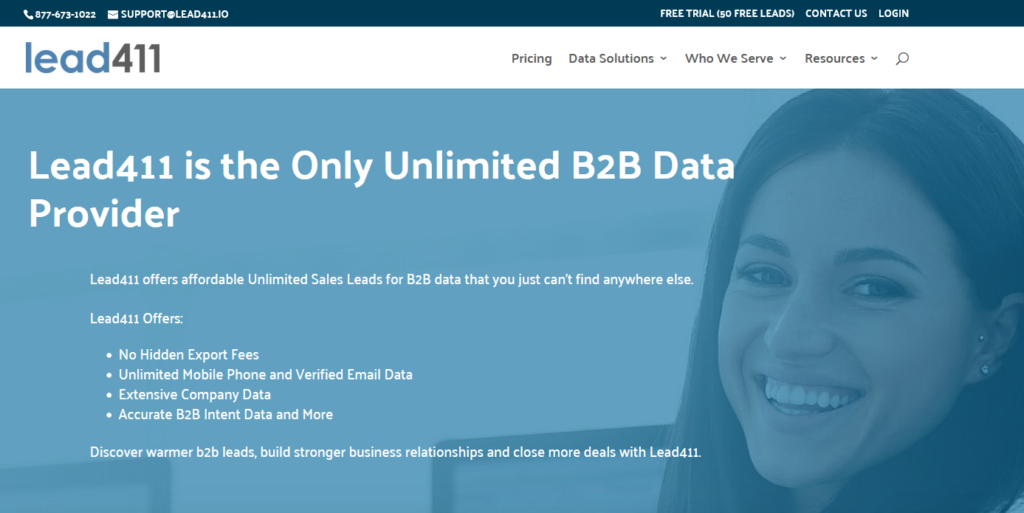
    When you need laser-focused data, Leads 411 is the answer.

    Lead 411

    What They Offer:

    • Industry-Specific Lists: Focus on real estate agents, healthcare professionals, or other niche markets.
    • Custom Data Solutions: Perfect for B2B campaigns needing precision targeting.

    Why It Matters:

    • Helps you identify and connect with hard-to-reach audiences.
    • Custom solutions align perfectly with specialized campaigns.

    Best For: Businesses requiring precise data targeting specific industries or audiences

    Catdi Printing

    And now, the star of the show—Catdi Printing! We’re your one-stop shop for personalized mailing lists and direct mailing solutions. At Catdi, we don’t just provide lists; we help you build business lists that deliver results.

    Catdi Printing

    What We Offer:

    • Tailored Mailing Lists: Business, consumer, and political mail lists customized to your needs.
    • Integrated Solutions: Combine mailing lists with print, design, and distribution services.

    Why It Matters:

    • Seamless integration saves time and ensures consistency.
    • Personalized support helps you make the best decisions for your campaign.

    Best For: Businesses looking for a boutique experience with personalized service

    Pro Tip: Our team works with Mailers Haven to enhance our data quality, combining their robust lists with our expertise to create campaigns that truly perform.

    Why Mailing List Providers Matter

    Your mailing list is the backbone of your marketing strategy. Business and consumer mailing lists help you make smarter decisions by targeting audiences with precision. Providers like LeadsPlease and Mailers Haven focus on reliability and simplicity, while Leads 411 and Caldwell List Company excel in customization and niche targeting.

    Catdi Printing takes it a step further by combining mailing lists with full-service printing and mailing solutions. We’re here to make sure your campaigns don’t just reach people—they leave a lasting impression.

    Ready to take your direct mail campaigns to the next level? Let Catdi Printing be your partner in creating impactful marketing strategies. Learn more about our direct mailing services and start connecting with your audience today!

  • Choosing the Right Envelope: An Easy Guide to #9 and #10 Envelopes

    Choosing the Right Envelope: An Easy Guide to #9 and #10 Envelopes

    Envelopes come in various sizes, tailored for different purposes. Among the most commonly used are the #9 and #10 envelopes. Understanding the differences between these two sizes is essential for efficient mailing, whether for personal or business use, such as sending invoices and correspondence. This article will explore their dimensions, uses, and practical considerations to help you make an informed choice in selecting the right business envelope.

    Dimensions and Specifications

    The primary difference between #9 and #10 envelopes lies in their dimensions. Here’s a comparative chart of their sizes:

    Envelope TypeWidth (inches)Height (inches) of the catalog envelopes
    #93.8758.875
    #104.1259.5

    Envelope size chart of #9 & #10 Envelopes

    The #10 envelope is slightly larger than the #9 envelope, making it suitable for enclosing standard 8.5 x 11-inch paper folded into thirds.

    The following chart visually represents the size comparison:

    Typical Uses

    • #9 Envelope Uses
      • Commonly used as a return envelope, inserted into #10 envelopes.
      • Suitable for smaller mailing needs, such as small documents or correspondence.
    • #10 Envelope Uses
      • The standard envelope for business letters.
      • Fits an 8.5 x 11-inch sheet of paper folded into thirds, making it ideal for various business documents and correspondence, fitting perfectly in a standard size business envelope.

    Envelope Paper Options: Natural, Linen, Regular, Offset, and Digital

    When choosing #9 and #10 envelopes, the type of paper can significantly impact the look and feel. Here’s a brief overview:

    • Natural and Linen: These offer a textured, elegant appearance, ideal for formal or high-quality communications.
      • Natural: Smooth and classic.
      • Linen: Textured and sophisticated, with a slight pattern.
    • Regular: Standard smooth paper used for everyday mailing needs.
    • Offset and Digital: These terms relate to the printing methods.
      • Offset: Best for large print runs, offering consistent quality and color accuracy.
      • Digital: Suitable for short runs, allowing for quick turnaround and variable data printing.

    Catdi Printing offers these options for standard envelopes, ensuring high-quality choices to meet your specific needs.

    Practical Considerations

    Mailing Costs: Due to its smaller size, the #9 envelope may slightly reduce postage costs when used for return purposes. Bulk mailing with #9 envelopes can be more cost-effective for certain types of correspondence.

    Storage and Handling: #9 envelopes, being smaller, are easier to store in bulk. However, #10 envelopes are more versatile for a range of business uses, offering a better fit for standard documents without folding too many times, unlike catalog and booklet envelopes.

    Visual Impact: Larger envelopes like the #10 can hold more content and provide a more professional appearance for business correspondence. The additional space allows for a clearer and less cramped presentation of materials.

    Mailing Efficiency and Security

    Mailing Efficiency: Using the right envelope size, such as a business envelope, can significantly impact the efficiency of your mailing process. #10 envelopes, being the standard for business letters, are more likely to be recognized and processed efficiently by mail handlers.

    Security: The security of the contents is another consideration. While both envelope sizes offer similar levels of protection, the larger #10 envelope allows for more secure enclosure of documents due to its increased size and ability to accommodate multiple folds and inserts without compromising integrity.

    Environmental Impact

    Material Usage: The size of the envelope affects the amount of paper used in its production, particularly in catalog envelopes. Smaller envelopes like the #9 use less material, which can be beneficial from an environmental perspective, especially when used in large quantities.

    Recycling and Reusability: Both envelope sizes are typically made from recyclable materials. Choosing the appropriate size for the task can minimize waste and promote better recycling practices.

    The choice between #9 and #10 envelopes depends on your specific needs. For business correspondence and standard documents, the #10 envelope is ideal. For return purposes and smaller enclosures, the #9 envelope is more suitable. Understanding these differences ensures efficient and effective mailing solutions, optimizing both cost and practicality for various applications.

    By considering the dimensions, uses, key differences, practical considerations, and environmental impacts, you can make a well-informed decision on the best envelope size for your needs. Whether for personal use or business communications, choosing the right envelope size can enhance the efficiency and professionalism of your mailing efforts.

  • 2024 USPS Rates | Postcard Postage Rates Cost Guide (UPDATED)

    2024 USPS Rates | Postcard Postage Rates Cost Guide (UPDATED)

    Skip Ahead:

    Well… here we go again with another postage increase. When it comes to mailing postcards, the postage always goes up! However, to be fair to the USPS, the increase is often minimal. However, it is essential to understand that various factors influence the overall cost. These factors include the class of mail, postcard size and weight, and the quantity being mailed. Let’s dive into the specifics to help you better understand the postage rates for your project, including any rate increase implications and the upcoming adjustments in January 2024, as announced by the USPS.

    Interested in learning about direct mail marketing click here to learn more

    Per the USPS: WASHINGTON, DC — Today, the U. S. Postal Service filed notice with the Postal Regulatory Commission of mailing services price changes to take effect July 14, 2024. The new rates include a 5-cent increase in the price of a First-Class Mail Forever stamp from 68 cents to 73 cents.

    The proposed adjustments, approved by the governors of the Postal Service, would raise mailing services product prices by approximately 7.8 percent. If favorably reviewed by the commission, the price changes would include:

    ProductCurrent PricesPlanned Prices
    Letters (1 oz.)68 cents73 cents
    Letters (metered 1 oz.)64 cents69 cents
    Domestic Postcards53 cents56 cents
    International Postcards$1.55$1.65
    International Letter (1 oz.)$1.55$1.65

    These listed prices don’t really reflect pre-sorted rates used with direct mail marketing, but they nevertheless do reflect an increase. Below, you’ll learn what steps and options are available to downplay any increases from the USPS.

    Classes of Mail (July 2024)

    First Class Mail Postage Rates

    First Class Postage is known for its speed and reliability but watch for any rate increase. This type of mail is given priority by the USPS, ensuring quick delivery times of 1-5 business days, even as postage rates increase. However, it comes at a higher cost, ranging from $0.40 to $1.16 per piece. A minimum of 500 pieces is required for bulk mailing to qualify for presort pricing, according to the Postal Regulatory Commission. This class of postcard postage is the most expensive.

    Pros:

    • Fast delivery (1-5 business days) with first-class or priority mail options, despite the USPS Ground Advantage service updates announced by the United States Postal Service.
    • Priority handling by USPS
    • Forwarding and return services are included, subject to postal service guidelines.

    Cons:

    • Higher cost compared to other classes
    • Requires a minimum of 500 pieces for presort pricing

    Standard Mail Postcard Rates (Marketing Mail aka Bulk Mail)

    Standard Mail is a cost-effective option for bulk mailing, though it has longer delivery times of 3-21 days, and postage rates increase periodically. It’s ideal for non-time-sensitive mailings, with rates significantly lower than First Class Mail. A minimum of 200 pieces is required; nonprofits can benefit from even lower rates.

    Pros:

    • Lower cost, especially for bulk mail, which benefits from lower shipping rates announced by the USPS.
    • Nonprofit rates available
    • Ideal for marketing campaigns, particularly as you navigate the usps rate changes.

    Cons:

    • Longer delivery time (3-are 21 days)
    • No forwarding or return services included

    Every Door Direct Mail (EDDM)

    EDDM allows you to send postcards to entire postal routes without a mailing list. Delivery times range from 2 to 15 days, with costs of around $0.20 per piece, according to the shipping rates announced by USPS. This is one of the main reasons, amongst many others, why many small businesses choose Every Door Direct Mail, as postage is very low. It’s very popular for service based businesses like dentists and dry cleaners.

    EDDM Postcards

    Pros:

    • No mailing list is needed, but consider using a postage meter for efficiency.
    • Low cost per piece
    • Broad audience reach

    Cons:

    • Limited to specific sizes and weights
    • Delivery time can vary (2-15 days), similar to standard rate postage.
    • No tracking or forwarding capabilities

    Presorted vs. Non-Presorted Postcard Mail

    Presorted mail involves organizing mail by ZIP codes to receive lower postage rates. Minimum mailing quantities are 500 for First Class Presort Rates and 200 for Standard Presort Rates. Partnering with a mail house can simplify this process and ensure you benefit from the reduced rates, even with the 2024 price increase.

    First Class Postcard

    Pros:

    • Lower postage rates
    • Efficient for large mailings
    • Faster delivery than non-presorted mail, although prices will increase soon.

    Cons:

    • Requires a minimum quantity, which postal service changes might impact.
    • It needs proper sorting by ZIP codes

    Commingled Postcard Marketing

    Commingling postcards combine your mail with other companies’ mailings to achieve bulk rates without meeting the minimum quantity requirements. This service offers delivery times of 2-15 days and costs similar to Standard Presort Mail, with no minimum quantity needed.

    Pros:

    • Given the current shipping rates, bulk rates without minimum quantity can be advantageous.
    • Cost-effective for small mailings
    • Decent delivery times (2-15 days)

    Cons:

    • Reliant on third-party services
    • Delivery times can vary

    Postcard Sizes

    Postcard sizes affect the class of mail you can choose and the postage rates, which may see a rate increase. Here are some standard sizes and their impact on postage costs:

    Standard Sizes

    • 4 “x6” and 4.25 “x6”: These sizes qualify for the lowest First Class Mail postcard rates, which might be affected when the United States Postal Service changes stamp prices. They are ideal for short, impactful messages and are economical for large mailings, especially when using a postage meter.
    • 5 “x7”: Slightly more significant, these can still be mailed at a reasonable rate but may incur higher costs than the most petite standard sizes.

    Oversized Postcards

    • 5.5 “x8.5”: Larger postcards like this have a higher visual impact and can convey more information. They often require higher postage rates.
    • 6.5 “x9” and 6 “x11”These sizes are eligible for EDDM and provide ample space for graphics and text, ensuring you can fully implement your marketing strategy. However, they cost more per piece in terms of postage, especially with the upcoming postage rates increase.

    Impact on Postage Costs: Expect potential price increases and adjustments in January 2024.

    • Small Postcards (4 “x6” ): These qualify for the lowest First Class Mail rates, making them a cost-effective option for large-scale campaigns.
    • Medium to Large Postcards (5 “x7” and larger): These require more postage due to their size and weight but can be more effective for detailed marketing messages.

    Postcard Mailing Quantities

    Quantities influence postage costs, with higher quantities generally reducing per-piece rates. Here’s how different quantities affect pricing:

    Small Quantities (Below 200)

    • It is ideal for targeted mailings but not eligible for bulk discounts, unlike some other methods recognized by the Postal Regulatory Commission.
    • Higher per-piece costs due to non-presorted rates might increase further in January 2024.

    Medium Quantities (200-500)

    • Qualify for Standard Mail rates.
    • Eligible for bulk discounts, reducing per-piece costs and offsetting any potential rate increase, including the cent adjustments in January 2024.

    Large Quantities (500 and above)

    • Benefit from the lowest rates due to presorted and commingled options, even as USPS rate changes take effect.
    • Significant cost savings on a per-piece basis, making them ideal for extensive marketing campaigns, even with us postal service rate changes.

    Postcard Postage FAQ

    How Many Stamps Do I Need for My Postcard?

    For standard and oversized postcards sent domestically, typically one stamp is sufficient. Larger postcards may require a second stamp.

    Is a Stamp Necessary for My Postcard?

    In high-volume mailings, using permit imprint indicia instead of stamps can be much more cost-effective and simplify the process, which the United States Postal Service often recommends.

    Do Postcards Need Envelopes?

    Postcards do not require envelopes, which ensures immediate visibility and typically lower costs compared to other options like postage stamps.

    What Are the Postcard Design Requirements?

    Ensure a blank space of 4″x2.25″ on the back, usually in the bottom right corner, for mailing information.

    Is a Return Address Needed on a Postcard?

    A return address is optional unless you want undeliverable postcards returned to you, typically used for first-class mail.

    Which Postcard Size Should I Choose?

    Choose a size based on your message and budget. Smaller postcards are cost-effective, while larger ones make a bigger impact.

    Why Does the USPS Keep Increasing Postage Rates?

    USPS increases postage rates to keep up with inflation, rising operational costs, and declining mail volumes. These adjustments help maintain financial stability and ensure continued service quality.

    How Often Does the USPS Raise Postage Rates?

    The USPS typically reviews postage rates annually and may implement increases to cover operational expenses and inflation. Staying updated with USPS announcements can help you plan your mailing budget as postage stamp prices fluctuate.

    How Can I Save on Postage Costs Despite Rate Increases?

    To mitigate the impact of rate increases, consider bulk mailing options, presorted mail, or using services like Every Door Direct Mail (EDDM) that offer discounted rates for larger quantities.


    Ready to Get Started on Your Postcard Project?

    Catdi Printing offers comprehensive commercial printing and direct mailing services, ensuring your postcards reach their destination efficiently and cost-effectively. For more information or to start your postcard mailing, visit our product page. Our direct mail experts can assist you with any questions or guidance, especially about the upcoming postage price changes, including how prices will increase.

  • Optimize Outreach: Non-Profit Orgs Every Door Direct Mail

    Optimize Outreach: Non-Profit Orgs Every Door Direct Mail

    Did you know that traditional direct mail marketing has consistently achieved response rates as high as 4.9% for nonprofit organizations? With the advent of Every Door Direct Mail (EDDM), nonprofits have unlocked a powerful and cost-effective tool to enhance their outreach efforts and connect with their target audience effectively. In this article, we will explore the benefits of EDDM for nonprofit organizations and how it can optimize their outreach, helping them achieve their fundraising goals through the strategic use of marketing mail.

    Unlocking Fundraising Potential with EDDM for Nonprofits

    Even in the digital age, direct mail remains a powerful and strategic tool for nonprofit organizations. Using Every Door Direct Mail (EDDM), nonprofits can unlock their fundraising potential and effectively connect with their target audience through personalized postcards and mail pieces sent to every carrier route within their chosen zip code. This section will explore the advantages of using direct mail, specifically EDDM, for nonprofit organizations and how it can optimize their outreach efforts.

    The Strategic Advantage of Direct Mail in the Digital Age

    Effective Direct mail offers a strategic advantage for nonprofit organizations in an increasingly digital world. While online campaigns have their place, direct mail pieces provide a tangible and personal touch that engages potential donors deeper through marketing mail. EDDM allows nonprofits to stand out from the digital clutter and create a lasting impression that drives fundraising success by using BMEU (business mail entry unit) for larger mailings.

    Mailbox

    Comparing Cost-Effectiveness and Engagement: EDDM vs. Online Campaigns

    Regarding cost-effectiveness and engagement, EDDM outshines online campaigns for nonprofit organizations by allowing targeted mailers to specified zip codes and carrier routes. Direct mail will enable organizations to target specific geographic areas, ensuring their message reaches the right audience. Additionally, EDDM® offers a higher response rate than online campaigns, as physical mail captures the attention and interest of donors in a way that digital ads often cannot. We have provided a simple calculator tool for pricing on postcard direct mail pieces.

    Creating Compelling Direct Mail Content for Donor Acquisition

    A key component of successful direct mail campaigns is creating compelling content that resonates with potential donors. To enhance the impact of their EDDM campaigns, nonprofit organizations must craft messages on mail pieces that inspire, connect, and evoke emotions in recipients. By telling impactful stories, showcasing the nonprofit organization’s mission, and highlighting the direct impact donors can make, nonprofits can effectively acquire new donors through EDDM mailers.

    Nonprofit Orgs Every Door Direct Mail: A Pathway to Heartfelt Connections

    Every Door Direct Mail (EDDM) provides nonprofit organizations a unique opportunity to establish heartfelt connections with their target audience. Through EDDM, nonprofits can directly reach their intended recipients with impactful mail pieces, creating a personal and impactful connection that goes beyond the digital realm through targeted nonprofit mail.

    One key benefit of using EDDM for nonprofit organizations is building relationships and fostering genuine connections with their audience. By delivering mail pieces directly to the doorsteps of individuals in specific zip codes, nonprofits can capture their attention and engage them more intimately.

    EDDM allows nonprofit organizations to go beyond the limitations of traditional mailing services by enabling targeted mail delivery to every door within selected carrier routes. With EDDM, nonprofits can bypass specific mailing lists and target entire neighborhoods or delivery routes, allowing them to reach a broader audience with every door direct mail®. This approach opens up new doors for nonprofits to connect with individuals who may not have previously been aware of their cause or organization.

    Moreover, EDDM offers a cost-effective solution for nonprofits seeking to maximize their outreach efforts. With reduced postage rates and simplified mailing requirements, nonprofit organizations can reach more individuals within their target areas without breaking the bank. This makes EDDM an attractive option for nonprofits looking to make a significant impact within their budget.

    Overall, EDDM serves as a pathway for nonprofit organizations to establish heartfelt connections with their audience. By leveraging the benefits of EDDM, nonprofits can go beyond traditional mailing services and create meaningful connections that drive their mission forward using every door direct mail®.

    Maximizing Donor Reach: How EDDM Serves Nonprofit Organizations

    Every Door Direct Mail (EDDM) presents a unique opportunity for nonprofit organizations to extend their outreach and connect with a broader audience. We explore how EDDM can help nonprofits maximize their donor reach and engagement through effective mailer strategies and targeted carrier routes using an online tool. By leveraging the power of personalized messaging, geographical targeting, and the advantages of physical mail over digital clutter, EDDM is a valuable tool for nonprofit organizations seeking to make a lasting impact.

    Demystifying the Power of Personalized Messaging

    One key benefit of EDDM for nonprofit organizations is the ability to create personalized messaging on mail pieces that resonates with potential donors on a deeper level, ensuring delivery to every door in chosen zip codes. With EDDM, nonprofits can customize their direct mail campaigns to address their target audience’s specific needs, beliefs, and interests. By tailoring the content to individual recipients’ values and motivations, nonprofit organizations can increase the chances of obtaining a positive response and cultivating long-term donor relationships.

    Geographical Targeting and Enhanced Response Rates

    Geographical targeting is another critical aspect of EDDM that allows nonprofit organizations to focus on specific areas where their target audience resides. By analyzing demographic data and donor profiles, nonprofits can identify regions with a higher concentration of potential donors and deliver their direct mail materials directly to those households using every door direct mail® services. This targeted approach increases the chances of reaching individuals more likely to respond and support the organization’s cause, resulting in enhanced response rates and a more efficient use of resources.

    Cutting Through the Noise: Physical Mail vs. Digital Clutter

    In today’s digital age, an overwhelming amount of information is bombarding individuals through various online channels. However, physical mail still holds a unique advantage in cutting through the noise and grabbing recipients’ attention. Unlike emails or online ads that can easily be ignored or marked as spam, physical mail pieces have a tangible presence that demands attention and creates a memorable impact through EDDM. By utilizing EDDM, nonprofit organizations can leverage this advantage and deliver their message directly to the hands of potential donors, increasing the chances of engagement and response.

    Overall, EDDM offers nonprofit organizations a powerful means to maximize donor reach and engagement. Through personalized messaging, geographical targeting, and the effectiveness of physical mail, nonprofits can connect with their audience on a deeper level and create impactful relationships that drive their mission forward.

    Cost-Effective Direct Mail Solutions for Charitable Outreach

    Cost-effective direct mail solutions are crucial in helping nonprofit organizations optimize their outreach efforts and achieve their goals without straining their budgets. In this section, we will explore different aspects of cost-effective direct mail strategies, including the pricing breakdown of Every Door Direct Mail® (EDDM), selecting the right online tool, and understanding the benefits of nonprofit mail. Nonprofit mailing services using EDDM-targeted zip codes for optimal outreach and tips for affordable direct mail campaigns.
    Breaking Down EDDM Pricing: Budgeting for Success

    Understanding the pricing structure of Every Door Direct Mail is essential for nonprofit organizations to plan and budget their direct mail campaigns effectively. EDDM offers a cost-effective solution by eliminating the need for addresses and allowing organizations to target specific neighbourhoods or areas. By utilizing this service, nonprofits can save on mailing list costs and postage fees. We will provide a detailed breakdown of EDDM pricing factors, including design, printing, and distribution costs, to help organizations make informed decisions and optimize their budget allocation.

    Selecting the Right Nonprofit Mailing Services for Your Organization

    Choosing the right nonprofit mailing services is crucial for achieving maximum impact with direct mail campaigns. Partnering with a reputable mailing service provider that understands nonprofit organizations’ unique needs and goals is essential. Factors to consider when selecting a mailing service include experience working with nonprofits, a proven track record of success, the ability to handle large-scale campaigns, and cost-effectiveness. We will provide insights and tips for nonprofit organizations to ensure they select the exemplary mailing service that aligns with their specific requirements and budget, focusing on cost-effective EDDM mail solutions and understanding indicia options.
    Ensuring Impact Without the High Costs: Tips for Affordable Direct Mail

    Affordable direct mail campaigns can still deliver significant impact and engagement for nonprofit organizations. By implementing intelligent strategies and cost-saving techniques, nonprofits can optimize their campaigns without compromising the quality and effectiveness of their direct mail materials. We will share practical tips and best practices for creating compelling and cost-effective direct mail content, leveraging design elements to make an impact, sourcing affordable printing options, and maximizing the ROI of direct mail efforts. These tips will help nonprofits achieve their outreach goals while keeping their costs in check.

    Case Studies: Transformative Impact of EDDM on Nonprofit Success

    In this section, we will delve into real-life case studies that highlight the transformative impact of Every Door Direct Mail (EDDM) on the success of nonprofit organizations. These case studies provide valuable insights into the effectiveness and benefits of using EDDM for fundraising and outreach, demonstrating the power of this marketing strategy in driving meaningful results.

    By examining the experiences of actual nonprofit organizations, we can better understand how EDDM has helped them optimize their outreach efforts and enhance their donor engagement with well-crafted mail pieces. These case studies are powerful examples of the positive outcomes that nonprofits can achieve by utilizing EDDM as part of their marketing strategies with well-designed postcards and mail pieces.

    Through these real-life examples, we will explore how EDDM has been successfully employed by nonprofit organizations, showcasing the diverse range of sectors and causes that have benefited from this innovative approach. From increasing donor acquisition to fostering more robust relationships with existing supporters, these case studies demonstrate the versatility and impact of EDDM in the nonprofit sector.

    FAQ

    Q: What is Every Door Direct Mail (EDDM)?

    A: Every Door Direct Mail (EDDM) is a mailing service provided by the United States Postal Service (USPS). It allows businesses and organizations, including nonprofits, to reach a specific geographic area or target audience through direct mail campaigns.
    Q: How can EDDM benefit nonprofit organizations?

    A: EDDM offers nonprofit organizations a cost-effective and impactful way to enhance their outreach efforts and connect with their target audience using flyers and per-piece pricing strategies. It allows them to reach potential donors directly, create personal connections, and maximize their donor reach and engagement.

    Q: What are the advantages of using direct mail, specifically EDDM, for nonprofit organizations?

    A: Direct mail, including EDDM, remains a powerful tool for nonprofit organizations. It can cut through the digital clutter and provide a tangible and personal connection with donors through marketing mail. EDDM also allows nonprofits to target specific geographical areas and enhance response rates by efficiently distributing flyers and marketing mail.

    Q: How can nonprofits create compelling direct mail content that effectively acquires donors?

    To create compelling direct mail content, nonprofits should focus on personalized messaging that resonates with donors on a deeper level. They should use EDDM to ensure these mail pieces reach every desired doorstep. They can highlight their organization’s mission, impact, and success stories to inspire potential donors to take action using every door direct mail®.

    Q: Is EDDM a cost-effective solution for nonprofit organizations?

    A: Yes, EDDM is a cost-effective solution for nonprofit organizations. Its pricing is affordable, especially compared to other marketing channels. It allows nonprofits to optimize their outreach efforts without incurring high costs and maximize their fundraising potential.

    Q: How can nonprofit organizations select the right mailing services for their organization?

    A: Nonprofit organizations can select the right mailing services by considering their specific needs and budget. They should research different service providers, compare prices, and ensure the chosen service aligns with their goals and objectives.

    Q: Are there any tips for nonprofit organizations to ensure impact without incurring high costs in their direct mail campaigns?

    A: Yes, nonprofit organizations can ensure impact without incurring high costs by strategically planning their campaigns, focusing on targeted messaging, and utilizing cost-saving strategies like bulk mail discounts and efficient design and printing methods.

    Q: Can you provide examples of nonprofit organizations benefiting from EDDM?

    A: Several nonprofit organizations have experienced transformative success by using EDDM for their fundraising and outreach efforts, leveraging both EDDM retail and be options. Real-life case studies showcase how EDDM has helped these organizations achieve their goals and make a meaningful impact in their communities.

  • EDDM vs Direct Mail Saturation Mailing

    EDDM vs Direct Mail Saturation Mailing

    In the ever-evolving landscape of direct marketing, the choice of mailing strategy can significantly impact your campaign’s success. Two popular methods are Every Door Direct Mail (EDDM) and Direct Mail, both of which fall under the umbrella of direct mail advertising. Understanding the nuances of each, including differences in postage rates, can help you make an informed decision tailored to your business needs. This knowledge allows you to optimize your marketing efforts, ensuring that your message reaches the right audience in the most effective way possible.

    What is EDDM?

    Every Door Direct Mail (EDDM) is a service offered by USPS that allows businesses to send mail to specific geographic areas without needing a mailing list. This method is ideal for businesses looking to target local customers efficiently.

    Benefits of EDDM:

    One of the primary benefits of EDDM is its simplicity, which makes it an effective part of a direct mail strategy for local businesses. Businesses can select postal routes that align with their target demographic without the hassle of acquiring or managing mailing lists or paying high postage. This method is particularly advantageous for local businesses aiming to raise awareness within specific communities. For instance, a new restaurant could target nearby neighborhoods to announce its grand opening and special promotions. EDDM’s cost-effectiveness also stands out, making it a budget-friendly option for extensive reach.

    EDDM USPS Tool

    What is Direct Mail?

    Direct Mail involves sending promotional materials to a targeted list of recipients. This method requires businesses to create or purchase mailing lists, allowing for more personalized and segmented marketing efforts in addition to saturation mailing campaigns.

    Benefits of Direct Mail:

    Direct Mail offers a more personalized approach to marketing. By leveraging detailed demographic data, businesses can tailor their messages to resonate with specific audiences. For example, a luxury car dealership might use Direct Mail to reach high-income households likely to be interested in their offerings. This granularity can lead to higher engagement and conversion rates, making Direct Mail a powerful tool for targeted marketing campaigns, especially when using saturation mailing campaigns.

    Mailing List

    Geographic Targeting with EDDM

    EDDM excels in geographic targeting, enabling businesses to reach entire neighborhoods or specific streets through saturation direct mail. This is particularly beneficial for localized marketing campaigns, such as promoting a new store opening or offering local services.

    Benefits for Localized Marketing:

    The strength of EDDM lies in its ability to blanket an area with promotional material, ensuring every household within the selected routes receives the postcard. This broad approach is ideal for businesses with services or products that appeal to a wide audience. Local events, such as a community fair or seasonal sale, can benefit greatly from this method.

    Interested in learning about direct mail marketing click here to learn more

    Direct Mail: Precision and Personalization

    While EDDM focuses on broad geographic targeting, Direct Mail offers precision in reaching specific demographics based on detailed data such as age, income, and purchasing behavior. This granularity allows businesses to tailor their messages more effectively, potentially leading to higher engagement and conversion rates.

    Pros and Cons: Direct Mail vs. EDDM

    Both EDDM and Direct Mail have their advantages and drawbacks, which can influence your decision based on your marketing goals. Understanding eddm and direct mail will help you choose the right method.

    EDDM Pros:

    • No Mailing Lists Needed: Simplifies the process by eliminating the need to purchase or manage mailing lists.
    • Cost-Effective: Reduces expenses, making it an affordable option for extensive reach.
    • Ease of Use: Streamlines the preparation and execution of campaigns with USPS tools.
    • Wide Coverage: Allows businesses to cover entire neighborhoods or specific routes efficiently.
    • Size: With the EDDM program, you have to use an oversized postcard, which provides more space for your messaging.

    EDDM Cons:

    • Less Precise Targeting: Limited ability to target specific demographics.
    • Limited Personalization: Generic mailers might not capture the recipient’s attention as effectively as personalized ones.
    • Potential for Wasted Reach can be mitigated by choosing targeted mailing options or eddm and saturation mail. Mailers may reach uninterested recipients within the targeted area.

    Direct Mail Pros:

    • Highly Targeted: Allows for detailed segmentation based on demographics and purchasing behavior.
    • Personalized: Tailored messages can lead to higher engagement and conversion rates.
    • Better ROI Tracking: Easier to measure and analyze the success of campaigns through targeted metrics.
    • Flexible Design Options: Allows for creative and customized mailer designs to engage specific audiences.

    Direct Mail Cons:

    • Requires Mailing Lists: More complex and time-consuming to manage.
    • Higher Costs: Potentially higher expenses due to list acquisition, personalized printing, and postage rate.
    • Logistical Challenges: Managing large-scale direct mail campaigns can be resource-intensive, but leveraging bulk mail options can streamline the process.
    Interested in learning about direct mail marketing click here to learn more

    How to Get Started with EDDM

    Getting started with EDDM is straightforward, making it easier for businesses to benefit from saturation mail. Here’s a step-by-step guide:

    1. Select Routes: Use USPS’s EDDM tool to choose routes that match your target audience and optimize your direct mail strategy. Consider factors like local events, income, demographics, and area-specific interests.
    2. Design and Print: Create your mailers, ensuring they meet USPS size and format requirements. Focus on eye-catching designs and clear calls-to-action to maximize engagement.
    3. Submit: Take your mailers to the post office or use an online service to complete the process. Ensure compliance with USPS guidelines to avoid delays or additional costs.

    How to Get Started with Direct Mail

    Getting started with Direct Mail involves a few key steps:

    1. Build or Purchase a Mailing List: Identify and acquire a high-quality mailing list that matches your target audience. This list can be segmented based on various demographics such as age, income, or purchasing behavior.
    2. Design Personalized Mailers: Create engaging and relevant content tailored to the specific segments of your mailing list. Utilize variable data printing to personalize each mailer with the recipient’s name and personalized offers.
    3. Print and Send a mail piece efficiently by understanding postage rate structures. Work with a reliable printing service like Catdi Printing to ensure high-quality production of your mailers. Once printed, coordinate the mailing process to ensure timely delivery.
    4. Track and Measure Results: Use unique codes, URLs, or phone numbers on your mailers to track responses. Analyzing this data will help you refine future campaigns and improve ROI, particularly when employing targeted mailing strategies to increase response rates.

    Case Study: Successful EDDM Campaign

    Example: Local Restaurant Launch leveraging direct mail marketing.

    A new restaurant used EDDM to announce its grand opening. They targeted neighborhoods within a 5-mile radius, including special offers and a map to the location. The result was increased foot traffic and customer engagement, leading to a successful launch.

    Case Study: Successful Direct Mail Campaign

    Example: Luxury Car Dealership

    A luxury car dealership used Direct Mail to target high-income households within a 20-mile radius. By using personalized mailers that included the recipient’s name and tailored offers, the dealership saw a significant increase in test drives and sales. The ability to track responses also allowed them to fine-tune future campaigns for even better results.

    Which Works Best for Your Business?

    Choosing between EDDM and Direct Mail depends on the nature of your business and your marketing objectives.

    Best Fit for EDDM:

    • Local Service-Based Businesses often see higher response rates through direct mail marketing strategies. Dentists, pizzerias, and other local services benefit from targeting nearby neighborhoods to attract local customers through direct mail marketing, including EDDM mailings or saturation direct mail.
    • Retail Stores: Ideal for announcing sales, new products, or store openings to the local community.
    • Event Promotions: Perfect for promoting community events, fairs, and seasonal sales. Open house events for real estate agents are great use as they target specific areas.

    Best Fit for Direct Mail:

    • High-End Products: Businesses selling luxury items like high-end pool builders or car dealerships benefit from targeted, personalized mailers that appeal to affluent demographics and improve response rates.
    • B2B Services: Companies offering specialized services to other businesses can leverage Direct Mail to reach decision-makers within specific industries and increase response rates.
    • Non-Profits: Charities and non-profits can use targeted mailers to reach potential donors who are more likely to contribute.

    Both EDDM and Direct Mail offer unique advantages for businesses. EDDM is perfect for simple, cost-effective local campaigns, while Direct Mail excels in targeting and personalization, potentially yielding higher conversion rates. By carefully considering the benefits and limitations of each method, you can make an informed decision that maximizes your marketing efforts and delivers the best results for your business, whether through EDDM mailings or other direct mail strategies.

    Ready to take your direct marketing to the next level? Contact Catdi Printing today to get started with your EDDM or Direct Mail campaign. Our team of experts will help you design, print, and deliver high-quality mailers that get results. Visit our website or call us to learn more and request a quote! Discover how eddm and saturation mail can lower postage rates.

  • Top 10 Direct Mail Companies in Houston

    Top 10 Direct Mail Companies in Houston

    Direct Mail Companies in Houston: Direct mail is a powerful marketing tool that can be used to reach a large audience, build brand awareness, and generate leads. If you’re looking for a direct mail company in Houston, there are many great options available. Here are the top 10:

    1. Catdi Printing

    Catdi Printing is a locally owned and operated printing company that has been in business for over 10 years. They specialize in direct mail and offer a wide range of services, including design, printing, and mailing. Catdi Printing is known for their high-quality direct mail campaigns, affordable prices, and excellent customer service.
    Catdi Printing Houston direct mail company

    Catdi Printing Houston direct mail company

    1. Print N Sign 

    Print N Sign is a full-service printing company that offers a wide range of printing services, including direct mail. They have a team of experienced printers who can help you create a custom direct mail campaign that meets your needs. Print N Sign also offers free design services, so you can get the perfect direct mail piece without having to hire a graphic designer.
    Print N Sign Houston direct mail company

    Print N Sign Houston direct mail company

    1. Next Level Sign and Print 

    Next Level Sign and Print is another great option for direct mail in Houston. They offer a variety of direct mail materials and finishes, so you can choose the perfect direct mail piece for your needs. They also offer fast turnaround times, so you can get your direct mail campaign started quickly.
    Next Level Sign and Print Houston direct mail company

    Next Level Sign and Print Houston direct mail company

    1. Banner Printing Houston 

    Banner Printing Houston is a locally owned and operated business that specializes in banner printing. They also offer direct mail services, so you can get all of your printing needs taken care of in one place. They offer high-quality banners at competitive prices. They also offer free delivery within the Houston area.
    Banner Printing Houston direct mail company

    Banner Printing Houston direct mail company

    1. Fastsigns Houston

    Fastsigns is a national chain of sign and banner printing companies. They have a location in Houston that can help you create and print a direct mail piece for your needs. They offer a variety of printing services, as well as design and mailing services.
    Fastsigns Houston direct mail company

    Fastsigns Houston direct mail company

    1. AlphaGraphics of Memorial Park 

    AlphaGraphics is another national chain of sign and banner printing companies. They have a location in Houston that can help you create and print a direct mail piece for your needs. They offer a variety of printing services, as well as design and mailing services.
    AlphaGraphics of Memorial Park direct mail company

    AlphaGraphics of Memorial Park direct mail company

    1. Texas Screen 

    Texas Screen is a local printing company that specializes in screen printing. They can print direct mail pieces on a variety of materials, including vinyl, canvas, and mesh. They also offer a variety of printing finishes, so you can choose the perfect look for your direct mail piece.
    Texas Screen direct mail company

    Texas Screen direct mail company

    1. Sel-Fast Printing 

    Sel-Fast Printing is a locally owned and operated printing company that has been in business for over 20 years. They offer a variety of printing services, including direct mail. They have a team of experienced printers who can help you create a custom direct mail campaign that meets your needs.
    Sel-Fast Printing direct mail company

    Sel-Fast Printing direct mail company

    1. Graphics Impression 

    Graphics Impression is a full-service printing company that offers a wide range of printing services, including direct mail. They have a team of experienced printers who can help you create a custom direct mail campaign that meets your needs. Graphics Impression also offers free design services, so you can get the perfect direct mail piece without having to hire a graphic designer.
    Graphics Impression direct mail company

    Graphics Impression direct mail company

    1. Signarama of Houston

    Signarama is a national chain of sign and banner printing companies. They have a location in Houston that can help you create and print a direct mail piece for your needs. They offer a variety of printing services, as well as design and mailing services.
    Signarama of Houston direct mail company

    Signarama of Houston direct mail company

    When choosing a direct mail company in Houston, it is important to consider the following factors:

    • Price: Direct mail can be expensive, so it is important to get quotes from several different companies before making a decision.
    • Quality: The quality of the printing is important, especially if you are using the direct mail for a professional or commercial purpose.
    • Turnaround time: If you need your direct mail campaign to be launched quickly, you will need to choose a company with a fast turnaround time.
    • Service: The customer service is important, especially if you have any questions or concerns about your order.

    If you are looking for a high-quality direct mail company in Houston, Catdi Printing is the clear choice. They have been in business for over 10 years and have a reputation for excellence. Click here to get a quote on any of your printing needs.

  • The Evolution of Mailing Services From Snail Mail to Digital Communication

    The Evolution of Mailing Services From Snail Mail to Digital Communication

    Mailing services have come a long way! We’ve gone from snail mail to the digital revolution. Now, email, instant messaging, and social media are replacing or at the vary least compete with traditional postal services. While we are in the direct mail business… it is very interesting to learn more about the history and how digital marketing has changed the way we communicate.

    It’s hard to imagine waiting weeks or months for a letter now. Just a few clicks and we can send important documents and messages instantly. It has changed businesses and made personal communication more efficient.

    Plus, we can now send multimedia messages with images, videos, and audio clips. This allows expressing ourselves in more dynamic ways and connecting deeper.

    Here’s an example of how the evolution of direct mailing services has impacted lives: Anna was an entrepreneur who used to rely on traditional direct mail marketing. She’d mail postcards, and anxiously wait for responses.

    But when she discovered email, her business started to creep up. She could instantly reach clients without worrying about time delays or the government. This saved her time and money, and helped her business flourish.

    Digital communication has made communication faster, more convenient, and more effective. As technology advances, what exciting developments will we see in the world of communication?

    Evolution of Mailing Services

    The transformation of postal services: A comprehensive exploration of the shift from traditional mail to digital communication

    The Evolution of Mailing Services:

    Mailing ServiceDescriptionYear Introduced
    Postal MailConventional system of sending physical letters and packages1635
    Courier ServicesUtilization of private companies to deliver packages and important documents1913
    Fax MachinesFacilitated the transmission of scanned documents over telephone lines1964
    EmailPopular form of electronic communication, allowing instant delivery of messages1971
    Instant MessagingReal-time online chat platforms for quick text-based conversations1988
    Video ConferencingEnables visual and audio communication between individuals or groups in different locations1990
    Social Media MessagingIntegration of messaging features within social networking platforms2006
    Mobile Messaging AppsDedicated applications for sending messages, photos, videos, and audio files via mobile devices2009

    In addition to the aforementioned milestones, the evolution of mailing services has been heavily influenced by advancements in technology and the Internet. These developments have not only facilitated faster and more efficient communication but have also led to the decline of traditional postal services.

    One crucial moment in the history of mailing services was the introduction of email in 1971. This marked a significant shift from physical mail to electronic communication. The ability to send messages instantaneously revolutionized the way people exchanged information, making traditional mail seem slow and cumbersome in comparison.

    It is fascinating to trace the progression from traditional postal mail to the current era of mobile messaging apps. Each stage in the evolution of mailing services has brought forth new methods of communication, challenging the dominance of the previous ones.

    Understanding the history and transformation of mailing services provides valuable insights into how communication has evolved over time. It is evident that technology continues to shape our communication landscape, leading to more efficient and convenient ways of staying connected in an increasingly digital world.

    While snails may be slow, snail mail was the original ‘sent’ revolution, proving that speed isn’t everything when it comes to delivering embarrassing childhood photos.

    Snail Mail: The Beginning of Mailing Services

    Mailing services, or snail mail, started the long-standing communication system. Ancient civilizations had limited technology and infrastructure for sending messages and items. But creative methods were used, like the Egyptians’ courier network.

    As societies progressed, reliable communication systems were needed. The Persians developed the ‘Angarium’, using mounted messengers. This revolutionized communication.

    In Europe, societies were divided into regions and communication was a challenge. Guilds and monasteries had their own courier systems.

    The Renaissance period saw publicly operated postal systems in Europe. Structured routes were provided and fees charged depending on distance or weight. Examples include England’s Royal Mail in 1516 and France’s La Poste in 1477.

    Technology has since transformed mailing services. Telegraphy in the 19th century allowed for electronic messages to be sent across distances almost instantly.

    Now, digital communication is popular. But traditional mailing services are still important for sending parcels and documents.

    Postal Systems and the Advances in Delivery

    Postal systems have come a long way in terms of delivery! These advancements have completely changed the way mail is transported and delivered.

    Here’s a table that shows the progression of postal systems and the corresponding advances in delivery:

    Postal SystemsAdvances in Delivery
    Ancient EgyptMessengers
    Roman EmpireCourier services
    Middle AgesHorse couriers
    Industrial RevolutionSteam trains
    Modern EraAircraft, electronic sorting, and barcode tracking systems

    There are also other notable achievements. One of them is the introduction of postage stamps in the mid-19th century. This made it easier to pay for postal services.

    It’s amazing to note that the first known mailing system dates back to ancient Egypt. They used messengers to deliver documents. This information gives us an insight into the history of modern-day postal services.

    Fact Source: Smithsonian Magazine

    Digital Communication: The Rise of Emails and Instant Messaging

    With the advent of technology, traditional mailing services have evolved into a new era of communication known as digital communication. This transformation encompasses the rise of emails and instant messaging, revolutionizing the way people exchange information.

    In this modern age, the traditional form of communication through postal mail has been largely replaced by electronic means. Emails have become the go-to method for sending messages, documents, and even formal letters. The instantaneous nature of email enables individuals and businesses to communicate efficiently and effortlessly, transcending physical boundaries.

    Moreover, instant messaging has gained tremendous popularity in recent years. This real-time form of communication allows individuals to chat and exchange information instantly, regardless of their geographical locations. With features like voice and video calling, instant messaging platforms have become the preferred choice for personal and professional conversations.

    In addition, digital communication provides numerous advantages over traditional mailing services. The speed of delivery is far greater, and documents can be sent and received within seconds, eliminating the need for physical transportation. Furthermore, digital communication offers convenience and accessibility, allowing individuals to communicate anytime and from anywhere with an internet connection.

    Pro Tip: When using digital communication platforms, it is essential to maintain professionalism in your conversations. Use proper grammar and avoid abbreviations or informal language to ensure effective communication.

    Email: Where you can let your fingers do the talking and your autocorrect do the apologizing.

    Email: The Electronic Equivalent of Letter Writing

    Emails have revolutionized letter writing by providing a digital version. They are cost-effective, attach files, documents, or images to messages, and offer a record of conversations. Emails are used in professional settings to quickly update and collaborate. Plus, they can simultaneously communicate with multiple recipients. Furthermore, emails have advanced beyond plain text with features like formatting, hyperlinks, and email signatures. Fun fact, the first email was sent in 1965 by Ray Tomlinson! He used the @ symbol as a separator for usernames and domain names, paving the way for modern email systems.

    Instant Messaging: The Real-Time Communication Revolution

    Instant Messaging has totally changed real-time communication! Its popularity and ease means it’s used around the world.

    • It lets people chat, no matter where they are.
    • Instead of phone calls or meetings, it’s fast and simple to share information.
    • Real-time messaging boosts team performance.
    • Read receipts and typing indicators show when messages are delivered and read.
    • It’s also possible to share photos, videos and documents.

    Plus, Instant Messaging platforms offer more features. Voice and video calls, emojis and stickers let you express yourself.

    Instant Messaging is so important for personal and business use. It connects people, making the world smaller.

    Tip: When using Instant Messaging professionally, keep messages direct and clear. Make sure they mean what you intend!

    Impact on Society and Communication Patterns

    The impact of digital communication on society and communication patterns can be analyzed from various perspectives. Considering the evolution of mailing services, it is evident that there have been significant shifts in the way people communicate and interact with each other. To further understand the impact on society and communication patterns, let’s explore a table that provides insights into the changes brought about by digital communication:

    AspectTraditional MailingDigital Communication
    SpeedRelatively slowNear-instantaneous
    CostExpensive for long distancesAffordable and often free
    AccessibilityGeographically limitedGlobal reach
    Paper consumptionHighReduced or eliminated
    Storage and searchPhysical files and archivesDigital storage and easy search

    These points highlight the advantages of digital communication over traditional mailing services. Digital communication allows for faster, more affordable, and accessible communication, while also reducing paper consumption and enabling easier storage and retrieval of information. In addition to these changes, digital communication has also transformed social dynamics and communication patterns. It has facilitated the rise of social media platforms, enabling people to connect and communicate globally. Online messaging and video conferencing have become integral parts of both personal and professional communication. One interesting fact related to the impact of digital communication on society is that as of January 2021, there were approximately 4.66 billion active internet users worldwide. This statistic, provided by DataReportal, demonstrates the immense reach and influence of digital communication in today’s society. Overall, the evolution of mailing services to digital communication has revolutionized the way society communicates and interacts. It has not only improved the speed and efficiency of communication but has also fostered global connections and reshaped social dynamics. Digital communication: where you can send a message in seconds and still wait hours for a reply.

    Efficiency and Convenience of Digital Communication

    Digital communication enables multitasking. We can attend virtual meetings while doing other tasks. Email threads help track conversations. Document sharing platforms let us collaborate in real-time – no need for emails.

    Social media has changed how we interact. Facebook, Twitter, Instagram are now part of our lives. News spreads fast, but too much digital communication can lead to a lack of personal connection. Non-verbal cues are also missing.

    To stay updated, we must embrace new tools and platforms. That way we can adapt to dynamics quickly.

    Challenges and Concerns in the Digital Era

    Navigating the digital era brings various challenges and concerns that affect society and communication. Technology advances quickly, leading to use of digital platforms and raising questions about privacy. Cybercriminals develop more methods, making cybersecurity a risk to individuals, companies, and even governments. This creates a digital divide between those with access and those left behind. Misinformation spreads quickly, impacting public opinion and decision-making. Additionally, new challenges arise, such as ethical dilemmas concerning AI and automation. The Cambridge Analytica scandal is an example of how vulnerable personal data can be when misused.

    The Future of Mailing Services

    The Future of Mailing Services is Shaping Automated Digital Communication. As technology advances, traditional mail is being replaced with digital communication methods that offer greater efficiency and convenience. Email, messaging apps, and electronic signatures are just a few examples of the evolving landscape of mailing services.

    With the rise of cloud computing and artificial intelligence, the future of mailing services will see a significant shift towards automated processes. Intelligent algorithms will streamline the sorting and delivery of digital mail, reducing manual labor and increasing accuracy. This automation will not only improve efficiency but also enhance security measures, ensuring that sensitive information is protected during transit.

    Another aspect of the future of mailing services is the integration of various communication channels. In addition to traditional email, users will have the ability to send and receive messages across different platforms seamlessly. This integration will not only save time but also eliminate the need for multiple applications, providing a more streamlined and user-friendly experience.

    Furthermore, the future of mailing services will also involve the expansion of smart technologies. Smart devices such as connected mailboxes and delivery drones will revolutionize the way mail is received and sent. These devices will offer real-time notifications, secure package storage, and even autonomous delivery options, further enhancing the convenience and efficiency of the mailing process.

    True Fact: According to a report by Statista, the number of email users worldwide is projected to reach 4.48 billion by 2024.

    Who needs stamps when you can just send a text? Welcome to the 21st century, where snail mail and digital communication coexist like a long-distance relationship on Facebook.

    Integration of Traditional and Digital Communication

    Integrating traditional and digital communication is a key trend for the future of mailing services. This links the reliability and familiarity of traditional mail with the speed and convenience of digital channels.

    Let’s look at the different aspects of each:

    Traditional Communication:

    • Requires physical delivery
    • Longer delivery time
    • Tangible and personal
    • Higher cost

    Digital Communication:

    • Instantaneous
    • Immediate response
    • Virtual and widespread reach
    • Cost-effective

    This integration helps businesses improve customer experience. They can use traditional mail for important documents, while relying on digital for quick updates. It also gives them a multi-channel approach. This increases their chances of engagement and conversion.

    To make the most out of this integration, here are some suggestions:

    1. Personalized direct mail campaigns. Combining traditional mail with personalization can create impactful campaigns.

    2. Implement email marketing automation. Automating workflows saves time and keeps messages relevant.
    3. Leverage social media messaging. Integrating social media platforms into customer service enables real-time conversations.

    These suggestions help businesses optimize messaging strategies. They can cater to different preferences while maximizing reach, leading to enhanced customer satisfaction and business growth.

    Emerging Technologies Shaping the Future of Mail Services

    The mail industry is being revolutionized by emerging technologies. Autonomous drones, blockchain, and AI are reshaping delivery operations, promising faster, more secure, and environmentally friendly mail services.

    Drones can navigate urban settings and deliver packages directly to customers’ doorsteps, bypassing traffic congestion and reducing reliance on traditional delivery methods.

    Blockchain provides transparency and security in mail tracking and verification, minimizing fraud and theft, and enhancing trust in the mailing process.

    AI-powered sorting systems process vast volumes of mail quickly and accurately, while AI-driven chatbots improve communication channels between postal services and end-users.

    Renewable energy sources, such as solar panels and electric vehicles, reduce carbon footprints and maintain reliable service levels.

    To leverage these technologies, postal organizations need to invest in research and development and form partnerships with tech companies. Governments should also enact favorable regulations to promote innovation.

    Autonomous drones, advanced sorting systems, and renewable energy sources will bring efficiency and sustainability to mail services. The future of mailing services holds immense potential!

    The Dangers of Malware and Hacking

    As mail services become increasingly reliant on advanced technologies, the risk of cyber threats, such as malware and hacking, also rises. Malware can compromise the integrity of mail operations, leading to data breaches, loss of sensitive information, and operational disruptions. It’s essential for postal organizations to implement robust cybersecurity measures to protect against these threats.

    Hacking poses a significant risk to the security and privacy of mail services. Understanding how to tell if your phone is hacked can provide insights into protecting mail systems from similar vulnerabilities. By staying vigilant and proactive, postal organizations can mitigate the risks associated with cyber threats and ensure the continued reliability of their services.

    Renewable energy sources such as solar panels and electric vehicles reduce carbon footprints and maintain reliable service levels.

    Postal organizations need to invest in research and development and form partnerships with tech companies to take advantage of these technologies. Governments should also enact favorable regulations to promote innovation.

    Autonomous drones, advanced sorting systems, and renewable energy sources will bring efficiency to mail services. This will ensure environmentally sustainable practices. The potential for the future of mailing services is immense!

    Conclusion

    The evolution of mailing services has seen a shift from the traditional ‘snail mail’ to digital communication. This transformation has transformed the way people connect, introducing a new era of communication.

    Email and instant messaging platforms have improved communication. Physical barriers no longer exist; messages reach their recipients within seconds, with no manual sorting or delivery.

    Innovative features like read receipts, file attachments, and group chats make communication easier and more organized. Technology advancements have also introduced secure encryption methods to protect sensitive data.

    Multimedia elements have been integrated into digital communication. People can now send images, videos, and audio files with ease. Interactions are enriched with content beyond traditional text-based messages. Video conferences and voice calls have revolutionized long-distance business relationships.

    Statista reports that there were over 4 billion active email users in 2020. This number reflects the reliance on digital communication in modern society.

    Frequently Asked Questions

    FAQ

    Q: What is snail mail?

    A: Snail mail refers to the traditional method of sending letters and parcels using physical mail services, typically through postal systems. It involves the physical transportation of mail from the sender to the recipient.

    Q: How has digital communication changed mailing services?

    A: Digital communication has revolutionized mailing services by introducing faster and more efficient methods of sending messages. With email, instant messaging, and various online platforms, communication now happens in real-time, eliminating the need for physical transportation of mail and significantly reducing delivery times.

    Q: What are the advantages of digital communication over traditional mail?

    A: Digital communication offers several advantages over traditional mail, including instant delivery, cost-effectiveness, convenience, global reach, and ease of storage. It allows for quick and easy exchange of information, saving time and resources compared to physical mail.

    Q: Are there any drawbacks to relying solely on digital communication?

    A: While digital communication has numerous benefits, it also has some drawbacks. Dependence on technology makes digital communication susceptible to technical failures, internet outages, and security threats. Additionally, the lack of physical presence may lead to misunderstandings, as non-verbal cues can be lost in digital conversations.

    Q: Are physical mail services still relevant in the digital age?

    A: While digital communication has become dominant, physical mail services still hold relevance in several areas. Legal documents, official notices, packages requiring physical delivery, and certain personal correspondence often still rely on traditional mail services for their reliability, security, and assurance of physical presence.

    Q: Will digital communication completely replace traditional mail services?

    A: It’s unlikely that digital communication will completely replace traditional mail services. While digital methods have gained prominence, the need for physical mail remains in certain circumstances. Both digital and traditional mail services will continue to coexist, each serving specific purposes based on convenience, security, and practicality.

  • The Convenience and Reliability of Direct Mailing Services To Grow Your Business

    The Convenience and Reliability of Direct Mailing Services To Grow Your Business

    Companies are now turning to Catdi Printing’s array of direct mailing services to reach their target audience in a personalized and successful way. These services allow businesses to send promotional items like flyers and brochures straight to potential customers’ mailboxes. They can also customize and tailor messages to particular demographics or regions. This level of personalization increases response rates and conversion rates. Direct mailing services also provide a reliable option compared to other marketing methods. Emails and online ads may be easily lost, but direct mailings ensure the message is received.

    Direct mailing services give amazing convenience and dependability for developing your business. With direct mail isnt dead and you can reach your intended audience expertly and proficiently. This type of advertising permits you to customize your message, making it more interesting and powerful.

    The primary benefit of direct mailing services is the convenience they provide. You can easily delegate the entire process to a professional mailing service provider, freeing up your valuable time and resources. These services handle every step, from designing your mailers to printing and delivering them, ensuring a seamless experience for both you and your customers.

    Besides, direct mail is a dependable advertising instrument that gives tangible outcomes. Not at all like computerized publicizing or email crusades that can get lost in crowded inboxes or obstructed by spam channels, physical mailings are conveyed straightforwardly to the beneficiary’s post box. This guarantees that your message is seen and has a higher possibility of being perused and acted upon.

    Close by convenience and dependability, direct mailing services likewise offer unique points of interest that can altogether affect your business development. For instance, you can test various mailings with little clusters before propelling an all-out crusade, permitting you to improve your messaging and plan for most maximum impact. Moreover, you can track and measure the accomplishment of your campaigns using response rates from coupon codes or personalized URLs, giving you valuable insights into what works best for your intended interest group.

    Pro Tip: When utilizing direct mailing services, make sure to split your mailing list dependent on socioeconomics or past behavior to convey highly focused on messages that resound with each beneficiary. This expands the chances of conversion and upgrades the overall effectiveness of your campaign.

    Benefits of Direct Mailing Services for Business Growth

    Direct mailing services offer a range of advantages for businesses wishing to expand their customer base. Convenience and reliability make direct mailing an effective marketing tool.

    It offers:

    • Targeted Audience: Businesses can reach certain target audiences based on factors such as age, interests, and buying habits. This means their promotional material reaches those most likely to be interested in their products.
    • Increased Brand Visibility: Sending out direct mailings helps raise brand awareness. By regularly appearing in mailboxes, businesses stay at the forefront of customers’ minds.
    • Personalized Engagement: Direct mailing allows businesses to create personal connections with customers. This could involve using their name, addressing their needs, and offering them promotions.

    Plus, it provides businesses with unique details, such as tracking capabilities. This helps measure the success of their campaigns and make data-driven decisions.

    For example, a small local bakery used direct mailing to market a new line of pastries. They targeted households known for liking baked goods, and within a few weeks had generated more foot traffic and sales. Their mailers and promotions created a buzz and word-of-mouth.

    How to Implement Direct Mailing Services for Your Business

    Direct mailing services can be a game-changer for your business. It’s convenient and reliable to help you reach your target audience. Here’s a step-by-step guide:

    1. Call Catdi Printing, naturally 🙂
    2. Identify target audience: Who are your ideal customers? Segment them based on demographics, interests, or behavior.
    3. Build mailing list: Get a reliable list of potential customers interested in your products/services.
    4. Create content: Make messages that show benefits and connect with audience.
    5. Design mailers: Use visuals like images and colors to grab attention.
    6. Test & measure results: Send different versions and analyze response rates.
    7. Track ROI and optimize: Monitor success by tracking metrics & adjust strategy.

    Personalization is key for direct mailing. Tailor messages to customer segments for more engagement and conversion.

    For unique details, consider data analytics tools to get deeper insights into customer preferences. Include discounts or codes to incentivize action.

    Real-life success stories are inspiring. A local bakery saw an increase in foot traffic from using mailers with images and offers. Direct mail was instrumental in their growth.

    Case Studies: Successful Businesses Utilizing Direct Mailing Services

    Direct mailing services can help businesses grow. Let’s look at some that have used them to their benefit. We found success stories across various industries. Here’s a table showcasing some of these case studies:

    BusinessIndustryDirect Mailing Campaign
    SearsRetailSent personalized catalogs to target audience. Saw a 30% sales boost.
    Fat Boy PizzaFood & BeverageDiscount coupons led to a major increase in customers.
    LMK Art Marketing AgencyAdvertisingTargeted mailings had a higher response rate than digital campaigns.
    Direct Mail Works for Wide Range of Companies

    These companies prove how effective direct mailing services can be. By tailoring campaigns to the needs of their audience, they had remarkable results.

    Sears used personalized catalogs, boosting sales by 30%. Fat Boy Pizza Restaurant sent out discount coupons, gaining more customers and loyalty. LMK Art Marketing Agency combined traditional and modern approaches. This gave them a higher response rate than digital campaigns.

    These case studies show that direct mailing services are reliable. They let companies connect with their target audience, giving them a personalized experience.

    Tips and Best Practices for Effective Direct Mail Marketing

    Direct mail marketing is a great tool for business growth. Here’s how to use it best:

    1. Personalize: Use recipients’ names and focus on their needs/interests.
    2. Craft compelling content: Make it engaging and persuasive. Focus on benefits, highlight unique selling points & include a call-to-action.
    3. Design eye-catching visuals: Use high-quality graphics, colors & fonts. Align with brand identity & enhance message.
    4. Test & measure: Try different formats, headlines, offers & target audiences. Analyze response rates & adjust approach.
    5. Segment your audience: Divide list into groups based on demographics, buying behavior, or preferences. This allows for more tailored messaging & higher conversion rates.

    Plan each campaign meticulously. Also track responses & analyze data to refine future campaigns for even greater success.

    Conclusion

    Direct mailing services are great for business growth. Reach out to your target audience and increase brand awareness. With physical mail pieces, you can connect to customers on a deeper level.

    You can tailor your mailing list and content with data analytics and segmentation. Here’s how to make the most of direct mailing services:

    1. Eye-catching mail pieces: Get high-quality design and printing. Use images, colors, and concise messaging.
    2. Personalize messages: Use variable data printing with the recipient’s name. This will make it more genuine.
    3. Include call-to-actions: Clearly state what action you want them to take. Make it easy for them to respond.
    4. Track and analyze responses: Use tracking mechanisms like unique URLs or phone numbers. Analyze the data collected.

    Consistency is key! Develop a strategic plan and execute it over time for the best results.

    Additional Resources and References

    Professional writers often require extra resources and references to boost their work. These tools can supply valuable facts, specialist opinions, and pertinent data that can fortify the content. Let’s explore some key resources and references that can up your writing game:

    • Research Papers: Studies and research papers offer in-depth info on multiple topics.
    • Books: Texts from renowned authors are a goldmine of knowledge and inspiration.
    • Expert Interviews: Asking professionals adds authenticity to your work.
    • Industry Reports: Reports from respected organizations give current stats and trends in certain industries.

    Moreover, obtaining dependable sources is essential for precise information. Probe online databases, scholarly journals, gov publications, and reliable websites. Credible sources will give your content credibility while creating trust in readers.

    Additionally, don’t overlook the potency of multimedia in reinforcing your writing. Incorporating relevant visuals, infographics, or videos can capture readers visually and enhance your text.

    To optimize the usefulness of these extra resources and references:

    1. Quality over quantity: Focus on using sound sources rather than overwhelming readers with numerous references.
    2. Resonate with readers: Ensure the sources are in-line with the interests and needs of your readers.
    3. Accurate citations: Attribute any quotes or data taken from references to avoid plagiarism.
    4. Seamless integration: Introduce additional resources and references with no disruption in the content flow.

    By utilizing these suggestions, you can add substance to your writing by including reputable insights from professionals, wide-ranging research findings, and captivating multimedia elements. With a well-referenced piece, you furnish helpful information while establishing yourself as a credible writer in your field.

    Frequently Asked Questions

    1. How can direct mailing services help my business grow?

    Direct mailing services can help your business grow by reaching a targeted audience with personalized messages. By sending physical mail directly to potential customers, you can create a more personal connection and increase the chances of them engaging with your products or services.

    2. Are direct mailing services still effective in the digital age?

    Yes, direct mailing services are still effective in the digital age. In fact, with increased digital noise and email clutter, direct mail stands out and can make a lasting impression. Studies have shown that physical mail can have higher response rates and better return on investment compared to digital marketing channels.

    3. How can I ensure the reliability of direct mailing services?

    To ensure the reliability of direct mailing services, it is important to work with a reputable and experienced provider. Look for a company that offers tracking and delivery confirmation options, as well as a history of successful mailings. Additionally, ask for customer testimonials and references to gauge their reliability.

    4. Can I target specific demographics with direct mailing services?

    Yes, direct mailing services allow you to target specific demographics. You can narrow down your target audience based on factors such as age, gender, income level, location, and interests. This targeted approach helps you reach the right people who are most likely to be interested in your products or services.

    5. How can I make my direct mail more effective?

    To make your direct mail more effective, it is important to have a clear call to action and a compelling offer. Use eye-catching designs and high-quality printing materials to grab the recipient’s attention. Personalize the mailings whenever possible and include relevant content that addresses the recipient’s needs or pain points.

    6. Are direct mailing services cost-effective for small businesses?

    Yes, direct mailing services can be cost-effective for small businesses. Many direct mail providers offer flexible pricing options, allowing businesses to target a specific number of recipients or geographic area within a budget. Additionally, the higher response rates and return on investment of direct mail can outweigh the initial costs.

  • Direct Mail Marketing vs. Email Marketing: Which Yields Better Results?

    Direct Mail Marketing vs. Email Marketing: Which Yields Better Results?

    Are your marketing messages lost in the digital clutter? Are you seeking genuine connections with customers? Experience the impact of Direct Mail Marketing, forging lasting impressions on your target audience. But is Direct Mail Marketing worth the investment, or does email marketing give you better results? 

    Picture this: your potential customers receive a physical piece of mail they can hold in their hands—a postcard, a beautifully designed brochure, or a personalized catalog. Unlike the fleeting nature of emails, these tangible materials become more than just messages; they become a tangible connection, evoking emotions and fostering trust. Direct Mail Marketing engages multiple senses, making it memorable and effective in a way that emails can’t match.

    Are you finding it challenging to decide which marketing method yields better results? Fear not! This comprehensive article explores the power of direct mail marketing versus email marketing, comparing their benefits and challenges. Discover which option stands out as the superior choice for your business. Let’s dive in and unlock the power of different types of marketing!

    Direct Mail Marketing: Bringing Tangibility to the Table

    Direct mail marketing involves creating and delivering physical marketing materials directly to the mailboxes of potential customers. Unlike emails that can end up in a crowded inbox, direct mail materials provide a tangible and physical presence, leaving a lasting impression. From postcards to brochures, catalogs, and promotional letters, each piece can be customized to cater to the unique preferences of the target audience.

    Benefits of Direct Mail Marketing

    1. Tangible and Physical Presence

    When your customers hold your marketing material in their hands, it becomes more than just a piece of paper—it’s a real connection. The tactile experience engages multiple senses, making your brand and message more memorable. A beautifully designed postcard or a creatively crafted brochure can significantly impact and set your brand apart.

    2. Higher Response Rates

    Unlike the fleeting nature of digital ads, direct mail captures attention for extended periods. According to industry data, direct mail response rates are remarkably higher than email response rates. The personal touch of physical mail elicits a sense of trust and authenticity, encouraging customers to take action.

    3. Better Targeting and Personalization

    Direct mail allows precise targeting based on location, demographics, or purchasing behavior. Customizing your message to your audience will enable you to create personalized campaigns that resonate deeply with recipients. This personalization fosters a stronger connection and improves the likelihood of conversion.

    Challenges of Direct Mail Marketing

    Environmental Impact

    Direct mail does have an environmental impact, with paper waste being a concern. However, eco-friendly options and sustainable practices are available for those looking to minimize their carbon footprint.

    Email Marketing: The Digital Outreach

    Email marketing is a staple in the digital marketing realm. By utilizing email campaigns and newsletters, businesses can reach a broad audience instantly. Let’s explore the benefits and challenges of email marketing and how it compares to its physical counterpart, direct mail.

    Benefits of Email Marketing

    1. Affordable and Budget-Friendly 

    Email marketing offers a key advantage in terms of cost-effectiveness. All businesses can benefit from a budget-friendly marketing solution by minimizing printing and postage expenses.

    2. Instant Delivery and Real-Time Tracking

    Email marketing allows for instantaneous delivery, providing immediate access to your message. Additionally, real-time tracking and analytics enable you to monitor open rates, click-through rates, and other essential points to measure the success of your campaigns.

    3. Automation and Scalability

    With automation tools, you can set up email campaigns in advance, saving time and effort. Furthermore, email marketing scales effortlessly as your subscriber list grows, making it ideal for businesses with expanding audiences.

    Challenges of Email Marketing

    1. Deliverability and Spam Issues

    Email filters and spam folders pose challenges to email deliverability. Ensuring your emails reach the intended inbox requires careful attention to content and formatting.

    2. Decreasing Open and Click-Through Rates

    Open and click-through rates can decline as inboxes become inundated with marketing emails. Engaging subject lines and valuable content are essential to combat this trend.

    3. Lack of Tangibility and Personal Touch

    Unlike direct mail, email marketing lacks the tangible element that physical mail provides. It may be harder to create a lasting impression with digital content alone.

    Effectiveness Metrics Comparison

    Measuring the success of marketing campaigns is highly important for refining strategies and optimizing results. Let’s explore how effectiveness metrics differ between direct mail and email marketing.

    Measuring Success in Direct Mail Marketing

    • Response Rates

    Direct mail consistently boasts higher response rates compared to email marketing. Recipients are more likely to engage with physical mail, leading to increased conversion rates.

    • Return on Investment (ROI)

    Despite higher initial costs, well-executed direct mail campaigns often yield a substantial return on investment. The tangible nature of direct mail contributes to higher customer engagement and loyalty.

    • Brand Recognition and Customer Retention

    Physical mail leaves a lasting impression, contributing to improved brand recognition and customer retention. When customers hold a well-designed mailer, it reinforces your brand’s identity and creates a sense of trust.

    Measuring Success in Email Marketing

    Open Rates and Click-Through Rates (CTR)

    Email marketing relies on open rates and CTR to measure campaign success. A compelling subject line entices recipients to open the email, while engaging content encourages clicks and conversions.

    Conversion Rates

    Email campaigns aim to convert subscribers into customers. By analyzing conversion rates, businesses can assess the impact of their emails on the customer journey.

    Subscriber Engagement and List Growth

    Engagement metrics, such as click rates and email forwards, provide insights into subscriber behavior. Monitoring list growth helps gauge the effectiveness of acquisition strategies.

    Target Audience Analysis

    Understanding the preferences of your target audience is essential for successful marketing campaigns, whether through direct mail or email.

    Understanding Preferences for Direct Mail

    Direct mail resonates with various demographics, especially those who prefer tactile experiences and tangible interactions. Physical mail may evoke nostalgia and positive emotions in older demographics, making it an effective marketing channel.

    Understanding Preferences for Email Marketing

    Younger demographics, particularly Generation Z and millennials, are more accustomed to digital communication. Email marketing aligns well with their tech-savvy nature, making it an effective way to reach and engage this audience.

    Direct Mail Marketing: The Clear Choice for Better Results

    When comparing direct mail marketing to email marketing, the numbers speak for themselves. Direct mail consistently achieves higher response rates, better ROI, and improved brand recognition. While email marketing has its merits, direct mail’s tangible and personal touch sets it apart. A well-crafted direct mail piece can make a lasting impression in today’s digital world, where inboxes are inundated with emails.

    Catdi Printing: Your Trusted Partner in Direct Mail Marketing

    When executing a successful direct mail marketing campaign, Catdi Printing is your go-to partner. With years of experience in the industry, Catdi specializes in providing value-added marketing services to medium-sized companies and small businesses. 

    Catdi Printing offers extensive marketing services tailored to meet clients’ unique needs. As a direct mail marketing company, Catdi Printing knows the power of physical connection. Their direct mail campaigns are tailored to your target audience, ensuring maximum impact.

    It offers two types of direct mail marketing:

    • Every Door Direct Mail (EDDM) 
    • Target Direct Mail Services

    Catdi Printing extends your reach through Every Door Direct Mail, enabling you to target specific neighborhoods precisely. Other than this, its targeted direct mail allows businesses to focus on particular demographics, increasing the relevance and effectiveness of marketing campaigns. 

    So supercharge your marketing with Catdi Printing’s direct mail expertise. Experience the power of tangible connection – Get a quote today!

    Conclusion

    Direct mail marketing is a time-tested and powerful tool that continues to deliver remarkable results. Its tangible and personal touch, coupled with Catdi Printing’s expertise, make it a compelling choice for businesses aiming to achieve better marketing outcomes. While email marketing plays a vital role in the digital realm, the impact of direct mail is unparalleled. By integrating both strategies into a cohesive marketing approach, businesses can get the full potential of multi-channel marketing. Embrace the power of direct mail marketing, and you’ll build meaningful connections and achieve remarkable results.

  • Why The 4 X 6 Postcard is (still) King

    Why The 4 X 6 Postcard is (still) King

    4 X 6 postcards have gained immense popularity in recent years due to their convenient size and versatility. While larger postcard sizes like 6 X 11 and 6 X 9 have become more popular, the 4 X 6 still has a place in your direct mail marketing efforts. Businesses and individuals alike have found them to be an effective marketing tool that can reach a wide audience at a low cost. In this article, we will explore the reasons behind their popularity and how they can benefit your business or personal endeavors..So why wait? Start using them today and watch your business grow! Catdi Printing offers a wide range of coatings, stocks and options when it comes to our 4 X 6 Postcards.

    What are 4 x 6 postcards?

    A 4 x 6 postcard is a small, rectangular piece of cardstock that measures 4 inches by 6 inches. It is commonly used as a marketing tool by businesses to promote their products or services. The front side of the postcard usually has an image or design along with a brief message, while the back side is reserved for the recipient’s address and a space for writing a message.

    Types of Postcards

    There are two main types of postcards: single-sided and double-sided. Single-sided postcards have information printed on only one side, while double-sided ones have information printed on both sides. Double-sided postcards are more versatile because they can contain more information and can be used for different purposes.

    Uses of Postcards

    Postcards can be used for various purposes such as advertising, promotions, invitations, announcements, and reminders. They are also commonly used to send greetings or messages to friends and family members who live far away.

    Benefits of Using 4 X 6 Postcards

    • Cost-effective: Postcards are relatively inexpensive to print and mail compared to other forms of advertising such as flyers or brochures.
    • Easily customizable: Postcards can be designed in different sizes, shapes, colors, and styles to suit any business needs.
    • Highly targeted: Postcards can be sent directly to specific audiences based on demographics or geographic location.
    • Easy to track: The response rate from postcard campaigns can be easily tracked using unique codes or phone numbers printed on them.

    The History of 4 x 6 Postcards

    The history of postcards dates back to the mid-1800s when they were first introduced in Europe. The first postcards were plain and had no images or designs on them. They were used primarily for sending short messages or notes.

    In the early 1900s, postcards became more popular and started to feature colorful images and designs. They were used as souvenirs, greetings, and advertising tools. During this time, the United States Postal Service also began to issue pre-stamped postcards that could be purchased at any post office.

    Today, postcards are still widely used for various purposes, including marketing and advertising. The 4 x 6 size is one of the most common sizes used for postcards because it is small enough to be easily mailed but large enough to contain a message and an image.

    Evolution of Postcard Designs

    Over time, postcard designs have evolved from plain text messages to colorful images and catchy slogans. In the early days of postcards, they were often printed with scenic views or landmarks from different cities or countries. Today, businesses use eye-catching graphics and bold colors to grab people’s attention.

    The use of technology has also made it easier for businesses to design and print customized postcards quickly and efficiently. Digital printing technology allows for high-quality prints with vibrant colors and sharp images.

    Who Uses 4 x 6 Postcards the Most?

    Businesses of all sizes use 4 x 6 postcards as a marketing tool to promote their products or services. Small businesses such as local restaurants, hair salons, or dry cleaners can benefit from using postcards because they are cost-effective and can be targeted to specific neighborhoods or zip codes.

    Larger companies such as retailers or service providers also use postcards to promote sales, events, or new products. Postcards can be sent to existing customers as a way to keep them engaged and informed about the business.

    Non-profit organizations also use postcards to raise awareness about their cause or upcoming events. Postcards can be sent to donors or supporters as a way of thanking them for their contributions and keeping them updated on the organization’s activities.

    Where to Buy 4 x 6 Postcards

    4 x 6 postcards can be purchased from various sources such as online printing companies, local print shops, or office supply stores. Online printing companies like Catdi Printing offer a wide range of design templates and customization options that make it easy for businesses to create high-quality postcards quickly and affordably.

    Local print shops may offer more personalized services such as custom designs or bulk discounts for larger orders. Office supply stores often have pre-designed postcard templates that businesses can use and print in-house using their own printer.

    Factors to Consider When Choosing a Printing Company

    • Pricing: Compare prices from different printing companies and choose one that offers competitive rates without compromising quality.
    • Design options: Look for a company that offers a variety of design templates or allows you to upload your own artwork.
    • Printing quality: Check reviews or samples of previous work to ensure that the company produces high-quality prints with vibrant colors and sharp images.
    • Timeliness: Choose a company that can deliver your order within your desired timeframe.

    Why Businesses Prefer Using 4 x 6 Postcards for Advertising

    Businesses prefer using 4 x 6 postcards for advertising because they are cost-effective, versatile, and highly targeted. Compared to other forms of advertising such as billboards or television ads, postcards are relatively inexpensive to print and mail.

    Postcards can also be customized to suit any business needs. They can contain images, graphics, and text that promote a specific product or service. Postcards can be sent directly to specific audiences based on demographics or geographic location, making them highly targeted and effective.

    Benefits of Using 4 x 6 Postcards for Advertising

    • Creative freedom: Businesses have complete creative control over the design and message on their postcards.
    • Highly targeted: Postcards can be sent directly to specific audiences based on demographics or geographic location.
    • Cost-effective: Postcards are relatively inexpensive to print and mail compared to other forms of advertising such as billboards or television ads.
    • Easily measurable: The response rate from postcard campaigns can be easily tracked using unique codes or phone numbers printed on them.

    The Effectiveness of 4 x 6 Postcards in Marketing Campaigns

    4 x 6 postcards are an effective marketing tool because they are attention-grabbing, easy to read, and memorable. The size of the postcard is small enough to be easily mailed but large enough to contain a message and an image that catches people’s attention.

    Postcards can also be designed in a way that makes them easy to read and understand. The message should be clear and concise, with a strong call-to-action that encourages recipients to take action such as visiting a website or making a purchase.

    Tips for Creating Effective Postcard Campaigns

    • Create eye-catching designs: Use bold colors, graphics, and images that grab people’s attention and make them want to read more.
    • Keep the message simple: The message should be clear and concise, with a strong call-to-action that encourages recipients to take action.
    • Target specific audiences: Postcards can be sent directly to specific audiences based on demographics or geographic location, making them highly targeted and effective.
    • Include a unique offer: Offer recipients a special discount or promotion that encourages them to take action.

    The Benefits of Using a 4 x 6 Postcard Over Other Marketing Materials

    There are several benefits of using a 4 x 6 postcard over other marketing materials such as flyers or brochures. Postcards are cost-effective, easy to design, and highly targeted. They also have a higher response rate compared to other forms of advertising because they are attention-grabbing and memorable.

    Flyers and brochures can be more expensive to print and mail than postcards. They also require more time and effort to design because they contain more information than postcards. Flyers and brochures may not be as effective in reaching specific audiences because they are often distributed in public places where anyone can pick them up.

    Benefits of Using Postcards Over Flyers or Brochures

    • Cost-effective: Postcards are relatively inexpensive to print and mail compared to other marketing materials such as flyers or brochures.
    • Easily customizable: Postcards can be designed quickly and easily using pre-designed templates or custom artwork.
    • Highly targeted: Postcards can be sent directly to specific audiences based on demographics or geographic location.
    • Easily measurable: The response rate from postcard campaigns can be easily tracked using unique codes or phone numbers printed on them.

    The Cost of Printing and Mailing a Batch of 4 x 6 Postcards

    The cost of printing and mailing a batch of 4 x 6 postcards can vary depending on several factors such as the quantity, design complexity, and mailing list. On average, the cost can range from $0.25 to $0.50 per postcard.

    Printing costs can be reduced by ordering in bulk or choosing a simpler design that requires less ink or special effects. Mailing costs can also be reduced by using a targeted mailing list that eliminates unnecessary postage fees.

    Factors That Affect Postcard Printing and Mailing Costs

    • Quantity: The more postcards ordered, the lower the per-unit cost.
    • Design complexity: Designs with more colors or special effects may require more ink and increase printing costs.
    • Mailing list: Using a targeted mailing list reduces unnecessary postage fees for undeliverable addresses.
    • Postage rates: Postage rates may vary depending on the size and weight of the postcard, as well as the destination address.

    The Best Time to Send Out a Batch of 4 x 6 Postcards for Maximum Impact

    The best time to send out a batch of 4 x 6 postcards depends on the purpose of the campaign and the target audience. For example, if the campaign is promoting a seasonal sale or event, it should be sent out at least two weeks before the start date to give recipients enough time to plan their visit.

    If the campaign is targeting specific holidays such as Christmas or Valentine’s Day, it should be sent out at least four weeks before the holiday to ensure that recipients have enough time to make purchases or reservations.

    Factors to Consider When Choosing the Best Time to Send Postcards

    • Purpose of the campaign: The timing of the campaign should align with its purpose, such as promoting a sale or event.
    • Target audience: The timing of the campaign should consider the habits and preferences of the target audience, such as when they are most likely to make purchases.
    • Holidays or special events: Campaigns targeting holidays or special events should be sent out at least four weeks in advance.
    • Seasonal factors: Campaigns that are affected by seasonal factors such as weather or tourism should be timed accordingly.

    Designing an Effective and Eye-Catching 4 x 6 Postcard That Stands Out from the Competition

    To design an effective and eye-catching 4 x 6 postcard, businesses should consider several factors such as color, typography, imagery, and layout. The design should be visually appealing and easy to read while conveying a clear message and call-to-action.

    The use of bold colors, high-quality images, and creative typography can help grab people’s attention and make them want to read more. The layout should be clean and organized, with a clear hierarchy that guides readers through the message.

    Tips for Designing Effective Postcards

    • Use bold colors: Bright colors can grab people’s attention and make your postcard stand out from other mail pieces.
    • Incorporate high-quality images: Use high-resolution images that are relevant to your message and brand identity.
    • Create a clear hierarchy: Organize your information in a way that guides readers through the message and call-to-action.
    • Make it easy to read: Use legible fonts and a font size that is easy to read, even from a distance.

    Businesses That Have Had Success Using 4 x 6 Postcards in Their Marketing Campaigns

    Many businesses have had success using 4 x 6 postcards in their marketing campaigns. Local restaurants, hair salons, and dry cleaners have used postcards to promote special offers or discounts to specific neighborhoods or zip codes.

    Retailers such as clothing stores or home goods stores have used postcards to promote seasonal sales or new product launches. Non-profit organizations such as animal shelters or environmental groups have used postcards to raise awareness about their cause and encourage donations.

    Examples of Successful Postcard Campaigns

      • A local restaurant sent out postcards with a coupon for a free appetizer with the purchase of an entree. The campaign resulted in a 20% increase in sales during the promotional period.
      • A clothing store sent out postcards promoting a seasonal sale on winter coats. The campaign resulted in a 15% increase in foot traffic during the sale period.
      • An animal shelter sent out postcards featuring photos of adoptable pets and encouraging donations. The campaign resulted in a 25% increase in donations compared to the previous year.

    The Downsides to Using a Smaller-Sized Marketing Material Like a 4 x 6 Postcard Over Larger Ones Like Posters or Billboards

    Limited Space for Information

    One of the biggest downsides to using smaller marketing materials like postcards is that there is limited space for information. This means that businesses have to be strategic about what information they include on the postcard and how they present it. It can be challenging to convey a complex message or showcase multiple products or services in such a small space.

    Less Visibility

    Another downside to using smaller marketing materials is that they have less visibility compared to larger ones like posters or billboards. While postcards can be effective at targeting specific audiences, they may not be as effective at reaching a wider audience. This is because smaller marketing materials are often overlooked or discarded by people who are not interested in the product or service being advertised.

    Tracking the Effectiveness of Your Marketing Campaign When Using Printed and Mailed-Out Postcards

    Include Unique Tracking Codes

    One way to track the effectiveness of your marketing campaign when using printed and mailed-out postcards is to include unique tracking codes on each postcard. These codes can be used to track how many people responded to the offer, how many sales were made, and other important metrics.

    Use Analytics Tools

    Another way to track the effectiveness of your marketing campaign is to use analytics tools. Many online printing companies offer analytics tools that allow you to track the performance of your postcard campaign in real-time. These tools can provide valuable insights into which postcards are performing well and which ones need improvement.

    How Technology Has Impacted the Use of Printed Marketing Materials Like the Traditional Postcard

    Digital Printing Technology

    One of the biggest ways technology has impacted the use of printed marketing materials like postcards is through digital printing technology. Digital printing allows businesses to print high-quality postcards quickly and efficiently, making it easier and more cost-effective to create targeted marketing campaigns.

    Online Printing Services

    Another way technology has impacted the use of printed marketing materials is through online printing services. These services allow businesses to design and order postcards online, making it easier to create custom campaigns that target specific audiences. Online printing services also offer a range of customization options, including different paper stocks, finishes, and sizes.

    The Future Popularity of Printed Marketing Materials Like the Traditional Postcard in the Age of Digital Advertising Methods

    Niche Targeting

    While digital advertising methods are becoming increasingly popular, there will always be a place for printed marketing materials like postcards. In fact, as digital advertising becomes more crowded and competitive, niche targeting with printed materials may become even more effective at reaching specific audiences.

    Personalization

    Another reason why printed marketing materials like postcards may continue to be popular in the future is because they offer a level of personalization that cannot be achieved with digital methods. With printed materials, businesses can create customized messages that resonate with their target audience on a deeper level. This can lead to increased engagement and higher conversion rates.

    In conclusion, 4 X 6 postcards are popular due to their versatility, affordability, and effectiveness in reaching a wide audience.omote your business or event and leave a lasting impression on potential customers.

  • Promoting Your Business With Tri-Fold Brochure

    Promoting Your Business With Tri-Fold Brochure

    Are You Thinking About Promoting Your Business Or Event with Custom Brochures? Catdi Printing Offers Tri Fold Brochures in Multiple Sizes, Stocks & Finishes.

    Tri-Fold Brochures Work!

    Tri-fold brochures are printed marketing pieces designed to be folded into three panels. They are very popular for their ease of transport or distribution by companies. Also referred to as letter folds, tri-fold brochures can often be found being sent out in corporate mail pieces.

    Brochures provide your business with a professional image while communicating its details clearly and highlighting special offers or discounts. They can also serve as cost-effective forms of marketing – making them the ideal solution for both small and large businesses.

    Pricing for tri-fold brochures depends on a combination of factors, including quantity, paper type, size and turnaround time. There may also be additional charges associated with design services or extra printing services.

    Make your tri-fold brochure look professional by including high-quality images and graphics of high-resolution. Ideally, these should be free from pixelation for ease of reading.

    Before designing a tri-fold brochure, it is essential that you consider its purpose and your target audience. This will enable you to select design elements and colors accordingly.

    If you want to promote your catering services, for instance, including images of dishes offered and testimonials from customers can help make a tri-fold brochure stand out from its competition.

    Limit your font choices to two or three, as this will keep the brochure easy for readers and avoid it becoming overcrowded. For optimal results, select simple yet clean fonts for headings and one with bold or italic letters for body text.

    Producing a brochure takes careful planning, so entrust it to us at Catdi Printing so we can take care of every detail and guarantee it looks fantastic.

    Showcase Your Business

    Tri-Fold Brochures are an ideal way to showcase all types of products and services. They can be printed on matte or glossy paper for optimal printing quality, are often more cost-effective than other brochures, and fold up small enough to be carried easily in your back pocket.

    Direct marketing through postcards is another cost-effective method that makes your message known directly to potential customers, with customized designs to set them apart from competitors.

    Tri-fold brochures should showcase your company’s name, logo, tagline and products and services offered so that readers can easily understand what your organization offers. A good tri-fold brochure will enable readers to understand who and what you are quickly.

    Add your website and phone number as additional contact points; these will encourage customers to explore your business further and learn more.

    To ensure the success of your brochure, it should include high-quality imagery that will elicit human emotions and make the audience feel as if they know you personally.

    As an example, if you represent a sports car brand, photographs of its latest models should be prominently featured. Unfortunately, tri fold brochures do not lend themselves well to such images due to creases that interrupt and detract from them.

    As with any paper product, selecting one suitable for frequent use requires selecting thicker paper that can withstand repeated wear and tear. Lightweight papers may be more pliable, making folding easier; however they may be less durable over time.

    Ideal for showcasing all types of products and services

    Make an impactful statement about your brand with tri-fold brochures for business promotion, while simultaneously expanding brand awareness and drawing in potential clients. Our selection of sizes, stocks and finishes offers something suitable to any business’s promotional needs.

    Tri-Fold Brochure Success lies in understanding your audience, then communicating the message clearly and convincingly. Our custom printing services provide the ideal way to do just this, with our experienced design and print experts on hand to craft the ideal piece for your business.

    Brochure printing services from us come complete with free proofs, fast turnaround times and competitive pricing. Contact us now to discuss the next big project your business has in mind; we look forward to speaking to you! For maximum success with any design endeavor, the key is having an in-depth discussion about your goals with one of our expert consultants – so they can create winning custom brochures!

    Multi-Use & Multi-Purpose

    Tri-fold brochures are one of the most frequently utilized print marketing media due to their versatility and simplicity in use. From self-mailers and direct mail letters, to brochure inserts in mailings containing direct mail letters containing tri-fold brochures inserted with direct mail letters; tri-fold brochures offer cost-effective marketing that’s simple for design and distribution.

    Brochures are an invaluable part of many marketing campaigns, as they showcase products and services, promote a company’s brand, and summarize key product information in an easy to digest format. Flyers provide an effective way for businesses to increase visibility within the community while marketing themselves successfully.

    There are also special folds you can employ to enhance the effectiveness of your tri-fold brochure, including the accordion and Z-folds. An accordion Fold divides your brochure into four or five panels which zigzag against one another – perfect for providing generalized product and service information.

    As readers flip through your brochure, the front cover should be the first panel they see. Having your layout reflect this order will increase readability for readers.

    Be sure to organize the content of your tri-fold brochure in an intuitive fashion, placing the most essential and relevant details at the forefront. Use the remaining panels of information about products or services you provide as space fillers.

    Remember to make your designs print-ready by including full bleeds on all panels. This can often be an issue when submitted for printing as images and text can wrap slightly onto panels behind when folded over.

    Ideal for Direct  Mail Marketing

    Direct mail marketing offers the ideal way to attract new customers while keeping in contact with current ones, cost-effectively targeting specific demographics.

    Tri-fold brochures can be an ideal way to promote specific products or services. Easy to create, they come in various sizes, and they can even be printed onto high-quality paper for optimal results.

    For optimal brochure design, take time to understand your brand and its message. Once you understand this information, begin creating a brochure that will leave an impactful lasting impression with its audience.

    Tri-fold brochures should display your company name, logo, tagline, products and services clearly and succinctly so readers understand its contents and how it may benefit them.

    As part of your brochure design, make sure to incorporate a call-to-action that encourages readers to take the next step – whether that be inquiring about products, contacting you via email, or visiting your store. However Catdi Printing has a team of dedicated graphic designers that can help create a professional brochure.

    An integral component of creating an effective brochure is including high-resolution images of your products and services, so your target audience can easily compare what you offer against what competitors provide.

    Once your tri-fold brochure is finished, it’s time to distribute it. You can do this simply by handing them out or by using our direct mail services.  Your brochure can be sent directly to its intended target audience and will provide them with an inviting piece of direct mail that will help drive new business!

  • Getting Accurate Mailing Quotes: Tips and Tricks for Direct Mail Marketing Campaigns

    Getting Accurate Mailing Quotes: Tips and Tricks for Direct Mail Marketing Campaigns

    When it comes to direct mail marketing campaigns, getting accurate mailing quotes is essential for staying within your budget and ensuring that your materials are delivered to the right audience. This is especially true when it comes to postage, the biggest expense in most direct mail campaigns. But how do you go about getting accurate mailing costs? In this blog post, we’ll explore some tips and tricks for getting the most accurate mailing quotes possible.
    What are Mailing Quotes?

    Simply put direct mail quotes are estimates of the cost to send your marketing materials to a specific number of addresses. These quotes typically include the cost of postage, as well as any fees associated with preparing and sending your materials, such as printing, design, list services and addressing.

    Its the Data, Stupid. Getting Accurate Mailing Quotes

    To ensure that you get the most accurate mailing quotes possible, it’s important to take the following steps:

    1. Determine your target audience: Before you can get accurate mailing quotes, you need to know how many addresses you’ll be sending your materials to. Determine your target audience based on factors such as age, income, location, and interests. At Catdi Printing we work the top data aggregators in sourcing the latest up to date data.
    2. Choose a mailing list provider: Once you know your target audience, you can choose a mailing list provider that can provide you with accurate mailing lists. Look for a provider that offers targeted lists that match your target audience.
    3. Choose a direct mail printing and fulfillment service: Once you have your mailing list, you’ll need to print and prepare your marketing materials for mailing. Look for a direct mail printing and fulfillment service that offers competitive pricing and high-quality printing. This is where a printer and direct mail house like Catdi Printing comes in. We guarantee our quotes for 30 days and stand behind what we quote so there’s no surprizes.
    4. Provide accurate information: To get accurate mailing quotes, you’ll need to provide accurate information about your campaign, including the number of addresses you’ll be sending to, the size and weight of your materials, and the level of service you require (such as first-class or standard mail). Postage is usually the biggest expense and haven’t the latest USPS tools is critical is ensurning that
    5. Compare quotes from multiple providers: While we think we offer some of the competitive rates on our mailing service it doesn’t hurt to shop around. Once you have all of the necessary information, compare quotes from multiple direct mail providers to ensure that you’re getting the best deal. However in our opinion not all printers and mail houses are created equal. Quality of printing and turnaround times are important when considering who you trust to handle your direct mail projects.

    Why Accurate Mailing Quotes are Important

    Accurate mailing quotes are important for several reasons:

    1. Staying within your budget: Accurate mailing fees allow you to plan your direct mail marketing campaign within your budget, without any unexpected costs or fees.
    2. Reaching your target audience: Accurate mailing costs ensure that your marketing materials are delivered to the right audience, increasing the chances of a positive response.
    3. Avoiding delivery issues: Accurate mailing costs help to ensure that your materials are delivered on time and to the correct addresses, avoiding delays and delivery issues.
    4. Measuring your ROI: Accurate mailing quotes allow you to measure the return on investment (ROI) of your direct mail marketing campaign, helping you to make informed decisions about future campaigns.

    Choosing the Right Direct Mail Printing and Fulfillment Service

    Choosing the right direct mail printing and fulfillment service is crucial for getting accurate mailing quotes and ensuring the success of your direct mail marketing campaign. When choosing a service, consider the following factors:

    1. Experience: Look for a direct mail printing and fulfillment service with extensive experience in the industry, and a proven track record of success.
    2. Quality: Look for a service that offers high-quality printing and fulfillment services, ensuring that your marketing materials make a positive impression on potential customers.
    3. Pricing: Compare pricing from multiple providers to ensure that you’re getting a fair and competitive price. While there’s many moving parts to any campaign we have created a simple postcard direct mail calculator that provides you with a solid estimate on what your campaign will cost.
    4. Customer service: Look for a service that offers excellent customer service, with prompt and professional communication throughout the entire process.

    At Catdi Printing, we offer a wide range of direct mail printing and fulfillment services to help you create successful direct mail marketing campaigns. Contact us today to learn more about how we can help you with your next campaign, and to get accurate mailing quotes that fit within your budget.

  • Is Direct Mail Dead? Adding Direct Mail Marketing Is Easier Than You Think

    Is Direct Mail Dead? Adding Direct Mail Marketing Is Easier Than You Think

    Introduction

    Where are you putting your marketing money? Companies of all sizes know just how important it is to make sure that they have proper marketing to help brand their business, increase name recognition. Without actual marketing, it is impossible to get enough customers to thrive and grow. Word-of-mouth marketing can only do so much.

    The use of digital marketing has grown significantly over the last few decades, but it is important that businesses do not forget about one of the best options for marketing that is still available

    – direct mail.

    That’s right.

    The direct mail that comes to you straight from the post office to your mailbox is still one of the best ways to reach a large number of people affordably and in a short time.

    There are ways that you can use the data you have on your customers and potential customers to ensure that you send out direct mail to those who are most interested in the types of services or products that you offer.

    However, you can’t simply flood those mailboxes with junk. You need to think about the quality and design of the pieces you are sending, and you need to make sure that they can provide the recipient with some type of value.

    Get Started in Direct Mail

    Of course, you might not know much about direct mail at this point. You might not know what benefits it can offer or why you should use it. You may not know how to get started with this type of marketing.

    This eBook will help to illuminate you. It will provide information on the benefits of direct mail, what you need to be successful, and how to do it – even when you have a small business. Let’s get a closer look at what direct mail will offer.

    Chapter 1: 

    DirectMail Is Still Alive and Kicking: The Biggest Benefits of DirectMail Marketing

    As a business owner, you know just how important proper marketing is when it comes to the success of your business. You probably also know that over the past decade or so there seems to have been an exodus from the traditional marketing options out there. Today, people tend to talk about various ways that they can market and reach their customers digitally.

    While having a good and firm grasp of digital marketing is certainly a good idea, it is also important to reconsider the benefits that using direct mail marketing can off. There might be some people out there who proclaim direct mail marketing to be dead, but the truth of the matter is that those people are dead wrong.

    Let’s take a quick look at some of the biggest benefits that direct mail can provide and why you need to start incorporating it into your business sooner rather than later.

    Benefit #1: Target Your Audience

    This is one of the main benefits of direct mail marketing. Businesses are able to buy mailing lists of people who would be their potential customers through mailing list distributors like Dun and Bradstreet, for example. You can find a list of people in various geographical regions who buy the types of products or use the types of services they offer.

    With a list of potential customers in hand, who are already known to have an interest in services and products like the ones you sell, they are considered targets. You do not have to simply send out direct mail blindly, hoping that you could find buyers.

    Benefit #2: It Is Measurable

    If you would like to know just how successful the direct mail marketing campaign can be, it is easy. You can put some type of coupon in the mail along with an expiration date. Deter- mine the number of direct mail pieces that were sent out with the coupon in question and then the number of times that the coupon was used during that period. This is a way that many eateries measure the success of their direct mail marketing campaigns.

    Benefit #3: Very Flexible

    There are many different types of direct mail options that are available to you. Some could work better for certain types of businesses than others might. For example, some companies might want to send out samples of a product they offer. This is possible with direct mail. Others might be on a tight budget, and they want to use postcards, which tend to be a very cheap option. This is possible, as well. There are ways that just about any company will be able to make use of this type of marketing effectively.

    Benefit #4: Individualized Options

    People do not want to feel like an afterthought, or even worse like you weren’t thinking about them at all when you sent the advertisement. Fortunately, there is technology that makes it possible to allow for more individualization with direct mail.  It is possible to address a person by name on a postcard or a sales letter, for example.

    While this might seem like a simple thing, people tend to be more likely to look at mail that has their name on it rather than just “resident.”

    Benefit #5: Cost Effective

    One of the reasons that some companies might have shied away from using direct mail in the past is because they thought it would be prohibitively expensive for them to do so.  That’s not the case, though.  In fact, it is possible to achieve great designs and layouts in less time than it once was.  You can have professionally printed direct mail pieces for less than what would be spent with many other types of marketing.

    If worrying about the cost was something that kept you from using direct mail for your business, you might want to take a closer look at today’s options and costs. It could be the perfect addition to your business’s marketing needs.

    What Can Direct Mail Do for You?

    You’ve seen five of the biggest benefits that direct mail can offer when you integrate it into your business. However, that’s just the start of the benefits. You will likely find plenty of other great reasons to start using and to continue using direct mail.

    Use the information and the guidance presented in the rest of the book to help you make sure that you are doing it the right way, and then experience just how helpful it can be for your business

    Chapter 2: DirectMail is a Great Choice for Companies Large and Small

    What size company do you run? Do you have a small, local business? Are you running a business that caters to the city and the surrounding area? A region of your state? Perhaps the entire state or the entire country. Regardless of the size of your business, you will find that it is possible to benefit from the use of direct mail.

    However, you need to make sure that you are doing direct mail the right way. Fortunately, it is not too difficult, but you probably will want some help from those who understand what does and does not work. We will cover this a bit further in Chapter 3.

    How Can Direct Mail Help Small Companies?

    Small business owners tend to work in the realm of digital marketing today because they see it as a cheap and relatively easy option. They worry that direct mail will be too complex or too cost-prohibitive for them. However, with the introduction to the USPS’s Every Door Direct Mail, businesses can pay as little as $.19 in postage to mail out a 6 X 11 Postcard! In addition, when businesses utilize our postage discounts, you’ll see that direct mail is cheaper to acquire clients at a lower cost.

    Add the fact that with inflation, more and more small businesses are on a tight budget and will find that they can make good use of targeted direct mail campaigns to help them grow.

    With a small business, it can be difficult to have the same advertising dollars as your larger competitors. You will, therefore, need to find ways that you can make better use of the money that you do have. Targeted direct mail can help in this area.

    People have been shown to prefer getting regular, physical mail from brands than they do online junk mail. While many of your competitors are likely putting a focus on digital marketing, you can reach people in an old way that has really become new again. You can focus on customers that are right for your business, and these types of ad campaigns can allow for flexible spending, so you only have to spend as much as you can afford. It is not dissimilar to today’s online campaigns in this aspect.

    You will also be able to reach customers that you might not have been able to reach through a computer. There are some people today who are not savvy when it comes to technology, and there are those who don’t care to spend much time on their computer or their phones, as hard as that might be to believe. With direct mail, you can speak directly to these people, potentially opening up an entirely new group of customers for your business.

    How Can Direct Mail Help Large Companies?

    You will find that the benefits that the large companies have are quite similar to those that the small companies will enjoy. However, they will generally be able to use direct mail on a much larger scale. Instead of focusing only on a city or a relatively small geographic region of the state, the direct mail ad campaign might be something that encompasses an entire region of the country or the whole country for that matter.

    The companies will be able to use the same types of promotion and deals tactics in their direct mail that the smaller companies will use. With larger companies that might have multiple stores around the country, it might be a good idea to make sure that the ads for each of the various locations are targeted toward the items that are available in their area.

    Consider the grocery store mailers and circulars for department stores. In some cases, these sales ads that come in the mail will be geared directly toward that particular store rather than the company as a whole. This would mean multiple and different printings for the direct mail depending on how many stores or regions will need to have individual mailers.

    This might seem like a lot of work and cost. However, companies will find that the amount of money that they can gain from get- ting people to come into the store to spend money, can more than makeup for the cost of direct mail.

    Local Service Companies Make Great Use of Direct Mail

    If you would like to see an example of just how beneficial direct mail can be, consider some of the local service companies in your area. Chances are very good that these companies have sent you fliers or postcards in the mail before. There is a chance that you might have even used their services if you happened to need them at the time.

    Service companies like plumbers, roofers, landscaping, auto mechanics, and the like provide services that people will likely need at some point in their life. They might not need it today or tomorrow, but they will eventually. By sending out direct mail to 

    the local area, these companies are reaching their target customers, and those customers will likely hold onto the mail, at least so they can keep the company’s name and number handy if they ever do need the service.

    When these local service companies use direct mail properly, it can help to drive their business and their brand, making them the go-to company in the area for the type of service they offer.

    The local service companies, especially those who have been in the business for a few years, know what it takes to make direct mail work for them. You will find that they will often use this type of advertising as much or more than their Internet marketing.

    What Makes Mailers from Local Businesses Work?

    As mentioned, local businesses have spent a lot of time trying to perfect the mailers that they send out to their customers and prospective customers. Here are some takeaways that other businesses should keep in mind when they are developing their own direct mail.

    • They sell the benefits of the service, not the features. They explain to customers why they can make the customer’s predicament or life better.
    • They explain what they do in simple terms.
    • They provide essential information that the recipient will find useful.
    • They will have all of their contact information and service areas noted on the pieces of mail they send out.
    • They make it easy. Whether it is calling a plumber during an emergency, ordering a pizza, or inquiring about a new garage door, they make getting in touch and getting what the customers need as easy as possible.
    • They provide some type of actionable content. This might be a simple call to action, or it might be a coupon or discount.

    Ultimately, it is about giving people what they want and what they won’t consider junk and throw away. Show them why you are essential to their life, and how you can make things better or easier, and then give them a reason to follow through and get in touch with you.

    Everyone Can Benefit Greatly from Direct Mail

    Data from the Direct Marketing Association has found that direct mail response rates are much higher than the response rate of email. While 0 .12% of people respond to email, 4 .4% of people respond to direct mail.  In addition, of those who respond, 62% of them become customers and actually make a purchase.

    As you can see, it doesn’t matter what type of business you have. It doesn’t matter whether it is large or small. You can benefit from the use of direct mail. However, that doesn’t mean that you can just send out anything through direct mail and expect great results.

    You need to do your research, you need to make sure that you are creating pieces of mail that people actually want, and you need to be sure that you consider working with professionals who can help with different aspects of your direct mail marketing campaign, including the design and printing.

    Chapter 3: Ugly Postcards and Mailers Will Not Work

    How important is design work in the direct mail that you send out to your prospective customers? For many, this is going to be the first thing that they see involving your company. The very first thing.

    As they say, you can only make a first impression once. This is very important when you are in someone’s mailbox. They are going to be sorting through their mail, and they are going to determine, often with little more than a glance, whether they are going to keep your mailer or toss it into the recycling.

    Naturally, you want to make sure that you have something that will catch their attention and make them keep your flier or postcard. Not only do you need to make sure that you provide quality information and offers on the mailer, but it also needs to look good from a design perspective.

    Good design really can make quite a difference, even though many people think that they can get by without actually working with a designer. This is one of the reasons that some people who attempt direct mail marketing end up failing.

    Why Do Businesses Hesitate to Spend on Design?

    Even though businesses want to succeed, they are not always willing to spend on certain things that can help with their success. One of the areas that tend to get neglected is design.

    While a company might realize that they need to have quality design for logos that they use, and they know that they need a good design for their website, they might not realize that they also need to have a great design for their direct mail. This leads them to send out mailers that are not going to get them the attention and the additional customers that they need.

    Why are they not putting in any effort on design? There are several reasons for this, as noted below.

    They Believe It’s Too Costly

    One of the first reasons that many businesses will cite when it comes to not getting professional design for their direct mail is the cost. They believe that it will cost them a lot of money to hire a designer who can put together quality mailers and fliers. Businesses like to cut corners on their expenses wherever they can, and design is often where they will cut corners, especially for direct mail design.

    However, the truth of the matter is that design today is not as expensive as most businesses believe. It only truly becomes costly for them when they do not bother with hiring a design team and put out poor-quality mailers.

    They Think They Can Do It on Their Own

    One of the other reasons that companies believe they do not need to hire a designer for their direct mail is because they believe they have someone on board who will do it. The owner might even think that they will be able to do it themselves despite not having any training or experience. It’s not as easy as downloading Photoshop and creating a flier.

    People need to have the knowledge and skills needed to under- stand what actually goes into proper design. They need to do more than just put your logo onto the flier or postcard along with your phone number.

    People who do not have some training and experience in design are not going to do as good of a job as those who have taken the time to truly understand what does and does not work in design.

    Take the time to hire a professional who can help with your design work. Make sure that they have experience creating direct mail and look at some examples of other work they have done in the past.

    They Don’t Think It’s Important

    Of course, there are those businesses that do not think that design is important. They think that the only thing that matters is the message and what they are offering the customer. While those things are certainly important, you aren’t going to be able to reach any of those customers with poor-quality design. Your fliers and postcards are not going to make it past the recycling bin. This is a simple truth that businesses need to admit and understand.

    Something that is well-designed and that catches the attention of the recipient will stand a better chance of being kept and read, and eventually used.

    The Importance of Good Design in Direct Mail

    When a company allows bad design to become a part of something they do, even if it is their direct mail, it will cause more problems than they might realize. Bad design can make your brand look bad. You need to make sure that every foot that you put forward looks as good as possible and truly represents your business and what you can offer.

    Bad Design Makes It Look Like You Don’t Care About Your Brand

    Every part of your brand identity makes an impression. Make sure that the impression is a good one. If it isn’t, it can color how people perceive your brand. After all, why would they want to do business with a company that doesn’t even care enough to make sure their mailers look good? They might think that you are going to be cutting corners in other areas, as well.

    Good Design Can Build Credibility

    However, when you put in the effort to ensure that you have quality design work for all of your direct mail – and other aspects of your business – it helps to increase your credibility.

    Those first impressions matter When thinking about doing business with someone. A nicely designed flier is going to be more appealing than something that looks like it was hastily scrawled and then photocopied. A nice-looking flier will help to improve that initial impression, and it will make it more likely that someone will be willing to do business with you.

    It really isn’t that much different than visiting a business in person for the first time. If you were to walk into a restaurant that was dirty, disorganized and didn’t have any information on the menus, what would you do? You would turn around and walk out. People view your direct mail the same way. When you have a good design that’s well-made and well-thought-out, they are more likely to be willing to check out what you have to offer.

    Good Design Helps You Stand Out

    Many businesses refuse to accept that their design is important. That’s the entire reason for this chapter, after all. This is why so many companies fade to mediocrity at best and close at worst. You do not have to suffer that fate with your business when you step up the quality of the design on your direct mail.

    The good design is going to stand out compared with all of the other mail that people are getting. Companies today are often sending out “adequately” designed mail. This isn’t good enough, and you do not want to be lumped into that category if you can help it. Just as the chapter title says, having ugly postcards and mailers will simply not work today.

    Put in the effort to improve the look and the design of your direct mail and be sure to work with a professional designer. This means that the recipients are more likely to look at the mail, more likely to keep it, and more likely to use it when they need it, as well. You can leave your competitors in the dust with better direct mail design.

    Tips for Great Direct Mail Marketing

    Before closing out this chapter, let’s look at a list of some of the things that you will want to do in order to help make your direct mail marketing campaigns even more effective. These can make a difference in your level of success.

    • Work with a professional for the design elements
    • Make it personal
    • Make it relevant
    • Make the mailers useful by providing value – don’t send out junk mail to people or they will write off your brand
    • Be creative
    • Have a call to action
    • Keep is simple
    • Tailor it to the individual whenever possible

    These are some simple tips that can really help you to improve the direct mail marketing materials that you are creating and sending out to your customers and those you hope will become your customers.

    Your direct mail marketing campaign deserves as much care and attention as all of the other marketing that you are doing.

    Chapter 4: Why Having Good Data Is Essential

    Thus far, we’ve discussed the importance of quality and design when it comes to direct mail marketing. This is because they are essential in getting potential customers to take the next step and contact your company. However, you can’t overlook something that is very important – finding and targeting the customers in the first place.

    What Roles Does Data Play?

    Data is important for a range of reasons. With the right data, you will be able to better calculate the market potential and what share of it you might get. It can also help to make it much easier for you to segment your audience into smaller and more manageable chunks. This will make it much easier for you to target specific groups with the right types of ads at the right time.

    Data will provide you with various types of demographic data that you will want and need to have on hand, as well.

    Some of the types of demographic data that can be obtained include:

    • Median income
    • Median age
    • Median home value
    • % owner/renter occupied
    • % of families with children
    • Ethnicities
    • Religion

    When you know the habits of the people that would likely be your ideal customer, and you combine that information with the data from demographics, it can help you with the design of your direct marketing campaign. Knowing who you should be targeting and where they are located will provide you with the best results.

    For example, if you offer services for roofing or installing solar panels, you will want to target homeowners, not renters. If you have a store that sells items geared toward the elderly, chances are good that you won’t be targeting millennials.

    Even if you are working with a professional, as you should be, you will find that it can be quite helpful when you have a solid knowledge of who your customers are and where to find them.

    How to Target Customers

    There are a number of ways that you can obtain the data you need. One of the first things that you will want to do is set up a mailing list for your current customers. These are people who will provide you with their addresses in the expectation that you will be sending out mailers from time to time. To help get more of your current customers on a list, you might want to come up with a loyalty program for them. Of course, it will depend on the type of business you are running.

    Another option is to acquire a third-party mailing list. One of the simplest and best options for sending direct mail, and which is the focus of the following chapter, is USPS Every Door Direct Mail Service.

    Keep in mind that you might want to have several different mailing lists, each of which are segmented and targeted for specific types of mail and ads.

    Be Sure to Collect and Analyze the Data

    Data is not only used when determining who you are going to target in your first round of direct mail marketing. It is also quite useful when it comes to determining the success of the campaign. After all, you want to know whether your efforts are being spent well, or if you might need to change some of your tactics.

    Keeping up with changes to the demographic data that you have collected will be important, as well.

    Some of the types of data that you will want to consider measuring and recording are in the list that follows:

    • Response rates for coupons
    • People who have recently moved to the area
    • New homeowners
    • The behavior of your current customers
    • Increases in social media engagement from people who have been sent mailers

    The more data you have the better. Keeping up with the data will ensure that you are making the most of your direct mail campaigns. It can take some work, for sure, but having someone who can help you through it will make it far easier
    Measure your success and continue to alter and improve your marketing mailers to increase the number of conversions that you get. In this respect, it is not much different from online marketing.

    Keep At It

    Data is essentially what is going to make your company a success and what will help you to focus your direct mail marketing efforts in the campaigns going forward. The following are some tips to remember.

    You need to know your buyer, make sure that you have a strong database, and that you clean out that database occasionally from those who are simply not responding. Be sure you are building your database of customers from quality sources and try to verify the data when possible, so you are not wasting your time and energy. You could also use EDDM, which can help to simplify things greatly, as you will see in the following chapter.

    Chapter 5: What Is EDDM and Why Is It a Good Option?

    We’ve mentioned Every Door Direct Mail in the book already, but you might still not really know much about EDDM or why it could be useful for your business. While there are some similarities to direct mail, the goal of EDDM has always been to make things as easy as possible for the businesses that use it.

    How Does EDDM Work?

    The system is offered through the USPS, and it is a good choice for anyone who has a business and who wants to target customers in the local area. It makes it possible to advertise to specific residential areas, and you do not need to have contact information from each of the households to do it.

    You might be wondering what other benefits it can offer. Check out the list below:

    • Place your ads in the hands of all houses in an area
    • Include coupons, menus, and more in the mailing – choose the format that’s right for your needs.
    • Choose the size that will work right for your needs
    • Cost-effective
    • Easy to set up

    Fortunately, it is easy to get started with this system. The following are the steps that you will need to take.

    Set Up an Account

    In order to get started, you will need to have a USPS account. There are a couple of options from which you can choose.

    • EDDM-Retail Account: Those who have this type of account are able to have up to 5,000 pieces of mail each day per ZIP code. No postage permit is required.
    • USPS Business Account: This type of account is a better option for those who have a high volume that they need to send out. It makes it easy to manage mailings online, and you can send out more than 5,000 pieces per day per ZIP code. There is a postage permit required for this type of account.

    What Routes Are Right for You?

    You will then use the USPS EDDM mapping tool to choose the delivery routes that you would like to use with your mailers. You can choose those routes based on different factors, such as income, age, or household size.

    Get the Mail Designed and Printed

    You will next need to design the mailers that you are sending out. Keep in mind the tips that were included earlier in the book and be sure that you have a professional design the mail for you. A clear, beautiful, and simple design will work wonders for you. Postcards, fliers, and leaflets can work nicely.

    Once you have designed the mail, you will need to make sure that you have them printed properly. A great design can be all for naught if you have a poor-quality printer handling the printing job. Whether you use a local or online printer, you need to make sure that you are choosing a quality, affordable option.

    Set Up a Date to Drop the Mailers Off and Prepare Them Properly

    Once you have the mailers ready to go, you will want to set up a drop-off date to bring them to the post office. Consider how many deliveries you have, their destination, and when you are going to need to have them delivered.

    You will also be responsible for preparing the mailers. They should be bundled together in stacks that are six inches high or less. They say that they prefer when the bundles contain between 50 and 100 pieces of mail.

    Complete EDDM Forms

    You will then complete all of the EDDM forms and facing slips needed so the post office can process the order for you. The facing slip will be attached to each of the bundles you provide and should include the number of mailers in that bundle.

    Those who have used the service before and have had a customer that has told them they do not want to be included in the mailings should include that address on the facing slip in the Do Not Deliver Address column.

    Pay for the Postage

    Next, you will just need to pay for the postage. The USPS will take care of everything else for you.

    As you can see, the use of EDDM can help make getting your direct mail out to customers in your area quick and relatively easy. It is a cost-effective option to get your brand in front of everyone in the area, and you will have to worry less about segmenting your audience at this point. This could be a good option for many businesses to consider as a major direct mail marketing plan component.

    Conclusion

    By now, you should have a much better understanding of what direct mail is and why it is so important for your business today. It’s not dead. It’s alive and thriving; you can make it work for your business.

    However, it is not always something that you will be able to handle on your own. Instead of pushing ahead on your own and making mistakes that could damage your brand, you will want to contact someone who can help.

    Time for Help from Professionals in the Field

    Sure, you might be able to do some of the work and have some ideas. The direct mail pros at Catdi Printing are here to help. It takes time and effort, though, that you might want to put into other aspects of your business. Instead of trying to take care of the entire direct mail marketing campaign, you might want to get some for our direct mail professionals.

    Working with direct mail professionals who know the ins and outs of direct marketing and who can ensure that you have exactly what you need to reach the right customers is essential. It can make all the difference in the world in the quality of your marketing materials.

    Just make sure you are working with one of the best in the field who can impart their experience and knowledge to help make your campaign successful. They can make the process easier for you, allowing you to get back to the other aspects of running your business.

  • Understanding EDDM Indicia: What It Is and Why It Matters

    Understanding EDDM Indicia: What It Is and Why It Matters

    If you’re in the marketing or advertising industry, you may have come across the term “EDDM indicia.” But what exactly is EDDM indicia, and why is it important? In this blog post, we’ll explain what EDDM indicia is, how it works, and why it matters for your business.

    What is EDDM Indicia?

    EDDM stands for Every Door Direct Mail, which is a direct mail marketing service provided by the United States Postal Service (USPS). EDDM allows businesses to reach a large number of potential customers in a specific area by delivering their marketing materials directly to every door on a postal carrier’s route.

    Indicia, on the other hand, refers to the markings that appear on a piece of mail indicating that the postage has been paid. The indicia usually includes the class of mail, the amount of postage paid, and the permit number of the mailer.

    EDDM indicia, then, is the indicia used for Every Door Direct Mail campaigns. It includes specific information about the EDDM campaign, such as the zip code it’s targeting and the USPS EDDM permit number.

    How Does EDDM Indicia Work?

    When you use EDDM to deliver your marketing materials, you don’t need to have a list of addresses or even a mailing permit. Instead, you can simply choose the carrier routes you want to target using the USPS online tool, and your materials will be delivered to every address on those routes.

    To use EDDM, you’ll need to create your marketing materials, such as postcards or flyers, and then bundle them by carrier route. You’ll also need to include EDDM indicia on each piece of mail. This indicia tells the USPS that the postage has been paid for the EDDM campaign, and it provides information about the campaign itself.

    Why Does EDDM Indicia Matter?

    EDDM indicia matters because it ensures that your marketing materials are delivered to the correct addresses and that you’re paying the correct postage for your EDDM campaign. If you don’t include the correct indicia, your materials may not be delivered or may be returned to you.

    In addition to ensuring that your materials are delivered, EDDM indicia also provides valuable information to the USPS. This information helps the USPS track EDDM campaigns and ensure that they’re being executed correctly. The USPS uses this information to make improvements to the EDDM program, which can benefit businesses that use the service.

    Another reason why EDDM indicia matters is that it can impact the overall effectiveness of your marketing campaign. When you use EDDM, you’re reaching a large number of potential customers in a specific area. By including an imprinted designation on mail, you’re demonstrating that you’ve taken the time to understand the EDDM process and that you’re committed to delivering a professional, high-quality marketing campaign.

    Tips for Using EDDM Indicia Effectively

    To ensure that your EDDM campaign is successful, there are a few tips to keep in mind when using EDDM indicia:

    1. Include all necessary information: Make sure that your imprinted designation on mail includes all necessary information, such as the USPS EDDM permit number, the zip code you’re targeting, and the class of mail.
    2. Use high-quality materials: When creating your marketing materials, use high-quality paper, ink, and other materials. This will ensure that your materials look professional and make a positive impression on potential customers.
    3. Target the right areas: Choose carrier routes that are most likely to contain potential customers for your business. Consider demographics, such as age, income, and education level, and tailor your marketing materials accordingly.
    4. Include a clear call to action: Make sure that your marketing materials include a clear call to action, such as “call now” or “visit our website.” This will encourage potential customers to take action and engage with your business.
    5. Track your results: After your EDDM campaign is complete, track your results to determine its effectiveness. Use this information to make improvements to your next campaign.

    In Conclusion

    EDDM indicia is an important part of any Every Door Direct Mail campaign. It ensures that your materials are delivered to the correct addresses and that you’re paying the correct postage for your campaign. By understanding how EDDM indicia works and using it effectively, you can create a successful direct mail marketing campaign that reaches a large number of potential customers in your target area.

    If you’re interested in using EDDM for your next marketing campaign, Catdi Printing can help. We offer a range of EDDM printing and design services to help you create high-quality marketing materials that will make a positive impression on potential customers. Contact us today to learn more about how we can help you with your EDDM campaign.

  • Why Dentists Love Using Every Door Direct Mail

    Why Dentists Love Using Every Door Direct Mail

    Effective EDDM Marketing Strategies for Dentists

    Did you know that 81% of people open and read their mail every day? That’s a staggering statistic when you consider the digital age we live in, highlighting the importance of integrating direct mail services with email marketing. This means that direct mail still holds immense power and potential for dentists looking to connect with their target audience.

    At Catdi Printing, we understand the importance of effective marketing strategies for dentists and offer marketing services that include a first-class mail option to ensure your direct mail marketing campaign reaches its intended audience. That’s why we offer extensive EDDM (Every Door Direct Mail) marketing options specifically tailored to dental practices. With the right EDDM strategies, dentists can not only attract new patients but also boost their practice’s visibility in the local community, making it a vital part of many different types of dental marketing plans.

    In this blog post, we’ll delve into the world of effective EDDM marketing strategies for dentists. We’ll explore the value of direct mail in dental marketing, why EDDM provides a competitive edge, how to pinpoint your target audience, the effective use of offers and incentives, the power of personal touch in dental postcard marketing, strategizing your dental practice promotion through EDDM, and the importance of tracking and measuring the success of your direct mail campaign.

    So, let’s dive in and discover how you can leverage the power of EDDM to take your dental practice to new heights!

    Understanding the Value of Direct Mail in Dental Marketing

    In today’s digital age, it’s easy to overlook the power of traditional marketing methods. However, when it comes to dental marketing, direct mail continues to prove its effectiveness. At Catdi Printing, we understand the value of direct mail in reaching potential patients and driving business growth.

    Unlike digital advertisements that can be easily ignored or quickly forgotten, direct mail offers a tangible experience. When a potential patient receives a well-crafted direct mail piece, it captures their attention and establishes a physical presence in their home or office. This tangible nature creates a lasting impression and increases the chances of the recipient engaging with the content.

    Moreover, direct mail builds trust and credibility with potential patients. In an era of online scams and phishing attempts, receiving a personalized direct mail piece from a dental practice provides a sense of authenticity and trustworthiness. By investing in direct mail, dentists showcase their commitment to personalized care and establish a strong foundation for a long-lasting patient relationship.

    By fully understanding the value of direct mail in dental marketing, dentists can make informed decisions about incorporating it into their marketing strategies. Understanding the different types of dental direct mail strategies can significantly benefit their approach. At Catdi Printing, we offer extensive EDDM (Every Door Direct Mail) marketing options specifically tailored for dental practices. Through targeted mailings, dentists can reach their desired audience and effectively communicate the unique benefits of their services. With the right combination of technology and creativity, direct mail continues to be a valuable tool in dental marketing.

    Why EDDM Marketing Dentists Provide a Competitive Edge

    In the highly competitive world of dental marketing, it is essential for dentists to find strategies that give them a competitive edge. One such strategy that has proven to be effective is EDDM (Every Door Direct Mail) marketing. EDDM marketing specifically tailored for dentists allows them to stand out from their competitors by reaching potential patients directly in their mailboxes.

    Trust and Credibility Through Tangible Mailers

    One of the key advantages of EDDM marketing for dentists is the use of tangible mailers as part of dental direct mail. Unlike digital advertisements that can be easily ignored or forgotten, physical mailers have a tactile presence that captures the attention of potential patients. When a dental practice sends out well-designed and informative mailers, it enhances the trust and credibility of the practice among recipients. The physical nature of the mailers gives them a level of authenticity that digital advertisements often lack, showcasing the tangible benefits of dental direct mail marketing. This reveals why many dental practices choose to integrate it into their comprehensive marketing plans.

    EDDM marketing dentists can utilize tangible mailers to showcase the services and expertise of their dental practice through dental direct mail marketing. By including before-and-after images, testimonials from satisfied patients, and informative content about common dental issues, dentists can build trust with potential patients and establish themselves as credible and reliable professionals.

    Direct Mail vs. Digital: The Case for Physical Outreach

    While digital marketing has gained popularity in recent years, the case for physical outreach through direct mail remains strong. Direct mail allows dentists to reach potential patients who may not be as tech-savvy or who prefer traditional communication methods. Additionally, the physical presence of a mailer increases the chances of it being seen and remembered by recipients.

    EDDM marketing dentists can leverage the benefits of physical outreach to complement their digital marketing efforts. By combining the strengths of both direct mail and digital marketing, dentists can create a comprehensive marketing strategy that effectively targets a wider audience and increases their chances of attracting new patients.

    When it comes to establishing trust, credibility, and making a lasting impression, EDDM marketing dentists utilizing direct mail services have a distinct competitive edge. By utilizing tangible mailers and embracing physical outreach, dentists can set themselves apart from their competitors and connect with potential patients in a meaningful and impactful way.

    Pinpointing Your Target Audience With EDDM

    In order to create highly effective EDDM marketing campaigns, dentists need to pinpoint their target audience. Understanding the demographics and behavior of potential patients is crucial for creating targeted and impactful marketing strategies using Every Door Direct Mail.

    By utilizing Every Door Direct Mail (EDDM), dentists can reach specific neighborhoods and households that match their ideal patient profile, ensuring that their marketing efforts are focused and yield maximum results.

    With EDDM, dentists can effectively target their specific geographic area and select households based on criteria such as age, income, household size, and more. This level of targeting allows dentists to customize their messages and offers to resonate with their ideal patients.

    Whether it’s promoting a new dental service, offering a special discount, or simply raising awareness about their practice, EDDM provides an efficient and cost-effective way to reach the right audience.

    At Catdi Printing, we understand the importance of pinpointing your target audience. That’s why we offer extensive EDDM marketing options for dental practices. Our team of experts can help you design, print, and distribute your EDDM materials, ensuring that your message reaches the right households and generates a positive response.

    Effective Use of Offers and Incentives in Dental EDDM

    In the world of dental marketing, offers and incentives play a crucial role in attracting new patients and driving business growth, especially when utilized through direct mail postcards. When combined with the power of Every Door Direct Mail (EDDM), offers and incentives can be a game-changer for dental practices looking to boost their visibility and generate a steady stream of new appointments.

    Crafting Time-Sensitive Promotions

    One effective strategy is crafting time-sensitive promotions that create a sense of urgency among potential patients. By offering limited-time discounts, exclusive deals, or free additional services, dental practices can encourage recipients to take immediate action and schedule an appointment.

    When designing time-sensitive promotions for EDDM campaigns, it’s essential to clearly communicate the expiration date and emphasize the urgency. This motivates potential patients to respond promptly, resulting in higher conversion rates and increased appointment bookings.

    Integrating Seasonal Offers Within Direct Mail Strategies

    Another valuable approach is integrating seasonal offers within your direct mail strategies. By tailoring your promotions to align with specific times of the year, you can leverage the seasonal mindset of potential patients and capture their attention.

    For example, offering discounted teeth whitening services before a major holiday season can resonate with individuals seeking to enhance their smiles for social events or family gatherings. By highlighting the relevance and timeliness of your offers, you can differentiate yourself from competitors and increase the likelihood of recipients availing themselves of your services.

    By utilizing offers and incentives effectively in your dental EDDM campaigns, you can entice potential patients to choose your practice over others. Remember to carefully plan your time-sensitive promotions and tailor your offers to seasonal events to maximize the impact of your direct mail strategies. This targeted approach, combined with the power of EDDM, will help you build a steady patient base and achieve sustainable business growth.

    The Power of Personal Touch in Dental Postcard Marketing

    In the realm of dental marketing, the power of personal touch should never be underestimated. Personalized messaging and design elements play a crucial role in creating a connection with potential patients and making a lasting impression. At Catdi Printing, we understand the importance of personalization in dental postcard marketing, and our extensive EDDM (Every Door Direct Mail) options for dental practices can help you leverage this power to its fullest potential.

    When it comes to dental postcard marketing, the goal is to stand out among the sea of advertisements and capture the attention of your target audience. By incorporating personalized messaging that speaks directly to the recipient’s needs and concerns, you can create a sense of relevance and resonate with them on a deeper level. Whether it’s addressing specific dental issues, showcasing the benefits of your services, or highlighting your practice’s unique qualities, personalization allows you to tailor your message to the individual, making them feel seen and valued.

    Equally important are the design elements of your dental postcards. Eye-catching visuals, colors, and typography can create an emotional response and enhance the effectiveness of your marketing campaign, particularly in the context of many different types of dental direct mail marketing campaigns. By harmoniously blending personalized messaging with visually appealing designs, you can create a postcard for your direct mail marketing campaign that not only captures attention but also instills confidence and trust in your practice.
    By leveraging the power of personal touch in your dental postcard marketing, you can establish meaningful relationships with new patients. The connection forged through personalized messaging and design elements sets you apart from competitors and makes a lasting impression in the minds of potential patients. This personal touch conveys your dedication to providing exceptional dental care and builds trust before they even step foot in your practice. It exemplifies the strength of direct mail marketing campaigns that specifically work with dentists to communicate their values.

    At Catdi Printing, we specialize in creating high-quality dental postcards that incorporate the power of personal touch. Our team of experts understands the unique needs and challenges of dental practices, allowing us to create tailored EDDM solutions that drive results. Our competitiveness compared with national chains like Minuteman Press & Kinkos With our extensive range of printing, design, and mailing options, we can help you deliver personalized postcards to your target audience, maximizing the impact of your dental marketing efforts through dental direct mail marketing service.

    So if you’re ready to take your dental marketing to the next level and harness the power of personal touch in dental postcard marketing, contact Catdi Printing today. Let us be your trusted partner in creating customized EDDM solutions that attract new patients, enhance your practice’s visibility, and drive growth. Our marketing service, which specifically works with dentists, can tailor a direct mail marketing campaign that works for your dental practice’s unique needs.

    Strategizing Your Dental Practice Promotion Through EDDM

    In order to effectively promote your dental practice, it is crucial to develop a strategic plan that utilizes EDDM marketing strategies. EDDM, or Every Door Direct Mail, provides a targeted and cost-effective approach to reach potential patients in your local community through direct mail services.

    Local Community Engagement Strategies

    One of the key components of successful dental practice promotion through EDDM is engaging with the local community. By actively participating in community events and initiatives, you can create awareness about your practice and build a positive reputation among residents. This strategy worked wonders for on of our dental clients, Best Dental.

    Consider sponsoring local sports teams or school events, hosting educational seminars at community centers, or volunteering at health fairs with marketing materials prepared for direct mail campaigns. Integrating such events with a direct mail marketing campaign can significantly enhance the visibility and reach of many dental practices. These activities not only showcase your commitment to the community but also provide opportunities to connect with potential patients.
    Another effective strategy is partnering with local businesses to cross-promote each other’s services. For example, you can collaborate with a nearby gym to offer exclusive discounts to their members, or provide free consultations to employees at partnering companies.

    Aligning Promotional Activities with Practice Goals

    When strategizing your dental practice promotion through EDDM, it is essential to align your promotional activities with your practice goals. This ensures that your marketing efforts are focused and yield maximum results.

    Start by defining your practice goals, such as increasing patient retention, attracting new patients, or promoting specific services. Once you have a clear understanding of your objectives, tailor your EDDM campaigns to align with these goals, utilizing direct mail services tailored for the dental office.

    For instance, if your goal is to attract new patients, consider offering a limited-time discount for first-time visitors or promoting a new patient special through your direct mail marketing campaign, which offers a tangible way to measure campaign effectiveness. If your focus is on increasing patient retention, send personalized mailers with exclusive offers to your existing patients, emphasizing the value of their continued loyalty.

    By aligning your promotional activities with your practice goals, you can ensure that your EDDM campaigns effectively drive patient engagement and contribute to the long-term success of your dental practice.

    Tracking and Measuring the Success of Your Direct Mail Campaign

    In the world of dental marketing, tracking and measuring the success of your direct mail campaign is crucial. By understanding the methods and metrics used to evaluate the effectiveness of your EDDM (Every Door Direct Mail) strategies, you can make data-driven decisions and continually improve your marketing efforts.

    One important method of tracking the success of your direct mail campaign is through call tracking. By assigning unique phone numbers to your mailers, you can accurately measure the number of calls generated by your EDDM efforts. This allows you to assess the response rate, measure the conversion rate, and determine the ROI of your campaign.

    In addition to call tracking, another effective method is using promo codes through direct mail postcard strategies as part of a comprehensive direct mail marketing campaign for dental practices. By including unique promo codes on your direct mailers, you can easily track the number of redemptions and purchases associated with your campaign. This not only helps you measure the success of your EDDM strategy but also provides valuable insights into the preferences and behaviors of your target audience.

    Furthermore, it’s essential to employ online tracking tools such as UTM parameters along with marketing materials sent via direct mail to measure effectiveness. UTM parameters are snippets of code added to the URLs in your direct mailers, enabling you to track website visits, conversions, and other valuable metrics through analytics platforms like Google Analytics. This data allows you to assess the online impact of your EDDM campaign and gain a deeper understanding of consumer behavior.

    FAQ

    Q: What are effective EDDM marketing strategies for dentists?

    Effective EDDM marketing strategies for dentists include targeting the right audience using a curated mailing list, using offers and incentives, personalizing messaging with marketing materials, and engaging with the local community.

    Q: Why is direct mail valuable in dental marketing?

    A: Direct mail is valuable in dental marketing because it is tangible, builds trust and credibility, and provides an alternative to digital marketing.

    Q: How does EDDM marketing for dentists provide a competitive edge?

    A: EDDM marketing for dentists provides a competitive edge by utilizing tangible mailers that enhance trust and credibility and by offering a physical outreach alternative to digital marketing. This marketing service has an

    Q: How can dentists pinpoint their target audience using EDDM?

    A: Dentists can pinpoint their target audience using EDDM by understanding the demographics and behavior of potential patients to create targeted marketing campaigns. This EDDM marketing service works specifically with many dental practices to refine their outreach strategies.

    Q: What is the effective use of offers and incentives in dental EDDM campaigns?

    A: The effective use of offers and incentives in dental EDDM campaigns includes crafting time-sensitive promotions to create a sense of urgency and integrating seasonal offers to capitalize on specific times of the year.

    Q: How does the power of personal touch impact dental postcard marketing?

    A: The power of personal touch in dental postcard marketing helps create a connection with potential patients and makes a lasting impression, enhancing the effectiveness of EDDM campaigns.

    Q: How can dentists promote their dental practice through EDDM?

    Dentists can promote their dental practice through EDDM by utilizing local community engagement strategies and aligning promotional activities with practice goals, making use of direct mail postcards.
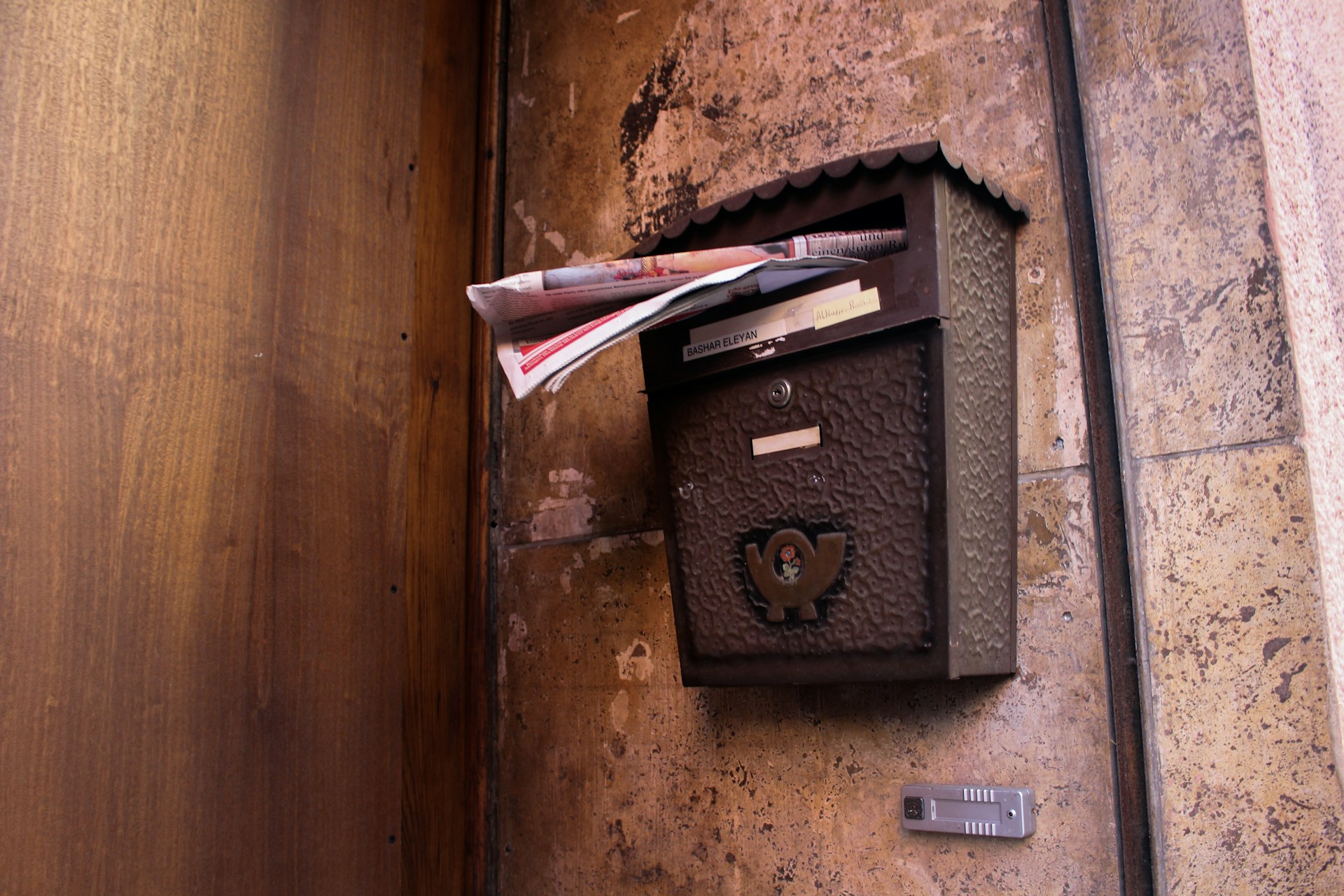
    Q: How can dentists track and measure the success of a direct mail campaign?

    A: Dentists can track and measure the success of a direct mail campaign by using various methods and metrics to evaluate the effectiveness of their EDDM strategies.