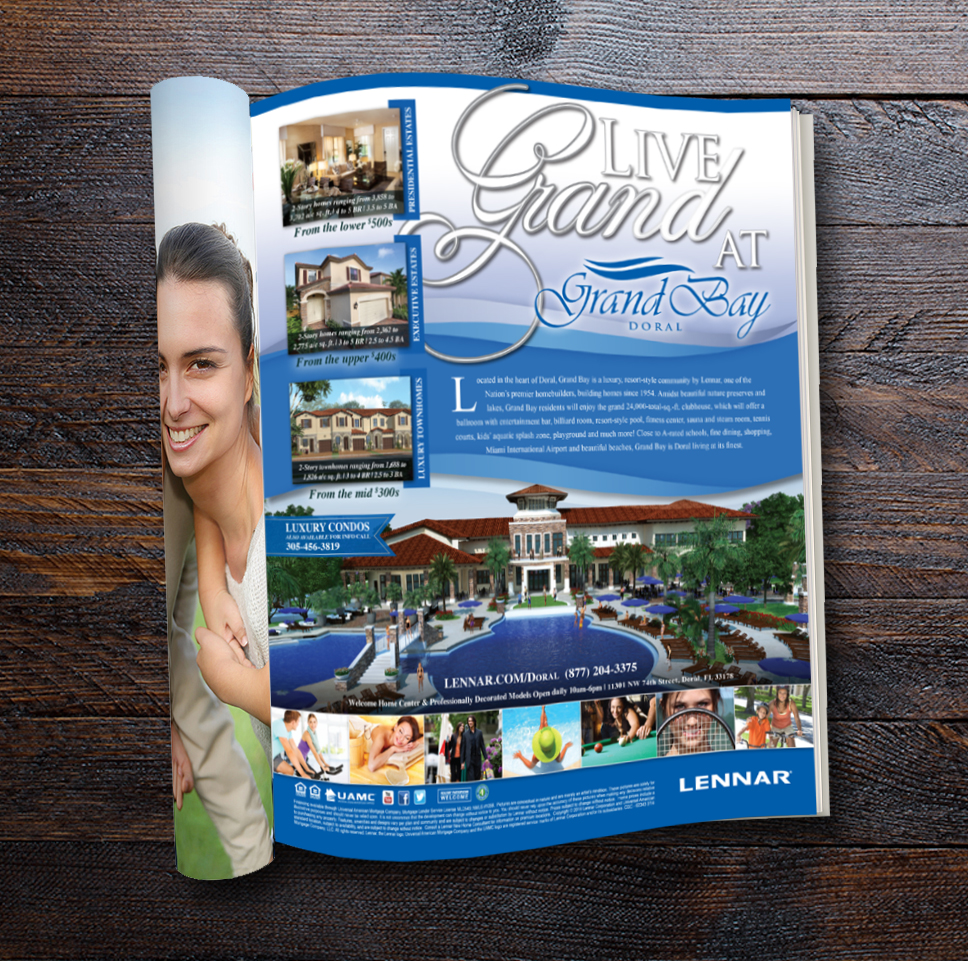
Marketing commercial real estate effectively demands a blend of traditional techniques and innovative digital approaches. In today’s competitive landscape, standing out from the crowd requires leveraging multiple platforms to attract buyers, sellers, and investors. While methods like postcard and print marketing still play a role, incorporating modern techniques such as SEO can significantly amplify your reach and impact.
Read on to learn how to market commercial real estate with SEO strategies.
Understanding the Importance of SEO in Commercial Real Estate
Search engine optimization (SEO) is the backbone of any successful digital marketing strategy. It ensures your real estate listings and business information appear prominently in search engine results, making it easier for potential clients to find you. With several online experiences beginning with a search engine, focusing on SEO can bridge the gap between your services and your target audience.
Also, if you’re a commercial real estate professional, local SEO is particularly significant. Prospective clients typically search for properties within specific locations, such as “office spaces in Chicago” or “retail spaces in Miami.” By optimizing your website and content for local keywords, you can rank higher in these searches and attract the right clientele.
Lastly, to maximize the effectiveness of your efforts, embracing digital marketing tailored to commercial real estate, such as SEO, is crucial. These strategies can help optimize your online presence, drive traffic to your website, and establish credibility in a crowded market.
Key Elements of a Strong SEO Strategy
A strong SEO strategy is essential for boosting visibility and driving targeted traffic to your commercial real estate listings. By focusing on the following key elements, you can improve your search engine rankings and effectively connect with potential clients in a competitive market:
Keyword Research and Implementation
Thorough keyword research is the foundation of any effective SEO strategy. Identify phrases and terms that prospective clients frequently search for, such as “commercial office space near me” or “warehouse for lease in [city].” Use tools to find relevant and high-ranking keywords.
Once identified, integrate these keywords naturally into your website’s content, metadata, titles, and blogs. Also, avoid keyword stuffing, as it can harm your rankings. A strategic approach to keyword placement enhances visibility and draws the right audience to your listings.
Local SEO Optimization
Local SEO is critical for targeting clients searching within specific areas. Start by claiming and optimizing your Google My Business (GMB) profile to appear in local search results and Google Maps. Ensure your NAP (Name, Address, and Phone Number) information is consistent across directories to maintain credibility with search engines. Incorporate location-based keywords, such as city and neighborhood names, into your website’s content and meta descriptions.
By tailoring your SEO efforts locally, you can connect directly with potential clients in your targeted geographical market.
High-Quality Content Creation
Publishing valuable and engaging content can help establish authority and trust in the commercial real estate industry. Create market insights, property investment guides, and detailed property showcases to attract and retain your audience. Also, include various formats like blogs, videos, and infographics to cater to different preferences. Use storytelling to make complex data accessible and compelling.
Remember, quality content can help improve your search engine rankings and keep visitors engaged, encouraging them to explore your services and listings more.
On-Page Optimization
On-page optimization involves enhancing website elements to align with your SEO goals. Use descriptive titles, clear headings, and image alt text incorporating target keywords. Ensure your site loads quickly and is mobile-friendly, as search engines prioritize user experience. Regularly update and optimize meta descriptions to accurately reflect your content and encourage clicks.
Furthermore, structured internal linking can help visitors navigate your site effectively and signals search engines about the hierarchy of your pages. On-page optimization ensures your site is both user-friendly and search-engine-friendly.
Link Building
Building high-quality backlinks is essential for improving your website’s domain authority and search rankings. To secure links, collaborate with reputable sources like industry blogs, news outlets, and local business directories. Share guest posts and contribute to authoritative platforms to expand your reach.
Additionally, diversify your backlink profile by earning links from educational resources, community partnerships, and social media. Avoid spammy or low-quality links, as they can negatively impact your site. Strategic link building solidifies your credibility and drives more organic traffic to your website.
Integrating Traditional Marketing with Digital Strategies
While digital marketing is essential, traditional methods like postcard and print marketing remain relevant in commercial real estate. Combining these approaches can create a holistic strategy to reach diverse audiences.
Typically, postcard and print materials offer a tangible way to connect with potential clients and leave a lasting impression. When designed creatively and paired with a clear call-to-action (CTA), these materials can drive traffic to your website or social media channels. Here’s how you can take advantage of postcard and print marketing:
Personalization: Use variable data printing to customize postcards with recipient names or property details.
QR Codes: Include QR codes directly linking to your website’s property listings or virtual tours.
Hybrid Campaigns: Combine print materials with email or social media campaigns to increase exposure and engagement.
With these strategies, you can market your commercial real estate more effectively.
Advanced SEO Tactics for Commercial Real Estate
Advanced SEO tactics can elevate your commercial real estate marketing by targeting emerging trends and leveraging innovative techniques. These tactics include:
Leverage Virtual Tours and Video Content
Search engines prioritize websites with engaging multimedia content. Incorporating 3D virtual tours, property walkthroughs, and drone footage of commercial spaces can improve your website’s SEO performance while captivating your audience.
Utilize Schema Markup
Schema markup can help search engines understand your website’s content better. For example, you can use real estate-specific schema to highlight property details like square footage, price, and location. This can improve your site’s visibility in search results.
Optimize for Voice Search
With the rise of smart assistants, optimizing for voice search is becoming increasingly important. Focus on natural language and question-based keywords, such as “What is the best commercial property in downtown Atlanta?”
Invest in Mobile-First Design
Given the surge in mobile device usage, having a mobile-responsive website is non-negotiable. A seamless user experience on smartphones and tablets can enhance your rankings and keep visitors engaged.
Measuring Success in Your Marketing Efforts
Tracking performance metrics is critical to refining your strategies. Many tools can provide insights into your website’s traffic, keyword rankings, and user behavior. Additionally, monitor offline efforts like postcard campaigns using unique URLs or tracking codes.
On the other hand, some key performance indicators (KPIs) to monitor include:
Website traffic and click-through rates
Conversion rates for inquiries or appointments
Ranking positions for target keywords
Engagement rates for blog posts and videos
With these KPIs, you can determine whether your marketing efforts are a huge success.
Final Thoughts
Effectively marketing commercial real estate requires a well-rounded approach that combines the power of SEO with traditional strategies like postcard and print marketing. By implementing these methods, you can enhance visibility, attract qualified leads, and close more deals. d close more deals.
EDDM rates 2024 are changing, and businesses need to stay informed. At Catdi Printing, we’ve seen firsthand how these changes can impact marketing strategies.
This blog post will break down the new rates, explain what they mean for your campaigns, and offer tips to maximize your EDDM budget. Get ready to supercharge your direct mail efforts in 2024.
What Are EDDM Rates?
Understanding EDDM
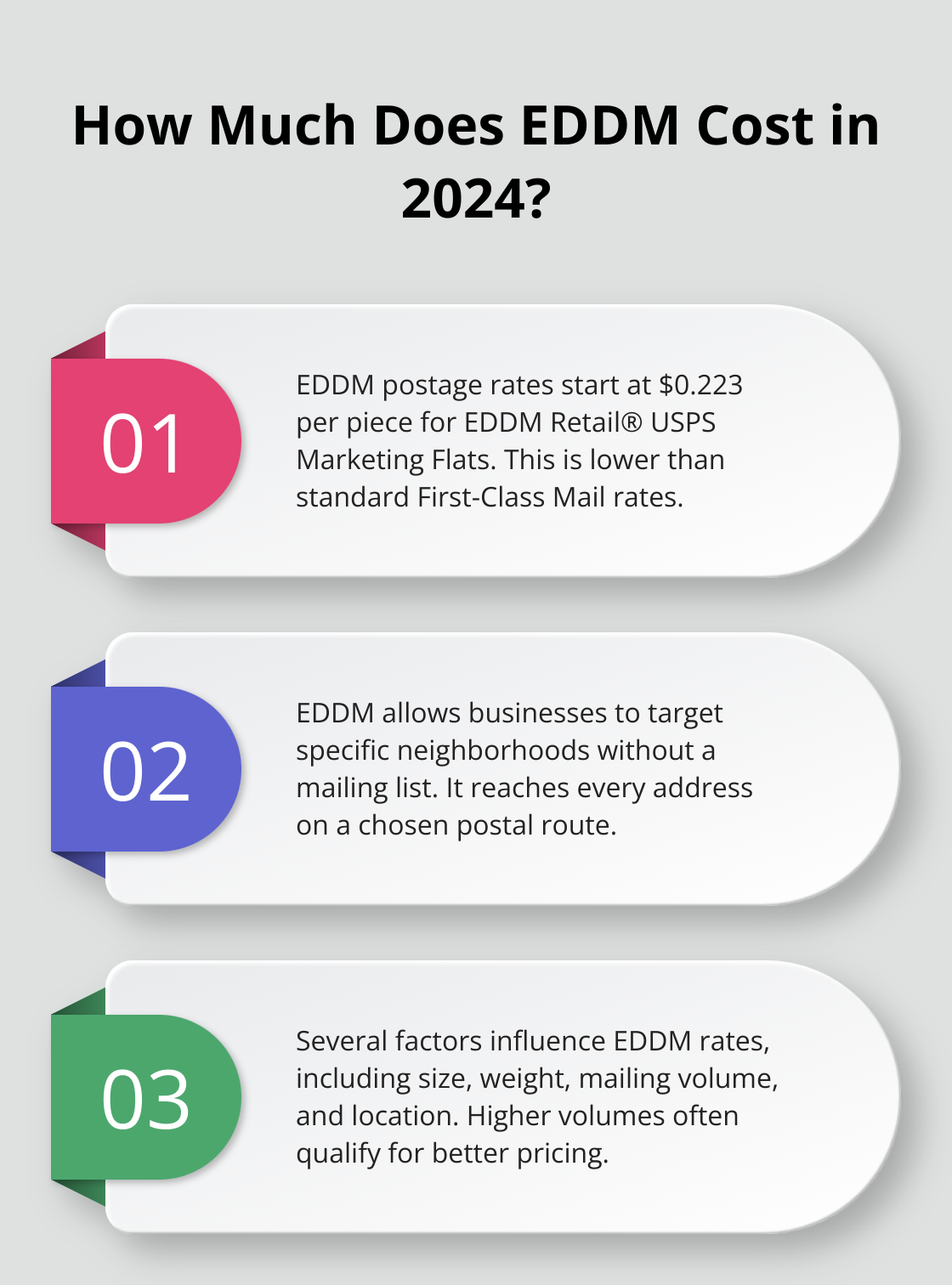
Every Door Direct Mail (EDDM) is a powerful marketing tool offered by the United States Postal Service (USPS). It allows businesses to target specific neighborhoods without a mailing list. Your promotional materials reach every address on a chosen postal route.
Factors Influencing EDDM Rates
Several elements impact EDDM rates:
Size and Weight: Standard-sized postcards (6.5″ x 9″) typically cost less to mail than larger pieces.
Mailing Volume: Higher volumes often qualify for better pricing.
Location: Mailing to local areas generally costs less than sending to distant zip codes.
Service Type: The USPS considers whether you use their retail service or work with a bulk mail entry unit (BMEU).
However, EDDM has limitations. You can’t personalize mailings or target specific individuals. If your marketing strategy relies heavily on personalization, traditional direct mail might suit you better despite the higher cost.
Strategies to Maximize Your EDDM Budget
To get the most out of your EDDM budget, consider these strategies:
Optimize your design: Create eye-catching, informative mailers that prompt recipients to take action.
Time your campaigns strategically: Align your mailings with seasonal trends or local events to increase relevance and response rates.
Test different routes: Start with a smaller mailing to test effectiveness before you scale up to larger campaigns.
The Role of Professional Printing Services
Professional printing services (like Catdi Printing) can significantly enhance your EDDM campaigns. They offer expertise in design, printing, and mailing logistics, ensuring your materials meet USPS specifications and maximize impact. With their help, you can create compelling content that resonates with your target audience and drives results.
As we move forward, let’s explore the specific EDDM rates for 2024 and how they might affect your marketing strategy.
What Are the 2024 EDDM Rates?
Retail EDDM Rates for 2024
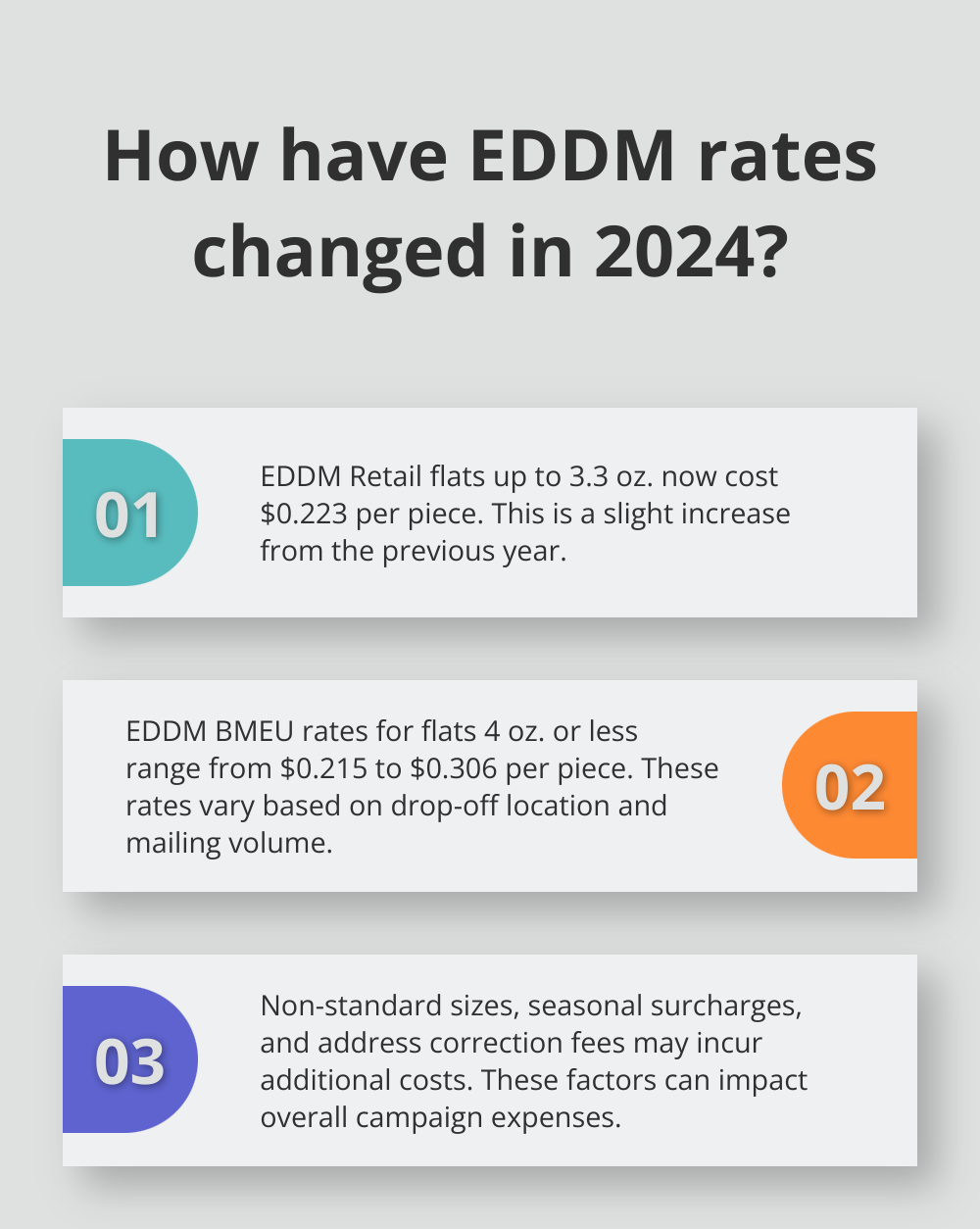
The 2024 EDDM rates have undergone adjustments that businesses should note. For EDDM Retail, the costs have increased slightly. As of January 2024, EDDM Retail flats (up to 3.3 oz.) now cost $0.223 per piece. This represents a modest increase from the previous year.
These rates apply to standard-sized mailers. Larger or heavier pieces incur additional costs. For instance, mailers exceeding the weight limit require an additional per-ounce fee.
EDDM BMEU Rates for 2024
Businesses using EDDM through a Bulk Mail Entry Unit (BMEU) will encounter different rates. BMEU rates typically undercut retail rates, making them an attractive option for larger campaigns.
While the base rates for EDDM are straightforward, additional fees and surcharges exist:
Non-standard sizes: Mailers that don’t meet USPS size requirements face additional charges.
Seasonal surcharges: During peak mailing seasons (like holidays), the USPS may implement temporary rate increases.
Address correction fees: Providing incorrect address information could result in additional charges.
To avoid unexpected costs, working with a professional printing service that understands these nuances proves beneficial. Professional services ensure that your EDDM campaigns comply with all USPS regulations, helping you avoid unnecessary fees.
Impact on Marketing Budgets
These rate changes, while modest, can significantly impact marketing budgets, especially for large-scale campaigns. For example, a campaign targeting 10,000 households could see an increase of $100 to $200 compared to 2023 rates.
However, EDDM remains a cost-effective marketing tool when used strategically. Focusing on high-potential neighborhoods and creating compelling designs can offset the increased costs with improved response rates.
Maximizing EDDM Budget in 2024
The key to maximizing your EDDM budget in 2024 lies in careful planning and execution. Consider factors like timing, design, and target area selection to ensure your campaigns deliver the best possible return on investment.
Professional printing services (such as Catdi Printing) can significantly enhance your EDDM campaigns. They offer expertise in design, printing, and mailing logistics, ensuring your materials meet USPS specifications and maximize impact. With their help, you can create compelling content that resonates with your target audience and drives results.
Now that we’ve explored the 2024 EDDM rates, let’s examine strategies to make the most of your EDDM budget and improve your campaign’s return on investment.
How to Maximize Your EDDM Budget
Create Eye-Catching Designs
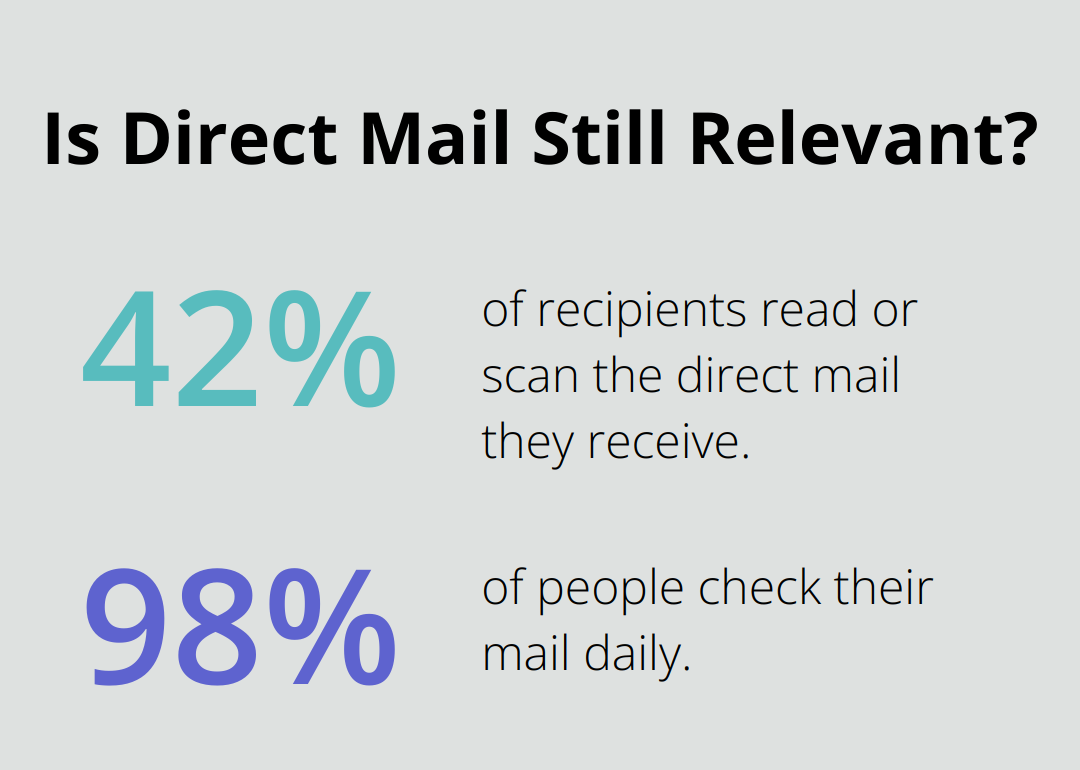
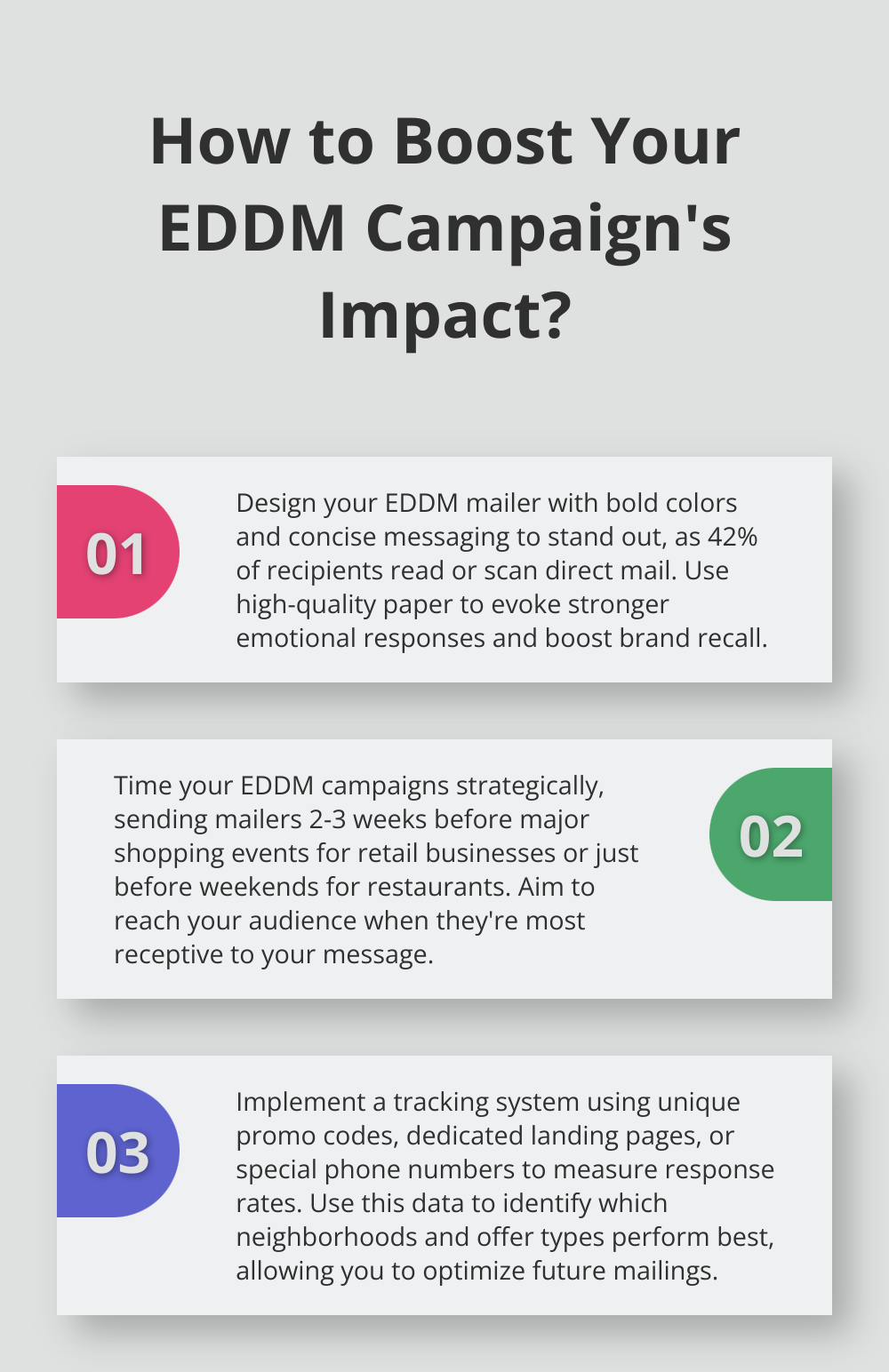
Your EDDM mailer must stand out from other mail. Use bold colors, high-quality images, and clear, concise messaging. 42% of recipients read or scan the direct mail they receive. Your design should aim to capture this audience’s attention.
High-quality paper enhances the impact of your mailer. A Temple University study found that physical ads (like EDDM mailers) evoke stronger emotional responses than digital ads. This emotional connection can boost brand recall and purchase intent.
Time Your Campaigns Strategically
The timing of your EDDM campaigns can significantly impact their success. Retail businesses should consider sending mailers 2-3 weeks before major shopping events (Black Friday or back-to-school season). Restaurants might benefit from mailers sent just before weekends or holidays.
A USPS report indicates that 98% of people check their mail daily. Your mailers should arrive when your audience is most receptive to your message.
Target High-Potential Neighborhoods
EDDM’s strength lies in its targeting capabilities. Every Door Direct Mail (EDDM) is an efficient and affordable service for businesses that want to target specific areas in their local market. High-end retailers, for example, should focus on neighborhoods with higher average incomes.
A local pizza chain experienced a 15% increase in new customers after targeting neighborhoods within a 3-mile radius of their locations. Their EDDM coupon distribution resulted in a 200% ROI on the campaign.
Track and Measure Results
Implement a system to assess the effectiveness of your EDDM campaigns. Use unique promo codes, dedicated landing pages, or special phone numbers to measure response rates. This data will help refine future campaigns.
A home services company saw a 300% increase in leads after implementing a tracking system for their EDDM campaigns. They identified which neighborhoods and offer types performed best, allowing them to optimize future mailings.
Leverage Professional Expertise
While EDDM can be a DIY project, professional assistance often yields better results. Companies specializing in printing and direct mail (such as Catdi Printing) offer expertise in design, printing, and EDDM logistics. They ensure your mailers comply with USPS regulations and maximize impact.
A local gym partnered with a professional printing service for their EDDM campaign. The result was a 25% increase in new memberships compared to their previous DIY efforts. The professional design and strategic distribution made a significant difference.
Final Thoughts
EDDM rates 2024 have increased slightly, with retail flats now costing $0.223 per piece and BMEU rates ranging from $0.215 to $0.306. Despite these changes, EDDM remains a cost-effective marketing tool when used strategically. The key to success lies in optimizing campaigns through eye-catching designs, strategic timing, and targeted distribution.
EDDM pricing will likely continue to evolve in response to market conditions and USPS operational costs. However, the value proposition of EDDM is expected to remain strong, especially for businesses seeking to reach local audiences efficiently. EDDM should be viewed as part of a comprehensive marketing strategy, combined with digital marketing efforts for a multi-channel approach that maximizes reach and engagement.
For businesses looking to make the most of their EDDM campaigns, partnering with experienced professionals can make a significant difference. At Catdi Printing, we offer expertise in EDDM services, from design to distribution. Our team strives to ensure your mailers meet USPS specifications and resonate with your target audience, aiming to drive results for your business.
Direct mail remains a powerful tool in the marketing arsenal, with success rates that often surpass digital channels. At Catdi Printing, we’ve seen firsthand how well-executed direct mail campaigns can drive impressive results for businesses across various industries.
In this post, we’ll explore the factors that influence direct mail success rates, share strategies to boost your campaign performance, and provide insights on measuring ROI effectively.
How Effective Are Direct Mail Response Rates?
Direct Mail Outperforms Digital Channels
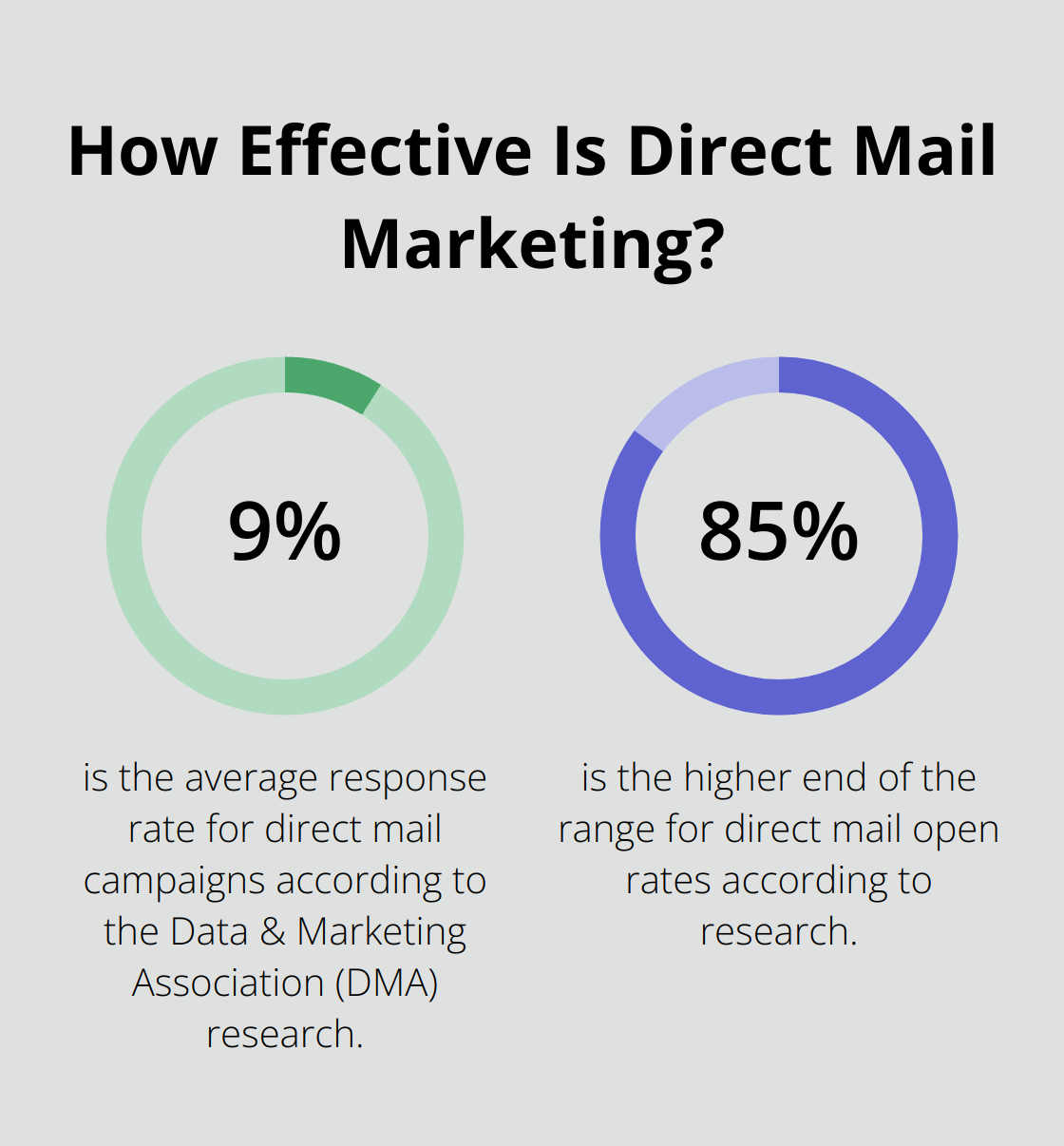
Direct mail response rates consistently surpass digital marketing channels, making it a valuable tool for businesses aiming to boost their marketing ROI. The Data & Marketing Association (DMA) research shows a 9% average response rate for direct mail campaigns. This impressive performance underscores the enduring power of physical mail in an increasingly digital world.
Industry-Specific Response Rates
Response rates vary across industries, reflecting differences in target audiences and campaign objectives. The financial services sector often sees higher response rates due to the personal nature of their offerings. Retail and e-commerce businesses also benefit from direct mail, with the tactile experience of catalogs driving online and in-store purchases.
Digital vs. Direct Mail Engagement
When compared to digital marketing channels, direct mail’s effectiveness becomes even more apparent. Email marketing, often considered a cost-effective alternative, typically achieves open rates of 20-30%. In contrast, research shows that direct mail gets better response rates than email marketing, with open rates varying between 57.5 and 85 percent. This stark difference in engagement levels translates to higher conversion rates for direct mail campaigns.
Key Factors Influencing Response Rates
Several factors play important roles in determining the success of a direct mail campaign:
List Quality: A well-targeted mailing list is fundamental. The more accurately you can pinpoint your ideal audience, the higher your response rates will be.
Offer Relevance: Tailoring your offer to the recipient’s needs and interests significantly boosts engagement. Personalization goes beyond just using the recipient’s name; it involves crafting messages that resonate with their specific circumstances.
Timing: Sending your direct mail at the right time can dramatically impact its effectiveness. For example, seasonal promotions or life event-triggered mailings often yield higher response rates.
Design and Copy: The visual appeal and messaging of your direct mail piece are critical. Clear, compelling calls-to-action and eye-catching designs increase the likelihood of recipient engagement.
Multi-channel Integration: Combining direct mail with digital touchpoints can amplify your campaign’s impact. For instance, following up a direct mail piece with an email can reinforce your message and provide an additional response channel.
Optimizing Your Direct Mail Strategy
To maximize the effectiveness of your direct mail campaigns, you should continuously test and refine each element. Use data-driven insights to optimize your mailing list, offer, timing, design, and multi-channel approach. This iterative process (which involves analyzing results and making adjustments) will help you achieve the best possible response rates for your specific industry and target audience.
As we move forward, it’s essential to understand how to measure the success of your direct mail campaigns accurately. In the next section, we’ll explore the key metrics and tools for evaluating direct mail ROI, ensuring you can quantify the impact of your efforts and make informed decisions for future campaigns.
How to Measure Direct Mail ROI
Measuring the return on investment (ROI) of your direct mail campaigns is essential for understanding their effectiveness and making data-driven decisions. This chapter explores key metrics and advanced tracking techniques to evaluate campaign success and optimize future efforts.
While response rate is important, conversion rate tells you how many respondents actually became customers. This metric helps you understand the quality of leads generated by your campaign. Industry averages for conversion rates typically fall between 1% and 5% (depending on the product or service offered).
Return on Investment (ROI)
Calculate your ROI by subtracting the total campaign cost from the revenue generated, then dividing by the campaign cost and multiplying by 100. For example, if a campaign cost $5,000 and generated $15,000 in revenue, the ROI would be 200%. Direct mail consistently achieves higher response rates, better ROI, and improved brand recognition compared to many digital channels.
Calculating Cost Per Acquisition
Cost Per Acquisition (CPA) is a critical metric that helps you understand how much you spend to acquire each new customer through your direct mail campaign. To calculate CPA, divide the total cost (whether media spend in total or specific channel/campaign to acquire customers) by the number of acquisitions (new customers).
For instance, if your campaign cost $10,000 and resulted in 100 new customers, your CPA would be $100. Compare this to your customer lifetime value (CLV) to ensure profitability. If your average CLV is $500, a $100 CPA indicates a healthy return on your marketing investment.
Advanced Tracking Techniques
Unique Promo Codes
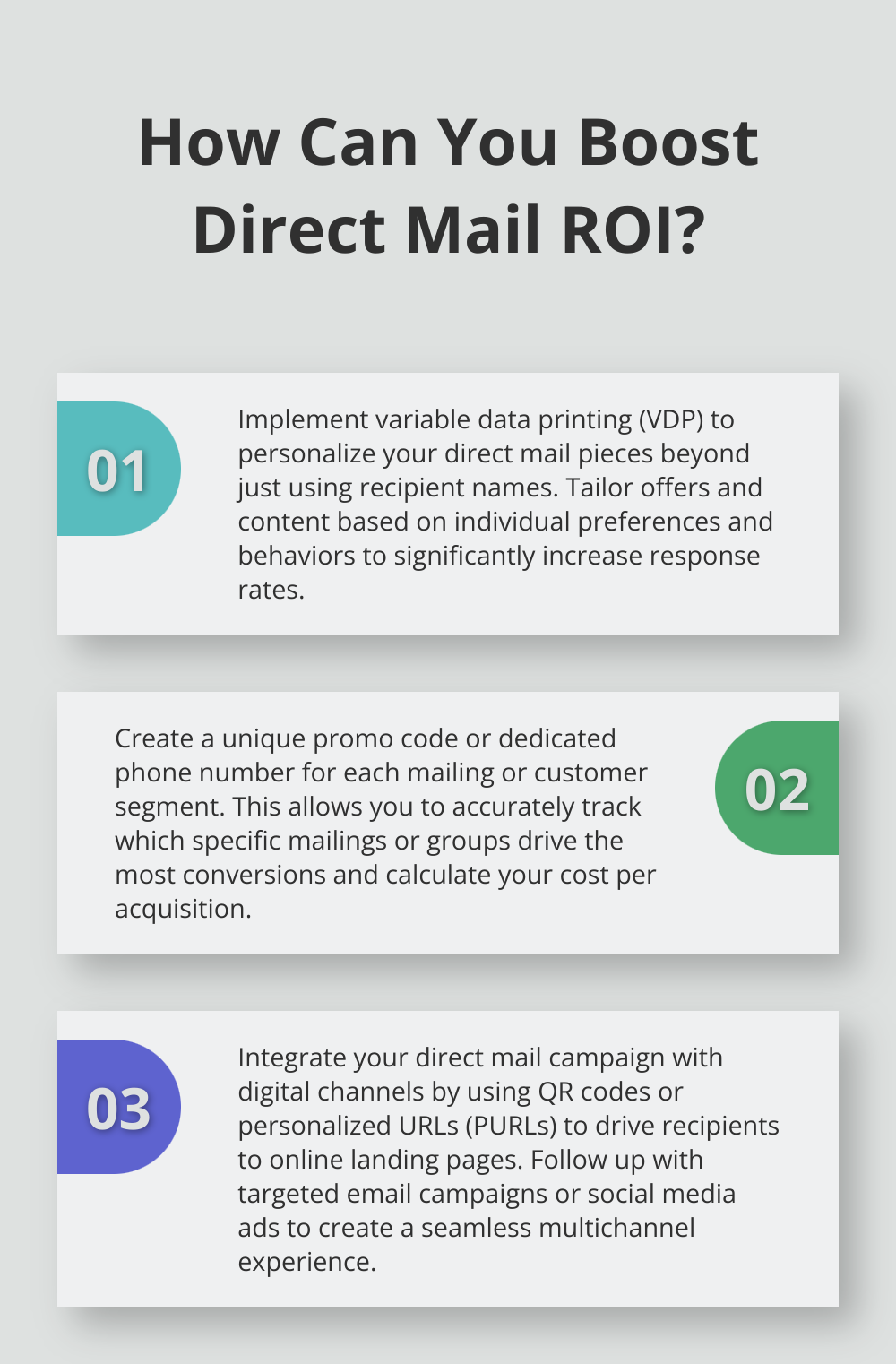
Assign individual promo codes to each mailing or customer segment. This allows you to track which specific mailings or groups drive the most conversions.
Call Tracking Numbers
Use dedicated phone numbers for your direct mail campaigns. This enables you to attribute incoming calls directly to your mailings and measure their effectiveness in generating leads.
Landing Pages
Create custom URLs or QR codes that lead to campaign-specific landing pages. This not only helps track responses but also provides a seamless experience for recipients transitioning from physical mail to digital interaction.
Integrating CRM Systems
Link your direct mail data with your Customer Relationship Management (CRM) system. This integration allows for more comprehensive tracking of customer interactions across multiple touchpoints, providing a holistic view of the customer journey.
A/B Testing
Continuously refine your campaigns by testing different elements such as offers, designs, or mailing formats. Comparing the performance of different versions helps you identify what resonates best with your audience and improve future campaigns.
These measurement strategies provide valuable insights into the performance of your direct mail campaigns. This data-driven approach allows for continuous optimization, ensuring that each mailing delivers maximum impact and ROI. Using unique tracking methods to evaluate the success of your campaigns is crucial for refining your direct mail strategy. Now that we’ve covered how to measure direct mail success, let’s explore strategies to further enhance your campaign performance and boost your results.
How to Boost Direct Mail Success
Personalize Your Message
Personalization extends beyond addressing recipients by name. It involves tailoring your message to individual preferences and behaviors. Use data-driven insights to segment your audience and create targeted campaigns. For example, a retailer might send different offers to frequent shoppers versus occasional buyers.
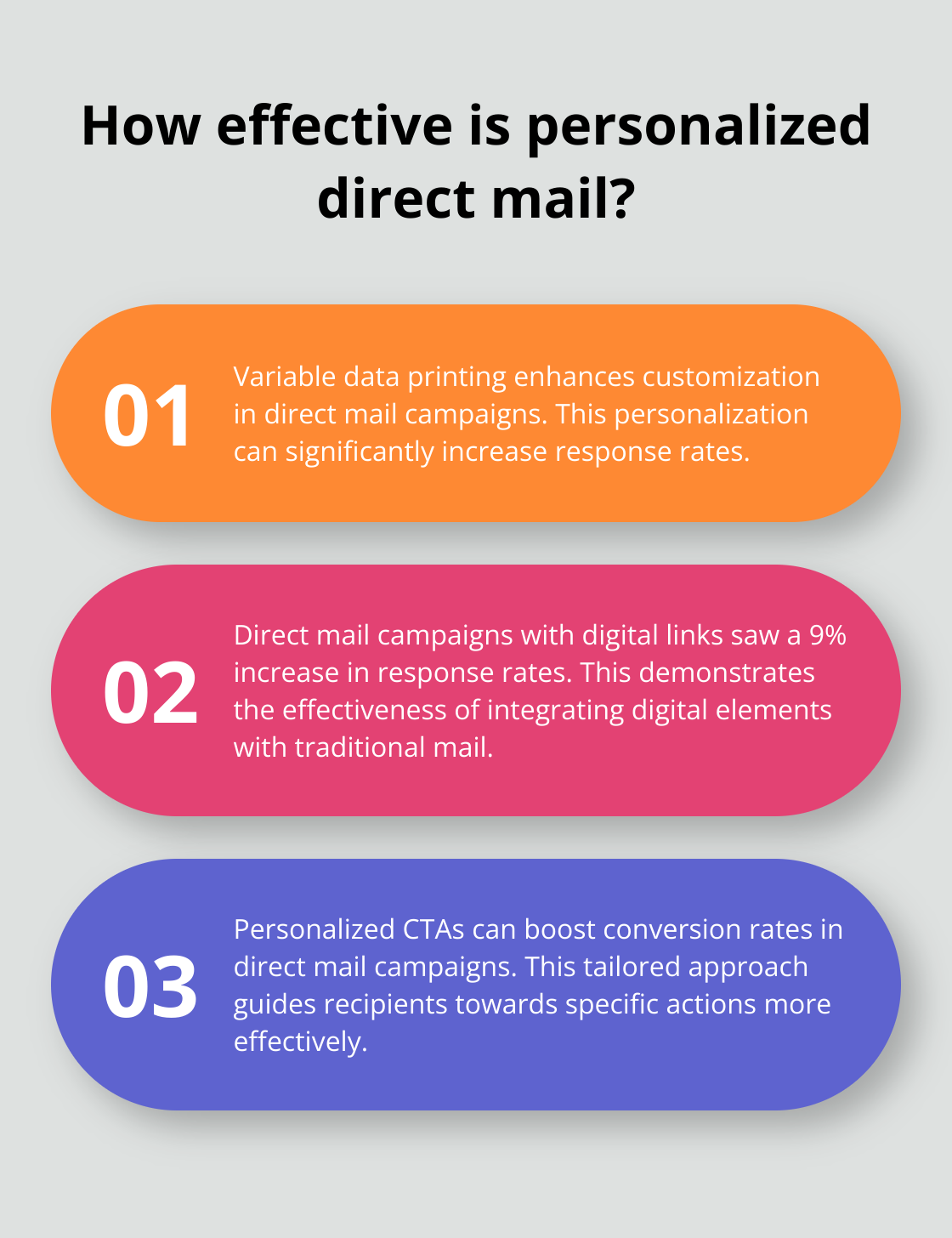
Variable data printing (VDP) is a modern solution that elevates your direct mail campaigns to new heights of customization and effectiveness. This level of personalization can increase response rates significantly, making your campaigns more effective.
Craft Compelling Designs
The visual appeal of your direct mail piece plays a key role in capturing attention and driving action. Consider these design tips:
Use high-quality images and graphics that align with your brand and message.
Incorporate white space to make your content more digestible.
Choose colors that evoke the right emotions and complement your brand identity.
Try unique formats, such as die-cut mailers or 3D pieces, to stand out in the mailbox.
The goal is to create a design that not only looks great but also guides the recipient towards your desired action.
Write Persuasive Copy
Your copy should be clear, concise, and compelling. Focus on benefits rather than features, and use action-oriented language to encourage response. Consider these copywriting tips:
Craft attention-grabbing headlines that address the recipient’s pain points or desires.
Use bullet points to highlight key benefits or offers.
Include a clear and prominent call-to-action (CTA) that tells the recipient exactly what to do next.
Create a sense of urgency with limited-time offers or exclusive deals.
Personalized CTAs can significantly increase conversion rates, making your direct mail more effective.
Integrate with Digital Channels
Combining direct mail with digital marketing efforts can amplify your results. Create a seamless multichannel experience with these methods:
Use QR codes or personalized URLs (PURLs) to drive recipients to online landing pages.
Follow up direct mail pieces with targeted email campaigns or social media ads.
Implement retargeting strategies to reach recipients who visited your website after receiving a mailer.
Direct mail campaigns that included digital links yielded a response rate increase of nearly 9% in relation to static campaigns.
Test and Optimize
Continuous testing and optimization are essential to improve your direct mail success rates. Consider A/B testing different elements of your campaigns, such as:
Offer types (e.g., percentage discount vs. dollar amount off)
Design layouts
Mailing formats (e.g., postcards vs. letters)
Personalization levels
Analyze the results of each test to inform future campaigns and refine your approach over time.
These strategies can significantly enhance the effectiveness of your direct mail campaigns. Success in direct mail marketing often comes from a combination of data-driven targeting, creative execution, and consistent optimization. These techniques can help you achieve better results and maximize your return on investment, whether you’re a small business owner or a marketing professional.
Final Thoughts
Direct mail marketing proves its effectiveness in today’s digital age, offering impressive response rates and ROI that often surpass digital channels. The success of direct mail campaigns depends on strategic planning, precise targeting, and creative execution. Businesses can significantly boost their direct mail success rates through personalization, compelling design, and data-driven insights.
The future of direct mail marketing looks bright with emerging trends such as augmented reality elements in mailers and environmentally friendly printing options. These advancements will make direct mail even more engaging and effective in capturing audience attention and driving conversions. Now is the time for businesses to act and harness the power of direct mail to stand out in a crowded marketplace.
At Catdi Printing, we offer a comprehensive range of direct mail and printing services designed to elevate your marketing efforts. Our team can bring your direct mail visions to life with high-quality, visually impactful materials (including postcards, EDDM services, business cards, and brochures). You can create powerful campaigns that resonate with your audience and drive meaningful results by combining the tangible appeal of direct mail with strategic planning and cutting-edge techniques.
Imagine this: you’re at a buzzing networking event, shaking hands and swapping business cards like a pro. By the end of the night, your wallet is bursting with a rainbow of tiny paper rectangles, and you feel like you’ve conquered the networking game. But fast forward a few days, and half those cards have mysteriously vanished—probably off to the same secret lair as lost socks and spare pen caps.
Traditional business cards are undeniably classic, and let’s be real, there’s something satisfying about handing someone a sleek, well-designed card. But they do have their limitations—like being accidentally left in someone’s pocket during a laundry cycle. Enter digital business cards: the modern upgrade that keeps your connections safe, organized, and ready to impress at a moment’s notice.
In this article, we’ll explore how digital business cards complement your networking efforts and share tips to make the most of this innovative tool. Think of it as leveling up your connection game without giving up the charm of paper cards. Ready? Let’s dive in!
Understanding Digital Business Cards
A digital business card is a modern tool for networking. It’s an electronic form of your traditional paper card but stored on your phone, a cloud, or a specialized app. Unlike paper cards, you can share these digital versions through email, QR codes, or even a simple link during conversations.
How They Differ From Traditional Paper Cards
Digital cards stand apart because they never run out and can’t be lost or damaged. You can update them anytime, ensuring your contacts always have your latest information. This is a stark contrast to paper cards that become outdated or useless once the details change or they run out.
Benefits Of Digital Business Cards
The benefits of digital business cards are significant. Firstly, they’re sustainable as they cut down on paper waste. This is a big plus for the environment. They’re also cost-effective since you don’t need to print new batches when your details change or you run out.
Lastly, their updatable nature means your network stays informed with real-time updates about any change in job title, address, or contact number. This flexibility makes digital business cards a powerful tool in today’s fast-paced professional world.
Creating Your Digital Business Card
Choosing the right platform is crucial for creating your digital business card. Look for features that suit your unique needs. Look for user reviews and compare features such as customization options and integration capabilities. Select a platform that aligns with your professional image and networking goals.
Design Your Card
When designing your digital business card, include essential elements such as your contact information, social media profiles, and a company logo. Ensure the design is clean and professional. The layout should allow quick scanning of information, making it easy for contacts to find what they need.
Optimize For Usability
To enhance usability, incorporate features like QR codes that link directly to your digital card. Opt for simple, intuitive layouts that are easy to navigate. Remember, the goal is to make it as easy as possible for recipients to access and use your information without any hassle.
These steps will help you create a digital business card that not only looks great but is also functional and effective in building and maintaining your professional network.
Sharing Your Digital Business Card
There are several innovative methods to share your digital business card that ensure you never miss a networking opportunity. QR codes can be displayed on your phone, allowing others to scan and instantly receive your card.
Embedding your card in your email signature ensures every email sent can expand your professional network. Additionally, Near Field Communication (NFC) technology lets others tap their NFC-enabled devices to your smartphone or NFC tag to access your digital card.
Best Practices For Digital Exchanges
When exchanging digital business cards, adhering to certain etiquettes is essential to optimize the process and ensure successful connections. Always seek permission before sharing your digital card, whether at live events or during online meetings. This respectful approach demonstrates your consideration for others’ privacy and readiness to establish a meaningful connection.
It’s equally important to keep your digital business card up-to-date. Regular updates to your card reflect your professionalism and reliability, reassuring new contacts that they have the most current information about you.
In addition to these practices, personalize your interaction when sharing your digital card. Mention a detail or topic discussed during your conversation to reinforce the connection and make your interaction memorable.
Also, be mindful of the platform or method you use to send your card; choose the most appropriate and effective method based on the context of your meeting or the preferences of the recipient.
By employing these sharing techniques and best practices, you ensure your digital business card not only reaches a wide audience but does so in a manner that fosters positive professional relationships.
Leveraging Digital Business Cards For Networking Success
Maximize your networking efficiency by syncing your digital business card with other digital tools. Platforms such as LinkedIn allow you to seamlessly integrate your digital card into your profile, enhancing your professional presence.
Syncing with Customer Relationship Management (CRM) systems can automate the addition of new contacts directly from your digital card, ensuring no valuable connection slips through the cracks. This integration facilitates a smoother flow of information and more organized contact management.
Tracking And Follow-Up
Utilize the analytics features of your digital business card to track interactions and gauge the impact of your networking efforts. These tools can show you how many times your card has been viewed or saved, providing insights into which connections are most engaged.
Prompt follow-up is crucial after sharing your card. Send a personalized message or email to reinforce the connection, using the information from your card’s analytics to tailor the conversation.
This timely follow-up demonstrates your commitment to the new relationship and can significantly increase the effectiveness of your networking.
By strategically integrating and utilizing your digital business card, you ensure it becomes a powerful tool in your networking arsenal, helping to forge and reinforce valuable professional connections.
Digital business cards are transforming networking practices by offering a reliable, efficient, and eco-friendly way to manage professional connections. Their ease of sharing and instant updating eliminates the limitations of traditional paper cards, ensuring your contact information is always just a tap away for your network.
These cards don’t just simplify sharing—they revolutionize connection management. With digital cards, you can keep an up-to-date and organized database of your contacts, accessible anytime, anywhere. No more scrambling to find a lost card or worrying about outdated information.
Whether you’re looking to embrace a digital-first approach or combine digital cards with traditional materials, Catdi Printing is here to help. We specialize in both high-quality traditional business cards that leave a lasting impression and digital business card solutions to keep you ahead in today’s tech-driven world. Ready to elevate your networking game? Let’s get started!
Hey there, business owners! Carlos Alonso here. You might know me as one of the founders of Catdi Printing—where my caffeine intake fuels more than just high-quality print marketing materials! Today, I’m here to guide you through direct marketing, one of the most effective ways to reach customers and grow your business. Direct marketing is all about delivering a clear marketing message to your audience. connecting with your audience personally, tracking results, and adjusting your approach based on what works. Let’s jump in and explore direct mail, print collateral, and other powerful direct marketing tools that can help take your business to new heights.
What is Direct Marketing?
Direct marketing is all about delivering targeted messages directly to your audience without relying on third-party channels. This means reaching your customers through mail, email, SMS, or online ads, giving you complete control over the message, timing, and customer experience. For small businesses, direct marketing can be especially powerful because it’s measurable, customizable, and helps you reach specific customer groups. Direct marketing campaigns have clear goals—whether it’s promoting a product, encouraging sales, or generating leads. And unlike broader forms of marketing, you can track responses, analyze results, and refine your approach for maximum return on investment (ROI). Let’s dive into some of the best direct marketing methods, starting with one of my favorites (and no, it’s not coffee): direct mail and print media advertising.
Direct Mail is a type of direct marketing that can effectively reach your target audience.: A Classic Choice with Modern Power
Direct mail may sound old-school, but trust me, it’s still a powerhouse! This form of direct marketing has proven effective for small businesses because it’s Tangible, memorable, and has a high engagement rate, direct response marketing can significantly boost your campaign’s effectiveness.. Here’s why direct mail should be at the top of your marketing toolkit:
High ROI: Direct mail boasts one of the highest ROIs in marketing, often outperforming digital channels. People trust mail more than many digital ads, which translates to higher response rates and a stronger connection with your brand.
Clear Conversion Tracking: Use tools like unique URLs, QR codes, and special offer codes to track how many customers respond to your direct mail campaigns. Curious about the benefits of different types of direct mail? Check out our guide on EDDM vs. Direct Mail Saturation Rates for the details.
Ideal for Targeted Campaigns: Direct mail lets you segment your audience based on location, interests, purchasing history, or demographics. Tailoring your message to each group ensures you’re speaking directly to their needs, making your campaign more effective.
Pro Tip: Include print collateral, like brochures or postcards, that showcase your brand’s story or highlight a promotional seasonal promotion. These items stay in the hands of customers longer, giving your message lasting power.
Whether you’re sending postcards, flyers, or coupons, direct mail gets you literally “in the hands” of your customers. It’s a fantastic way to build connections and stand out from the crowd through effective marketing materials.
Other Effective Direct Marketing Options
While direct mail is amazing, there are other direct marketing channels that work wonders too. Here are some options that can complement your direct mail efforts and expand your reach.
1. Email Marketing
Email marketing is versatile and budget-friendly, perfect for small businesses. With email, you can reach a large audience while still adding that personal touch. It’s great for newsletters, product announcements, and special offers. Plus, you can utilize various types of direct marketing strategies to enhance your outreach.
Reach customers instantly
Track opens, clicks, and conversions to measure the effectiveness of your direct response marketing efforts.
Segment audiences for targeted messaging
Make sure your emails offer value to keep your readers engaged and connected with your brand.
2. SMS Marketing
With sky-high open rates, SMS marketing is ideal for urgent updates, flash sales, and appointment reminders, making it a powerful direct response tool. Just remember to get permission first! This approach works best when messages are short, direct, and offer immediate value to your customers.
3. Social Media Ads
Platforms like Facebook, Instagram, and LinkedIn offer precise targeting for direct marketing. With social media ads, you can reach your ideal audience based on interests and behaviors, with ads that link directly to your site or landing pages.
4. Pay-Per-Click (PPC) Advertising
PPC ads on search engines, like Google Ads, are ideal for driving traffic to your website and enhancing your marketing message. PPC lets you target keywords relevant to your business, reaching customers actively searching for products or services like yours.
5. Door Hangers and Flyers
For local businesses, printed materials like door hangers and flyers are tried-and-true methods. They’re great for neighborhood marketing And direct selling strategies are ideal for reaching nearby customers. Real estate agents, cleaning services, and home improvement companies can benefit from this approach by reaching customers right on their doorstep.
Pro Tip: Combine print collateral with digital offers. For example, include a flyer with a QR code linking to an online discount or free download—bridging print and digital marketing for greater impact.
Why Direct Marketing Works for Small Businesses
Direct marketing is a game-changer for small businesses, offering a way to connect with customers on a personal level and inspire real action. By speaking directly to your target audience with clear calls to action (CTAs) in every message, direct marketing encourages customers to respond immediately—whether they’re visiting your store, requesting a quote, or signing up for your newsletter.
Here’s why direct marketing is so effective for small businesses:
Immediate Responses: With direct marketing, clear CTAs lead customers to take quick action, like visiting your store, calling for a quote, or engaging with your website.
Easily Trackable Results: Direct marketing provides measurable outcomes. Track responses from specific campaigns—like postcard mailers or email clicks—and gain insights into what works for your audience.
Budget-Friendly and Scalable: Direct marketing fits both small and large budgets. Start small with targeted mail or digital ads, and easily scale up as your business grows.
Tailored for Key Industries:
Healthcare: Keep patients informed about new services, upcoming appointments, or health tips through personalized mail or emails.
Political Campaigns: Reach voters effectively with personalized messaging during election season through targeted mail, encouraging engagement and awareness.
Customizable Campaigns: Direct marketing allows you to tailor your approach. Adjust your messaging, design, and offers to appeal directly to your ideal audience.
Direct marketing’s flexibility, affordability, and ability to foster meaningful connections make it an ideal choice for small businesses seeking growth, engagement, and brand loyalty.
Getting Started with Direct Marketing
Starting a direct marketing campaign is simpler than it might seem. First, define your goal, whether it’s increasing brand awareness, driving sales, or generating leads. Next, choose the marketing channels that best align with your audience. For example, if you want to reach local customers, consider direct mail or door hangers. If you’re targeting a younger audience, email or social media ads might be a better fit than traditional indirect marketing methods. Finally, track your results. Use unique codes, links, or other tracking methods to measure success. Direct marketing thrives on data, so use what you learn to improve your strategy and achieve even better results next time.
How Catdi Printing’s Direct Marketing Services Can Work for You
Direct marketing offers powerful tools for small businesses to connect with customers directly. From direct mail to digital options like email and SMS, these methods help you reach your audience and inspire action. Remember, the key to successful direct marketing is to keep your messaging clear, targeted, and valuable. If you’re ready to get started, Catdi Printing can help bring your direct mail campaigns to life. With options like postcards, EDDM, and more, we’re here to support you with a custom campaign that drives results. Let’s work together to make your marketing strategy a success—and maybe I’ll even share my secret coffee blend to keep those creative ideas flowing!
Business cards play a vital role in establishing your brand identity when making a lasting impression. But what makes a business card genuinely effective in conveying your brand message? Is it the design? The choice of materials? Or perhaps the strategic placement of your personal details?
In this article, I will share valuable branding tips to help you design business cards that stand out from the crowd and leave a lasting impact on your recipients. From creative design ideas to branding strategies, we will explore various elements that can make your business cards a powerful tool for brand recognition.
Understanding the Role of Business Cards in Brand Recognition
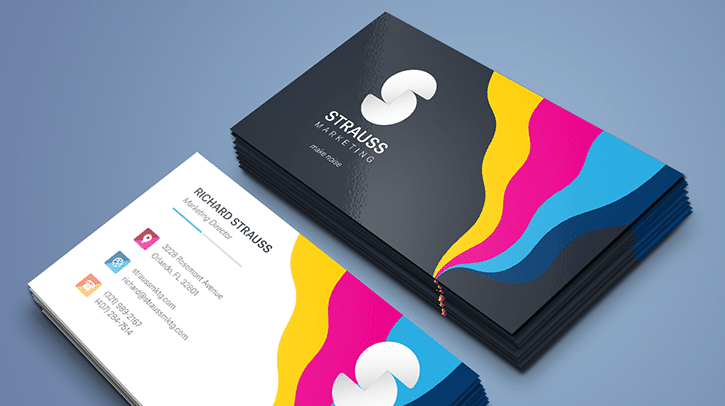
Even after all these years business cards are still the most popular items we print. Its amazing how manydifferent options and new things people are doing with their cards. Business cards play a crucial role in brand recognition. As a physical representation of a brand, business cards provide an opportunity to make a lasting impression on potential clients and customers. Creating a sound business card that effectively represents your brand is critical to building brand awareness, effective networking and recall for potential clients.
A well-designed business card reflects the personality and values of your brand, leaving a positive impression on recipients. It is a tangible reminder of your brand, making it easier for potential clients to recall and connect with your business when they need your products or services. When you create business cards that are visually appealing and aligned with your brand identity, you establish a strong brand presence, which is crucial for small businesses.
Furthermore, business cards serve as a visual touchpoint for your brand, reinforcing your brand image and messaging. When people see your brand’s logo, colors, and other branding elements on your business card, they can easily associate them with your company. Consistency in brand elements across all marketing materials, including business cards, is crucial for maintaining brand identity and improving brand recognition.
To create good business cards that contribute to brand recognition, it is essential to consider the design and overall presentation. This includes using high-quality materials, selecting appropriate fonts and colors, and incorporating key branding elements aesthetically pleasingly. By strategically designing your business cards, you can effectively convey your brand’s professionalism, creativity, and unique selling points.
When thoughtfully designed, they become powerful tools for brand recognition. By creating visually appealing and cohesive business cards that reflect your brand’s identity, you can leave a lasting positive impression on your target audience and reinforce your brand presence and ultimately make more money!
The Power of Simplicity in Business Card Design
When it comes to designing a business card, simplicity is often underestimated. However, a clean and minimalistic design can be compelling and make a lasting impression on potential clients and customers. Here are some top tips for creating a visually appealing and effective business card using simple design elements:
Consider employing a business card maker tool to experiment with different designs and shapes, making your card stand out.
1. Focus on Essential Information
When designing your business card, include only the most essential information. This includes your name, job title, company name, phone number, email address, and website. Keeping the information concise and clutter-free ensures it is easily readable and memorable for recipients.
2. Choose a Clean Layout
Avoid overcrowding your business card with excessive design elements. Opt for a clean and organized layout that allows each component to breathe. Use white space strategically to draw attention to the essential details and make the overall design look more polished.
3. Limit the Color Palette
When it comes to colors, less is often more. Limit your color palette to two or three complementary colors that align with your brand. This creates a cohesive and professional look visually appealing to the eye. Remember, simplicity can be as impactful as a bold and vibrant design for creating a new business card.
4. Use High-Quality Fonts
Choose fonts that are clean, legible, and professional. Avoid using multiple fonts, which can create a chaotic and unprofessional look. Stick to one or two fonts throughout your business card to maintain consistency and enhance the simplicity of the design.
5. Incorporate Minimalistic Graphics
If you include graphics or icons on your business card, opt for minimalistic designs that align with your brand. These subtle touches can add visual interest without overwhelming the overall design. Remember to keep them simple and relevant to your business or industry. We concur that keep the images limited.
Simplicity is the key to effective business card design. By focusing on essential information, clean layouts, limited color palettes, high-quality fonts, and minimalistic graphics, you can create a visually appealing and impactful business card that represents your brand professionally. Remember, sometimes less is more, especially in graphic design for small business cards!!
Material and Finish: Conveying Quality through Your Business Card
Choosing materials and finishes plays a crucial role when creating a lasting impression with your business card. Your business card should look visually appealing and convey a sense of quality and professionalism. That’s why it’s important to consider options like silk coating, satin aqueous, matte coating, UV coating, spot UV, foil, and different card stocks to make your card stand out and reflect the quality of your small business.
Silk coating adds a smooth and luxurious touch to your business card. It gives a subtle sheen and enhances colors, making your design elements pop. On the other hand, matte coating provides a sophisticated and elegant finish, perfect for minimalistic and modern designs.
UV coating, especially spot UV, is a popular choice for adding a glossy and eye-catching effect to specific areas of your business card, such as your logo or essential elements. This creates a contrast that draws attention and leaves a memorable impression on recipients.
Consider adding foil to your business card if you want something more unique and distinctive. Foil can highlight specific design elements like your company name or logo, adding a touch of elegance and sophistication.
With the right combination of materials and finishes, your business card can become a powerful tool for promoting your brand, standing, and competition. Take the time to carefully select the materials and finishes that best align with your brand image and leave a lasting impact on anyone who receives your card.
Differentiating with Unique Business Card Shapes and Sizes
In business card design, thinking outside the box can make a lasting impression on potential clients and partners, adhering to innovative design principles. Differentiating your business cards with unique shapes and sizes is an excellent way to stand out from the crowd and showcase your creativity. This approach can make your card stand out.
One top tip for designing a unique business card is to consider the nature of your industry or profession. For example, if you are a florist, you can opt for a business card shaped like a flower or a die-cut design to mimic petals, making your card unique and memorable. This not only reflects your profession but also creates visual interest. Catdi Printing offers rounded corners or semi-rounded cards and they are pretty popular for various businesses.
Another creative business card design tip is to play with unconventional sizes. Consider square or circular cards instead of the standard rectangular shape to create a unique and memorable business card. These distinctive shapes catch the eye and make your business card memorable, adhering to creative design principles.
When experimenting with unique shapes and sizes, it is essential to balance creativity and practicality. Ensure that the shape or size doesn’t hinder the card’s usability, making it difficult for recipients to store or carry.
You can make a statement and leave a lasting impression by incorporating unique shapes and sizes into your business card design. Stand out from the crowd and showcase your creativity with an innovative and attention-grabbing business card.
Branding Tips for Business Cards: Elements that Make a Statement
When it comes to creating impactful business cards, incorporating key branding elements is crucial. These elements represent your brand and help build a strong visual impact on your recipients. In this section, I will discuss the critical branding elements that can make a statement on business cards and provide you with innovative ideas to elevate your business card branding.
1. Logos: Your logo is the face of your brand, and it should be prominently displayed on your business card. Ensure that your logo is high-resolution and perfectly represents your brand identity. This is crucial to make your card convey your professional image. A strategically placed logo will grab attention and help make a lasting impression, ensuring your card represents your brand effectively.
2. Colors: Colors evoke emotions and play a significant role in branding. Choose colors that align with your brand identity and evoke the desired emotions, adhering to design principles for an effective business card. Incorporate these colors into your business card design to create a visually appealing and cohesive look.
3. Fonts: Fonts can convey your brand’s personality and tone. Select legible fonts that reflect your brand’s style. Consider using a combination of fonts to create visual interest and hierarchy in your design.
4. Design Elements: Use design elements unique to your brand. These could include patterns, icons, or illustrations that visually represent your products, services, or values. These elements will make your business card memorable and reinforce your brand image.
5. Taglines or Slogans: If you have a memorable tagline or slogan, consider incorporating it into your business card design. A well-crafted tagline or slogan can communicate your brand message effectively and leave a lasting impact on your recipients.
6. Consistency: Maintain brand consistency across all marketing materials, including your business cards. Ensure that your branding elements, such as colors, fonts, and logo placement, are consistent with your other marketing collateral. Consistency helps reinforce your brand identity and improves brand recognition.
Incorporating these branding elements into your business card design can create a strong visual impact, increase brand recognition, and leave a lasting impression on recipients.
Strategic Content Placement for Maximum Impact
Strategic content placement is critical to creating maximum impact and effectively conveying your brand message when designing business cards. By organizing your information visually appealingly, you can ensure that your business cards leave a lasting impression on recipients.
One of the most essential elements of content placement is the positioning of your contact information. Prominently display your name, job title, phone number, email address, and website. These details should be easily readable and accessible, allowing potential clients or customers to reach out to you quickly.
Additionally, consider incorporating branding elements such as your logo, tagline, or brand colors into the design of your business card. This helps to reinforce your brand image and make a memorable impression.
Another tip for effective content placement is to prioritize the most critical information. Consider what key details you want to highlight and ensure they are easily noticeable. Consider using bold or larger fonts for crucial information, such as your name or company name, to draw attention to these elements.
Finally, consider the overall layout and design of your business card. Effectively utilize negative space to create a clean and uncluttered look. Pay attention to the alignment of text and graphics, ensuring a cohesive and professional appearance.
By carefully considering the strategic placement of your content, you can maximize the impact of your business cards and create a lasting impression on potential clients or customers.
Embracing Digital Business Cards
In today’s fast-paced, tech-driven world, digital business cards are gaining popularity as a modern complement to traditional ones. They combine the personal touch of networking with the convenience and efficiency of digital technology. Here’s how they can enhance your branding:
1. Always Updated, Always Accessible Unlike traditional cards, digital business cards can be updated instantly. No more worrying about outdated phone numbers or email addresses—they keep your information current and accessible.
2. Eco-Friendly Branding Gen Z and eco-conscious professionals appreciate sustainability. Digital cards align with environmentally friendly practices, reducing paper waste while still making a memorable impact.
3. Easy Sharing and Integration Share your card with a simple tap or scan. Many platforms allow you to integrate digital cards with your email signature, social media profiles, or direct QR codes on traditional cards, bridging the gap between physical and digital branding.
4. Analytics and Engagement Tracking With digital cards, you can often track interactions—like how many people viewed or saved your information. This adds an analytical layer to your networking efforts, helping you refine your approach.
Pro Tip: Consider adding a QR code to your traditional card that links directly to your digital card. It’s a great way to blend the best of both worlds and appeal to tech-savvy contacts.
Encouraging Engagement: Adding Calls to Action on Business Cards
When designing business cards, it’s crucial to go beyond simply providing contact information. Adding calls to action can encourage recipients to take the next step and engage with your brand. One effective way to do this is by incorporating QR codes.
QR codes are scannable codes that allow users to quickly access websites, social media profiles, or other digital content. They make your business card a powerful tool for digital engagement. Placing a QR code on your business card provides a convenient and interactive way for recipients to connect with your brand.
For example, you could create a QR code linking to your company’s website or online portfolio, ensuring your card is a direct gateway to your digital presence. This allows potential clients or customers to easily explore your products or services without manually typing in a URL. QR codes can also direct recipients to your social media pages, encouraging them to follow or engage with your brand online.
“Aside from QR codes, there are many other creative ways to add calls to action on your business cards. Consider incorporating a catchy slogan or tagline that prompts recipients to visit your website, sign up for a newsletter, or take advantage of a special promotion. You could also include a specific call to action, such as”Call Now for a Free Consultation” or”Scan to Receive a Discount Code.”Aside from QR codes, there are many other creative ways to add calls to action on your business cards. Consider incorporating a catchy slogan or tagline that prompts recipients to visit your website, sign up for a newsletter, or take advantage of a special promotion. You could also include a specific call to action, such as “Call Now for a Free Consultation” or “Scan to Receive a Discount Code.”
Remember, the goal is to capture recipients’ attention and entice them to engage with your brand further. By adding calls to action on your business cards, you create opportunities for meaningful interactions and conversions, a vital tip for effective small business marketing.
Utilizing the Back of Your Business Card: A Canvas for Creativity
In today’s competitive business landscape, making a lasting impression with your business card is essential. While the front of the card is typically reserved for important contact information and branding elements, the back provides a blank canvas for creativity, additional information, and a chance to make your card stand out.
One creative idea is to use the back of your business card to convey additional information about your products or services. For example, you can include a brief description of your offerings, highlight key features, or showcase customer testimonials. This gives recipients valuable information and a reason to hold onto their cards.
Another way to utilize the back of your business card is to showcase portfolio samples or relevant images. Suppose you’re a graphic designer, photographer, or artist. In that case, this is an excellent opportunity to display your work and give potential clients a glimpse of your talent. Using a business card template designed for creatives can enhance this effect. You can also use this space to include a QR code that links to your online portfolio or website for easy access to more examples of your work.
Adding a personal touch to your business card can also make a lasting impression. Consider incorporating a handwritten note or a personalized message on the back of the card. This small gesture shows that you value personal connections and attention to detail, which can leave a positive and memorable impact on the recipient.
When designing the back of your business card, it’s essential to maintain a cohesive look and feel with the front. This can be achieved using consistent branding elements such as colors, fonts, and logos. Remember that the back of your business card extends your brand identity, so ensure it aligns with your brand image.
By effectively utilizing the back of your business card, you can maximize the impact of this small but powerful marketing tool. Whether you convey additional information, showcase your work, or add a personal touch, the back of your business card presents endless creative possibilities to make a lasting impression on potential clients and customers.
Maintaining Brand Consistency Across All Marketing Materials
Consistency is critical to effective branding—maintaining consistency across all marketing materials, including business cards. By, is important doing so, businesses can reinforce their brand image, improve brand recognition, and establish a solid and cohesive visual identity.
One of the first steps in maintaining brand consistency is to ensure that all branding elements are consistent across different marketing materials. This includes using the same logo, colors, fonts, and design elements on your business cards as you do on your website, social media profiles, and other marketing materials. This consistency helps create a unified and recognizable brand presence.
Another critical aspect of maintaining brand consistency is to use consistent messaging on your business cards. The tone and language used on your business cards should align with your brand’s overall messaging and voice. This helps create a cohesive brand narrative and ensures your business cards convey the right message to your target audience.
In addition, it’s crucial to pay attention to the visual aspects of your business cards. Ensure that your business cards’ layout and design are consistent with your brand’s visual identity. This includes using the same color schemes, typography, and imagery representative of your brand.
Lastly, don’t forget to maintain consistency in the quality and presentation of your business cards. Opt for high-quality materials and finishes that align with your brand’s image. Whether it’s a sleek matte finish or a luxurious foil stamping, the materials and finishes you choose should reflect the quality and professionalism of your brand. Incorporating a business card template can streamline this process.
Maintaining brand consistency across all marketing materials, including business cards, is essential for effective branding. By using consistent branding elements, colors, messaging, and visual presentation, businesses can reinforce their brand image, improve brand recognition, and leave a lasting impression on their target audience.
Avoiding Common Pitfalls: Best Practices for Business Card Branding
When branding your business cards, it’s crucial to avoid common pitfalls that can undermine your efforts. Following some best practices and practical tips, you can create business cards that effectively represent your brand and leave a positive and lasting impression on recipients.
First and foremost, best practices for branding on business cards involve ensuring consistency with your overall brand image. Use the same colors, fonts, and design elements in your other marketing materials. This helps to reinforce your brand identity and make your business cards instantly recognizable.
Another important consideration is the branding techniques for business card success. It’s essential to prioritize the relevant information and make it easily readable. Include only the necessary contact details and key messaging. Cluttered or overcrowded business cards can confuse and overwhelm recipients, so keep it simple and concise.
Also, while Canva and other free design apps are great for setting up your designs, we definitely recommend hiring a professional to design your cards. We offer bcard design starting at $50, and we can create the card of your dreams. You can guarantee you will cover all these key design points.
Remember, best practices for branding on business cards also involve selecting suitable materials and finishes. Choose a high-quality paper stock and consider adding special finishes such as silk coating or spot UV to enhance the perceived value of your cards.
Lastly, remember to review your business cards for errors or typos. Proofreading is a crucial step in ensuring a professional and polished final product. Double-check all the information, including phone numbers, email addresses, and social media links, before sending your business cards to print.
By following these best practices for branding on business cards and avoiding common pitfalls, you can create business cards that effectively represent your brand, make a strong impression, and help you stand out in a competitive market.
Using business cards as appointment reminders is an effective way to ensure clients and customers remember their scheduled appointments.
Distributing business cards during sales or displays can help increase brand awareness among potential customers.
Placing business cards in every bag, including swag bags or goodie bags, can create repeat customers by providing easy access to contact information.
Well-designed referral cards with necessary information and discounts or incentives can encourage customers to refer their friends and family to the business.
Printing coupons or discount codes on business cards not only increases customer retention but also provides easy visibility for potential customers.
Using business cards as cost-effective raffle cards allows participants to easily write their names and provides a convenient alternative to traditional raffle tickets.
Creating information cards with creative elements engages customers and provides detailed information about the business, products, and services.
Enhancing business cards with essential event information and design features like stamped foil or raised foil turns them into unique event tickets.
Using eye-catching design features like Spot UV and images on business cards helps to leave a lasting impression on new acquaintances.
Engaging in a friendly competition to distribute business cards can be a fun and effective way to make new business contacts and increase brand visibility.
Quality business cards play a crucial role in representing a successful business and should be emphasized for an effective marketing strategy.
Introduction
In today’s rapidly evolving digital landscape, it’s easy to dismiss the traditional role of business cards. However, their significance in establishing connections and promoting businesses cannot be overlooked. According to recent data from The Paperworker, 72% of professionals have admitted that carrying a unique, well-designed business card helps them stand out from the competition. In this section, we’ll explore the various creative ways businesses can utilize these small but powerful marketing tools to make lasting impressions and foster meaningful connections in a highly digital world.
The importance of business cards in establishing connections and promoting businesses
Business cards play a crucial role in establishing strong connections and promoting businesses. These small but powerful tools serve as a tangible representation of a company’s identity and offerings. They not only provide essential contact information but also leave a lasting impression on potential clients and customers. By handing out well-designed business cards, individuals can effectively communicate their professionalism, credibility, and commitment to their business.
In addition to serving as a simple contact card, business cards can be utilized in various unique ways to maximize their impact. For instance, they can be used as appointment reminders for clients and customers, ensuring that important meetings and engagements are not forgotten. Business cards can also be distributed during sales or displays to increase brand awareness among potential customers.
Furthermore, by including business cards in every bag or packaging, businesses can create repeat customers who will have easy access to their contact details for future purchases or inquiries. Similarly, by incorporating business cards in swag bags or goodie bags at events or conferences, businesses can reach a wider audience and potentially attract new customers through word-of-mouth referrals.
Moreover, designing referral cards with necessary information and offering discounts or incentives to customers who refer their friends and family members are effective strategies for leveraging the power of business cards. This encourages existing customers to actively promote the business while benefiting from the rewards offered.
Additionally, printing coupons or discount codes on business cards provides an easy way for businesses to offer special deals to their target audience. Customers who receive these cards can also become brand ambassadors by giving them out to others, thus increasing customer retention.
Furthermore, using business cards as cost-effective alternatives to raffle tickets is another innovative way of utilizing these handy marketing tools. Participants can simply write their names on the card for entry into the raffle draw.
Information cards are yet another creative use of business cards. These specially designed cards provide detailed information about the business’s products and services while incorporating personal touches and creative design elements that engage potential customers.
Moreover, business cards can be used as event tickets, making them not only practical but also enhancing the overall experience for attendees. Adding features like stamped foil or raised foil further elevates the design and creates a sense of exclusivity.
Appointment cards: The business card that will remind your clients to show up, so you don’t have to hunt them down.
The Appointment Card
When it comes to the versatility of business cards, one unique application is using them as appointment reminders for clients and customers. This practice not only helps in keeping appointments organized but also serves as a tangible reminder that stands out among digital notifications. Additionally, another effective way to maximize the potential of business cards is distributing them during sales or displays to increase brand awareness. By providing a physical card that potential customers can take with them, it creates a lasting impression and makes it easier for them to connect with your brand in the future. Source: Reference Data.
Using business cards as appointment reminders for clients and customers
Using business cards as a means to remind clients and customers about upcoming appointments is an effective strategy in professional settings. This method allows businesses to provide a tangible reminder that can easily be kept on hand and referred to. Business cards as appointment reminders create brand recognition and help establish connections with potential clients or customers.
Appointment reminders: Business cards can serve as convenient reminders for clients and customers, ensuring they don’t forget their scheduled appointments.
Effective distribution: By distributing business cards during sales or displays, businesses can increase brand awareness and reach a wider audience.
Brand loyalty: Placing business cards in every bag ensures repeat customers, as they will have the contact information readily available for future engagements.
Events and conferences: Including business cards in swag bags or goodie bags serves as a reminder of the event attendees’ positive experience and enables them to easily contact the business in the future.
Promoting referrals: Well-designed referral cards with necessary information encourage customers to refer friends and family, often by offering discounts or incentives.
Increase customer retention: Printing coupons or discount codes on business cards not only provides easy visibility but also encourages customers to share them, increasing customer retention.
Additionally, utilizing business cards as appointment reminders allows businesses to showcase their creativity by incorporating eye-catching design features like Spot UV and images. This further engages potential clients or customers while reinforcing the overall image of professionalism associated with quality business cards. Pro Tip: When designing business cards as appointment reminders, make sure to include all essential information such as date, time, location, and any special instructions. Keep the design clean and easy to read for maximum impact. Don’t just sell products, sell yourself – distribute business cards to increase brand awareness.
Distributing business cards during sales or displays to increase brand awareness
Distributing business cards during sales or displays is an effective strategy to enhance brand recognition and increase brand awareness. By strategically placing business cards in front of potential customers, businesses can ensure that their contact information and brand message are readily available. This approach allows for a personal and tangible connection between the business and its target audience, leaving a lasting impression that can lead to new opportunities.
1. Making a lasting impression: Distributing business cards during sales or displays provides businesses with an opportunity to make a lasting impression on potential customers. By handing out well-designed and informative business cards, businesses can showcase their professionalism and attention to detail, leaving a positive impact on recipients.
2. Extending reach: Sales or displays provide an ideal platform for distributing business cards as they attract a concentrated audience interested in the products or services being showcased. By strategically placing stacks of business cards at prominent locations, businesses can reach a larger number of individuals who may be interested in their offerings, thereby increasing brand awareness.
3. Creating valuable connections: Business cards serve as tangible reminders of an interaction between a business representative and a potential customer. Distributing business cards during sales or displays allows for follow-up communication, enabling businesses to nurture leads and build valuable connections that can lead to future collaborations or referrals.
In addition to these strategies, there are also unique ways that businesses have employed to distribute their business cards during sales or displays:
Some businesses create eye-catching displays where people can take one of their branded notecards which also double as their calling card.
Others offer incentives such as exclusive discounts or freebies when customers present the business card they received during the sales event.
By effectively utilizing these strategies, businesses can maximize the impact of distributing business cards during sales or displays to increase brand awareness.
True History:
One successful example comes from a clothing boutique that offered free personalized styling consultations at a local trade show. To promote this service, they distributed specially designed appointment cards that included their branding and contact information. This not only increased brand awareness but also ensured that potential customers had a physical reminder of the appointment, increasing the likelihood of them showing up and providing an opportunity for the boutique to build lasting relationships with new customers.
Stuff your bags with business cards and watch your customers keep coming back for more.
The Bag Stuffer
When it comes to creative ways to use business cards, one interesting approach is known as “The Bag Stuffer.” Personally, I find this method intriguing because it allows businesses to maximize exposure and potentially create repeat customers. Imagine the impact of placing your business cards in every bag or package that leaves your store or e-commerce fulfillment center. Additionally, including business cards in swag bags or goodie bags at events or conferences can further expand your reach and attract potential clients. These tactics can significantly boost brand visibility and leave a lasting impression on recipients.
Placing business cards in every bag to create repeat customers
By placing business cards in every bag, companies can ensure that customers have access to contact information for future reference.
This strategy serves as a subtle reminder for customers to consider the company’s offerings and potentially make additional purchases or engage in further transactions.
Including business cards in bags also creates convenience for customers who may want to share the company’s information with others or refer them to the business.
Additionally, this practice helps create a sense of professionalism and attention to detail, which can leave a positive impression on customers.
Business owners can utilize this opportunity by designing visually appealing and informative business cards that accurately represent their brand image.
By consistently implementing this technique, businesses can foster customer loyalty and increase the chances of repeat purchases or ongoing engagements.
In addition to these key points, it is important for businesses to regularly assess their market demographics and target audience preferences when designing the business cards for placement in bags. This ensures that the cards effectively resonate with the customer base and provide relevant information that encourages continued engagement with the company. Pro Tip: Ensure that each business card includes clear and concise contact details along with any special offers or incentives to further entice customers’ interest. Add a little ‘swag’ to your event by including business cards in every swag bag or goodie bag!
Including business cards in swag bags or goodie bags for events or conferences
1. Creating Brand Awareness: Including business cards in swag bags or goodie bags allows businesses to get their brand in front of a larger audience. Attendees of events or conferences are likely to go through the contents of their bag, giving them the chance to discover the business’s contact information and offerings.
2. Extended Reach: Swag bags and goodie bags are often taken home by attendees, which means that even after the event or conference is over, the business’s information remains with the potential customer. This can lead to increased visibility and may result in future connections or purchases.
3. Connection Opportunities: By including business cards in these bags, businesses provide an easy way for attendees to reach out and connect with them. It eliminates the need for individuals to search for contact information later on, increasing the likelihood of making meaningful connections.
4. Professional Image: Including business cards in swag bags or goodie bags showcases professionalism and attention to detail. It demonstrates that the business is prepared and values staying connected with potential customers, which can leave a positive impression on recipients.
5. Convenient Reference: Having a physical business card readily available in a swag bag or goodie bag makes it convenient for attendees to reference later on when they need the products or services offered by the business.
6. Networking Opportunities: Swag bags and goodie bags often contain various items from different businesses. By including business cards along with these items, it opens up possibilities for collaborations, partnerships, and further networking opportunities among event participants.
Including business cards in swag bags or goodie bags for events or conferences is a strategic way for businesses to reach a wider audience, make connections, and increase brand exposure. By making their contact information easily accessible and providing a memorable impression, businesses have the chance to build long-lasting relationships with potential customers. There are a few suggestions to maximize the impact of including business cards in swag bags or goodie bags. 1. designing visually appealing and attention-grabbing business cards can help them stand out among other items in the bag. Including unique features such as embossed logos, foil stamping or UV coating can make the cards more memorable. 2. offering incentives like discounts or exclusive deals on the business cards can encourage recipients to take action and further engage with the company. Lastly, including additional promotional materials such as brochures or flyers can provide more detailed information about the business and its offerings, enhancing the overall experience for recipients. By implementing these suggestions, businesses can ensure that their inclusion of business cards in swag bags or goodie bags is effective in generating interest, fostering connections, and driving customer engagement. The Referral Card: Because word-of-mouth is the cheapest form of advertising, and bribing your customers with discounts always works wonders.
The Referral Card
When it comes to unique ways to use business cards, the referral card stands out as a powerful tool for expanding your network. These cards not only provide necessary contact information but also allow you to harness the power of word-of-mouth marketing. In this section, we’ll explore how to design referral cards that are visually appealing and convey the necessary information effectively. Additionally, we’ll discuss the benefits of offering discounts or incentives to customers who refer their friends and family, ultimately resulting in increased customer acquisition and business growth.
Designing well-appealing referral cards with necessary information
Referral cards play a crucial role in promoting businesses by encouraging customers to refer their friends and family. When designing these cards, it is important to create visually appealing designs that will catch the attention of recipients. Including all the necessary information about the business and the referral program is also essential for clarity and effectiveness.
Design visually appealing referral cards: Utilize eye-catching colors, fonts, and images to create a design that stands out from other business cards. This will increase the chances of recipients keeping and using the card.
Incorporate necessary information: Ensure that the referral cards clearly outline the benefits of referring others, such as discounts or incentives. Include contact information, social media handles, and website details for easy reference.
Create memorable designs: Add creative elements such as unique shapes or textures to make the referral card more memorable. This will increase the likelihood of customers sharing it with their network.
To further enhance the effectiveness of referral cards, businesses can consider offering special discounts or rewards to customers who successfully refer others. This not only incentivizes customers but also strengthens customer loyalty. Importantly, research suggests that well-designed business cards can significantly impact brand perception and make a lasting impression on potential customers (Entrepreneur). Spread the love (and discounts) by rewarding customers who spread the word about your business with referral cards.
Offering discounts or incentives to customers who refer their friends and family
Here are four ways to offer discounts or incentives to customers who refer their loved ones:
1. Loyalty Programs: Implement a loyalty program where customers earn points or rewards for every successful referral they make. This encourages them to spread the word about your business and keeps them engaged with your brand.
2. Exclusive Discounts: Provide exclusive discounts or special offers to customers who refer their friends and family. This not only shows appreciation for their loyalty but also motivates them to actively promote your products or services.
3. Gift Cards or Vouchers: Offer gift cards or vouchers as incentives for customer referrals. This allows referred customers to enjoy a discount on their first purchase, while the referring customer receives a reward for their recommendation.
4. Referral Contests: Organize referral contests where customers have the chance to win exciting prizes by referring the most number of friends and family members. This creates a sense of competition and excitement among your customer base, leading to increased referrals. In addition, focusing on customer satisfaction by providing exceptional experiences and high-quality products can further encourage customers to refer their loved ones to your business. By implementing these strategies, you can tap into the power of word-of-mouth marketing and harness the potential of existing customers in expanding your customer base. “A penny saved is a business card with a coupon code.”
The Coupon or Discount Code
When it comes to unique ways to use business cards, one effective approach is utilizing them as coupons or discount codes. This creative tactic not only enhances the visibility of your promotions but also serves as a convenient tool for customers to carry with them. By printing coupons or discount codes directly on the business cards, you make it easier for potential customers to access and redeem the offers. Moreover, by encouraging customers to distribute these valuable cards, you can boost customer retention and expand your business reach. So, let’s dive into the exciting possibilities of leveraging business cards for effective coupon and discount code distribution.
Printing coupons or discount codes on business cards for easy visibility
Printing coupons or discount codes on business cards is an effective method of enhancing visibility and enticing customers. This strategy allows for easy access to promotional offers and encourages customers to take advantage of the discounts available. By incorporating these special codes or coupons into the design of a business card, businesses can maximize their reach and ensure that potential customers are aware of the benefits they offer.
Printing coupons or discount codes on business cards makes it convenient for customers to access and redeem special promotions.
By having these offers clearly visible on their business cards, companies can increase customer interest and drive sales.
This approach also allows for easy distribution of promotional material because customers can simply hand out their business cards with the coupon codes attached.
These printed discounts further highlight the value that businesses provide, helping to attract new customers while retaining existing ones.
In addition to the points stated above, printing coupons or discount codes on business cards enables businesses to track the success of their promotions more accurately. By using unique codes specific to each card, companies can easily monitor how many customers have redeemed these offers. This data provides valuable insights into customer behavior and helps businesses refine their marketing strategies for optimal results.
A popular restaurant in town decided to print discount codes on their business cards as a way to attract more diners during weekdays. The creative approach not only caught the attention of potential patrons but also increased customer retention. Customers loved receiving these personalized discounts, which were easily accessible through a simple presentation of their card. As a result, word-of-mouth spread about this inventive promotion strategy, leading to an influx of new customers for the restaurant. The success story encouraged other local businesses to adopt similar tactics in order to boost their sales and engage with a wider audience.
Keep your customers coming back for more by encouraging them to share your business cards like they’re hot gossip.
Encouraging customers to give out the cards to increase customer retention
Encouraging customers to share business cards for improved customer retention involves implementing strategies that incentivize and motivate customers to distribute these cards. Here are six effective ways to encourage customers to give out their business cards:
1. Loyalty Programs: Reward loyal customers with exclusive discounts or special offers when they give out their business cards to friends or family members.
2. Referral Incentives: Offer incentives like referral bonuses, discounts, or free products/services to customers who refer others using their business cards.
3. Social Media Sharing: Encourage customers to share pictures of themselves with your business card on social media platforms, offering them a chance to win prizes or receive additional discounts.
4. Networking Events: Organize networking events where customers can connect and exchange business cards, creating opportunities for new referrals and customer retention.
5. Customer Testimonials: Request satisfied customers to leave testimonials on review platforms and provide them with additional business cards to share their positive experiences with others.
6. Community Partnerships: Collaborate with local businesses or community organizations and ask them to display your business cards at their locations in exchange for offering the same visibility for their own materials.
To maximize the effectiveness of these strategies, it is essential to ensure that the design of the business card stands out, includes clear information about the benefits of your products/services, and highlights any unique selling propositions. Providing well-designed and visually appealing cards will make it more likely for customers to share them with others, increasing customer retention organically.
Business cards that give you a chance to win without winning at life.
Raffle Cards
When it comes to creative and cost-effective alternatives for raffle tickets, business cards take the spotlight. They not only serve as a practical solution but also provide a platform for participants to engage with the event. By utilizing business cards as raffle tickets, you can save on printing costs and ensure a seamless process for everyone involved. Moreover, allowing space on these cards for participants to write their names adds a personal touch and enhances the overall experience. In this section, we’ll explore the various ways business cards can be used for raffles and the benefits they bring to the table.
Using business cards as a cost-effective alternative to raffle tickets
In today’s competitive business world, finding cost-effective alternatives to traditional marketing strategies is crucial. One such innovative approach is utilizing business cards as a budget-friendly replacement for raffle tickets. By doing so, businesses can reap numerous benefits and maximize their marketing efforts.
Cost-Effective: By using business cards instead of traditional raffle tickets, companies can save money on printing and purchasing specific raffle tickets. This cost-saving measure allows businesses to allocate more resources to other aspects of their marketing strategy.
Increased Brand Awareness: Distributing business cards as raffle entries helps increase brand visibility. As participants keep the cards, they serve as a constant reminder of the company and its offerings long after the event has ended. This increased exposure leads to potential customer conversions in the future.
Elevated Professionalism: Using business cards as an alternative to raffle tickets adds a touch of professionalism to any event or promotional campaign. It showcases that the business values quality and attention to detail, leaving a positive impression on customers and prospects.
Improved Database Collection: Business cards collected during raffles can serve as valuable database-building tools. With each card representing a potential lead, businesses can follow up with these individuals through email campaigns or direct outreach, nurturing them into loyal customers.
However, it is important to note that businesses should not solely rely on this method for lead generation or customer engagement purposes. While using business cards as a cost-effective alternative to raffle tickets can be effective, it should be complemented by other marketing strategies for maximum impact.
To make this approach work effectively, consider implementing some suggestions:
Create Eye-Catching Designs: Design visually appealing business cards with bold colors, captivating graphics, and compelling content that captures participants’ attention and encourages them to keep the card even if they do not win the raffle.
Incentivize Card Sharing: Encourage participants to share the business cards with friends and family by offering additional raffle entries or exclusive discounts for each referral. This expands brand reach and increases the chances of customer conversion.
Maximize Brand Exposure: Use business cards not only for raffles but also as promotional materials in other events, such as trade shows or conferences. Distribute them strategically during these occasions to maximize brand exposure and engage with potential customers.
Overall, using business cards as a cost-effective alternative to raffle tickets presents an opportunity for businesses to enhance their marketing efforts without breaking the bank. By creating visually appealing designs, incentivizing card sharing, and maximizing brand exposure, companies can effectively leverage this strategy to increase brand awareness, capture valuable leads, and foster customer loyalty.
Leave your mark and your name, all on one convenient card.
Allowing space on the card for participants to write their names
Allowing participants to write their names on the business cards helps in personalizing the interaction and adds a sense of ownership. It also allows for easy identification and organization, especially in cases where participants need to submit or return the cards. 5-Step Guide: 1. Design an appropriate space: Ensure that there is enough blank space on the card specifically designated for participants to write their names. This can be in the form of a dedicated area or a designated line. 2. Provide clear instructions: Include simple and concise instructions, such as “Please write your name here,” to guide participants on where and how to write their names on the card. 3. Use legible fonts: Choose a font style and size that is easy to read, ensuring that participants’ names are clearly visible when written on the card. 4. Consider additional details: Depending on the purpose of the card, you can also allow space for participants to provide other relevant information, such as contact details or additional comments. 5. Test usability: Before implementing this feature on a large scale, conduct tests with a sample group to ensure that the space provided is sufficient and meets participants’ needs effectively. Providing sufficient space for participants to write their names promotes engagement, personalization, and ease of use while maintaining professionalism. In events where business cards are used as raffle tickets or entry passes, allowing participants to write their names ensures transparency during prize draws or event access checks. Additionally, it fosters a sense of connection between attendees and the event or organization hosting it. True Story: During a marketing conference, each attendee was given a business card with space provided for them to write their names. Towards the end of the event, organizers conducted a raffle draw using these cards as entries. The winner’s name was proudly displayed on social media platforms along with their winning prize. This creative use of business cards not only generated excitement among attendees but also served as promotional material for the event and its sponsors. Get all the details with information cards that are so creative, they practically do a tap dance on your curiosity.
Information Cards
When it comes to business cards, they are not just limited to sharing contact information. Information cards serve as an effective tool to provide detailed information about your business, products, and services. They enable you to go beyond the basics and truly engage potential customers. By adding personal touches and unleashing your creativity, you can create information cards that leave a lasting impression. From incorporating unique design elements to crafting compelling content, these cards become more than just a means of contact; they become a powerful marketing tool for your business. (Reference Data: Unique Ways To Use Business Cards)
Creating information cards to provide details about the business, products, and services
Creating information cards is an effective way to share important details about a business, its products, and services. These cards serve as handy reference tools for potential customers and help in promoting the business effectively.
Here is a table showcasing the various ways in which information cards can be used:
Purpose
Use
Business Details
Provide contact information, address, and website URL
Product Information
Describe key features, benefits, and specifications
Service Details
Outline the types of services offered and their advantages
Special Offers
Highlight discounts, promotions, or exclusive deals
In addition to these commonly covered aspects, it is essential to ensure that the design of the information cards is visually appealing. This can be achieved by incorporating creative elements and personalized touches that engage customers.
To maximize the impact of these cards, it is crucial to strategically distribute them at relevant events or locations where target customers are likely to be present. By doing so, businesses can increase their brand visibility and attract potential customers.
Unleash your creativity and leave a lasting impression by personalizing your business cards to captivate customers.
Adding personal touches and creative elements to engage customers
Adding personalized and imaginative elements to captivate and involve customers can greatly enhance the effectiveness of business cards. By infusing unique touches, such as custom artwork or embossed designs, businesses can create an immediate connection with their target audience. This personalization not only grabs attention but also makes a lasting impression on potential customers, increasing the likelihood of them keeping and utilizing the business card.
Furthermore, incorporating creative elements like holographic foiling or interactive QR codes can engage customers on a deeper level. These innovative features not only add visual appeal but also provide additional value and functionality to the business card. The use of technology in this way allows for a seamless integration between offline and online experiences, providing customers with convenient access to more information or exclusive offers through their smartphones.
To further differentiate themselves, businesses can include handwritten notes or personalized messages on their business cards. This adds a human touch and shows genuine care towards customers, making them feel valued and appreciated. Additionally, using high-quality materials such as textured paper or environmentally friendly options conveys a sense of professionalism and attention to detail.
Considering that first impressions are vital in establishing customer relationships, adding personal touches and creative elements to engage customers is essential for businesses looking to stand out from the competition. By investing in well-designed and customized business cards, companies can effectively showcase their brand personality while leaving a memorable impression on potential clients.
Turn your business card into a golden ticket and make every event a wonkaful experience.
The Event Ticket
Let’s dig into a fascinating aspect of business cards: using them as event tickets. Imagine the convenience and efficiency of having essential event details right at your fingertips. Not only can business cards serve as a practical ticketing solution, but they also offer an opportunity to enhance the design with eye-catching features like stamped foil or raised foil. Picture the impact these embellishments can make, creating an unforgettable and visually appealing ticket. Join me as we explore the versatility and creativity of utilizing business cards in this unique way.
Using business cards as event tickets with essential event information
In the realm of business cards, one unique way to utilize them is by using business cards as event tickets with essential event information. This approach serves as a practical and efficient method for providing attendees with access to an event and important details. Using business cards as event tickets offers several advantages:
Efficient Access: By incorporating event information directly on the business card, attendees can have easy and convenient access to the necessary details without the need for additional physical tickets or papers.
Professional Appeal: Utilizing a business card format for event tickets imparts a professional and polished image. It enhances the overall brand representation and demonstrates attention to detail.
Compact and Portable: Business cards are small in size, making them easily portable for attendees. They can carry their ticket in their wallet or purse, ensuring they have it readily available when needed.
Creative Possibilities:Business cards provide opportunities for creative design elements and features that can make the event ticket visually appealing. Elements such as stamped foil or raised foil can enhance the design and make it more memorable for attendees.
Moreover, by leveraging business cards as event tickets with essential event information, organizers can streamline their operations and reduce costs associated with printing traditional admission tickets. A historical example of this approach being utilized successfully is in music concerts. Many artists and concert promoters have started using business cards as entry passes for their performances. This change not only eliminates the need for bulky paper tickets but also allows fans to keep a unique memento from the show—a personalized keepsake that involves an innovative use of business cards. By embracing unconventional methods like using business cards as event tickets with vital event information, businesses and organizations can demonstrate creativity, efficiency, and attentiveness towards their clientele’s experience while setting themselves apart from more conventional approaches. Take your event tickets to the next level with stamped foil or raised foil designs that will leave attendees impressed and excited to attend.
Enhancing the design with features like stamped foil or raised foil
Enhancing the design of business cards by incorporating unique features such as stamped foil or raised foil can elevate their visual appeal and leave a lasting impression on recipients. These design elements offer a touch of elegance and sophistication, making the business cards stand out from the competition.
1. Choose the right design: Select a design that complements the overall branding and messaging of the business. Consider using subtle patterns, intricate designs, or minimalist elements to enhance the visual impact of stamped or raised foil.
2. Utilize stamped foil strategically: Stamped foil involves applying metallic foils onto specific areas of the business cards. It can be used to highlight important information, such as the company logo, contact details, or any other key aspects that need emphasis. This technique adds a luxurious and eye-catching element to the cards.
3. Incorporate raised foil for tactile appeal: Raised foil involves creating an embossed effect on certain parts of the card’s design. Use this technique to add depth and texture to essential elements like text or graphics. The raised surface not only enhances the overall aesthetic but also provides an engaging tactile experience for recipients.
4. Opt for high-quality materials: To ensure that stamped or raised foil features withstand wear and tear, choose high-quality materials for printing your business cards. Consider options like thick cardstock or premium paper finishes that can showcase these design enhancements effectively. Incorporating features like stamped foil or raised foil into business card designs offers a unique way to enhance their visual appeal while maintaining a professional tone. These additions help create memorable impressions on potential contacts and reinforce brand recognition in a competitive market. True History: The practice of adding stamped foil or raised foil to enhance business card designs can be traced back decades. In earlier times, skilled craftsmen manually applied metallic foils using heated tools or pressured machinery. This meticulous process required precision and attention to detail, emphasizing the value placed on visually captivating business cards even in older eras. As technology advanced, modern printing techniques emerged, simplifying the process while still retaining the timeless elegance and allure of stamped or raised foil designs. Today, businesses and individuals can readily incorporate these features into their business cards, leaving a lasting impression on recipients. Making new connections? Let your business card do the talking and leave a lasting impression.
Making New Business Contacts
When it comes to making new business contacts, business cards can serve as valuable tools in creating lasting impressions. One innovative way to utilize them is by using business cards to remind new acquaintances about the business and its offerings. By incorporating eye-catching design features like Spot UV and images, these cards not only convey contact information but also make a visual impact. This makes it easier for potential clients or partners to remember the business and stand out from the competition. According to researchers at Forbes, 72% of people judge a company or person based on the quality of their business cards, highlighting the importance of making a strong impression.
Using business cards to remind new acquaintances about the business and its offerings
Design eye-catching business cards that reflect the brand and provide necessary contact information.
Incorporate unique design elements like Spot UV and images to make the card stand out.
Use business cards as a reminder tool, leaving them with new contacts after initial meetings or interactions.
Ensure that the message on the card accurately reflects the value proposition of the business.
Personalize each card by adding a handwritten note or personalized message to create a memorable impression.
Foster engagement by incentivizing recipients of your cards, such as offering discounts or exclusive access to promotions.
In addition to these key points, it is important to continuously evaluate the effectiveness of using business cards as reminders for new acquaintances. Analyzing feedback from recipients and measuring their response can help tailor future strategies. By doing so, businesses can make sure their message resonates with potential customers and results in further interactions.
As an example, a real estate agent named Sarah used her business card as a reminder tool when meeting potential clients at networking events. She made sure her card included her contact details along with a personalized note thanking them for their conversation. This small touch created a lasting impression which resulted in multiple referrals from those acquaintances who received her card. Sarah’s strategic use of her business cards helped her maintain valuable connections in the industry while effectively reminding new acquaintances about her real estate services.
With eye-catching design features like Spot UV and vibrant images, your business cards will be visually stunning and impossible to ignore.
Incorporating eye-catching design features like Spot UV and images
Incorporating captivating design elements like Spot UV and visually appealing images can greatly enhance the overall impact of business cards. These eye-catching features can make a lasting impression on potential clients and customers, attracting their attention and making the card stand out among others.
Spot UV Technology: By incorporating Spot UV technology into the design of business cards, certain areas of the card can be highlighted or given a glossy, raised effect. This adds a tactile element to the card, making it visually striking and memorable.
Images: Including relevant and high-quality images on business cards can instantly capture the viewer’s attention. Images can effectively communicate the essence of a brand or convey specific messages related to products or services.
Creative Design: Utilizing innovative design techniques and layouts can further enhance the visual appeal of business cards. Creative use of colors, typography, and unique shapes can make the card stand out in a crowded marketplace.
By incorporating eye-catching design features like Spot UV and images, businesses can create visually stunning and memorable business cards that leave a lasting impression on recipients. These design elements not only capture attention but also effectively convey important information about the brand or business offerings.
Additionally, pairing these design features with high-quality printing materials further enhances their impact. Utilizing premium paper stock, finishes like matte or glossy surfaces, or adding elements like embossing or foil stamping can elevate the overall look and feel of the card.
To ensure maximum effectiveness, it is important to consider how these design features align with your brand identity and target audience. Tailoring the design elements to reflect your brand aesthetics while appealing to your specific customer base will result in an impactful business card that leaves a positive impression.
Unleash your inner card shark and see how many business cards you can distribute in the ultimate game of networking domination!
The Business Card Distribution Game
In the fascinating section of the article, we dive into the world of the Business Card Distribution Game. It’s all about engaging in a friendly competition to distribute business cards to as many people as possible. Picture this: a team of professionals passionately exchanging their business cards, aiming to make meaningful connections in a lively and interactive setting. Success is measured not just by the number of cards given out, but also by the distance covered in the process. It’s an innovative approach that blends fun with networking, providing a unique way to utilize business cards effectively.
Engaging in a friendly competition to distribute business cards to as many people as possible
This competition encourages participants to actively seek out opportunities to distribute their business cards. They may attend networking events or visit places where potential customers frequent in order to maximize their chances of reaching a larger audience.
Participants may adopt creative strategies to stand out and make a memorable impression with their business cards. These strategies could include engaging in conversations, offering additional information about the company’s products or services, or incorporating unique design elements that catch the recipient’s attention.
The goal of this competition is not only to distribute as many business cards as possible but also to establish meaningful connections with potential customers. Participants should focus on building relationships rather than simply handing out cards indiscriminately.
In addition, this approach allows companies to evaluate the effectiveness of their marketing efforts based on the number of business cards distributed and the subsequent responses received. It provides valuable insights into which locations or events yield greater engagement and allows for adjustments in future marketing strategies.
Historically, engaging in friendly competitions like this has led to increased brand exposure and generated new leads for businesses. By encouraging active participation from employees or team members, companies have seen a boost in awareness and an upswing in customer acquisition. This approach helps create a sense of camaraderie among participants while generating excitement around promoting the business through business card distribution.
Go the distance with your business cards and measure your success by the numbers given out.
Measuring success based on the number of cards given out or the distance covered
“Measuring Success through Card Distribution Metrics
Businesses can gauge their success by analyzing the number of business cards distributed or the distance covered during the distribution process. This metric provides valuable insights into the effectiveness of a business card campaign and helps determine its reach and impact. Here are six key points to consider when measuring success based on the number of cards given out or the distance covered:
Reach: The number of cards distributed reflects how widely a business has been able to promote itself. A higher distribution count indicates greater exposure and potential for new connections.
Engagement: Analyzing the response rate from those who receive a business card can provide insight into its effectiveness. Tracking how many recipients take action, such as visiting a website or contacting the business, offers valuable data on customer engagement.
Brand Awareness: The more business cards handed out, the more opportunities there are for potential customers to become familiar with the brand. A wider distribution can lead to increased brand recognition and visibility.
Networking Opportunities: Distributing business cards over a larger distance allows businesses to reach potential clients or partners who may be geographically dispersed. This expands networking opportunities and increases chances of collaborations or partnerships.
Lead Generation: The distribution process can serve as a method of lead generation, as each card represents a potential customer or client. By measuring the number of leads generated through card distribution, businesses gain insight into their marketing strategies’ effectiveness.
Geographic Reach: Measuring success based on distance covered provides an understanding of how far-reaching a business’s network is becoming. It highlights areas where expansion efforts have been successful and identifies regions that may require further attention.
In addition to these points, businesses should also consider other factors such as conversion rates, sales metrics, and customer feedback when assessing their overall success in using business cards as a promotional tool.
Looking back into history, examining the different approaches businesses have taken towards measuring success based on the number of cards given out or the distance covered reveals a significant shift in focus. In the past, businesses relied heavily on sheer numbers and distribution range to measure success. However, with advancements in technology and data analytics, there is now a more nuanced understanding of the impact and significance of each distributed card. This evolution has allowed businesses to refine their strategies and tailor their marketing efforts to be more efficient and targeted.
Your business card: the mini marketing tool that fits in your pocket, but packs a punch that lasts.”
Conclusion
In conclusion, after exploring the various unique ways business cards can be used effectively, it is evident that they possess immense potential beyond their traditional purpose. From acting as mini brochures to serving as promotional coupons, business cards can make a lasting impact on potential clients and customers. Moreover, emphasizing the importance of quality business cards cannot be overstated, as they visually represent the professionalism and credibility of a successful business. With these insights in mind, it becomes clear that investing in well-designed and high-quality business cards is a crucial aspect of any business’s marketing strategy.
Recap of the unique ways business cards can be used effectively
– As Appointment Cards: Use business cards to remind clients and customers of their appointments, ensuring timely and organized communication.
– As Bag Stuffers: Insert business cards in every bag as a subtle reminder of your brand, encouraging repeat customers and creating brand loyalty.
– As Referral Cards: Design attractive referral cards with necessary information, offering discounts or incentives to customers who refer friends and family.
– With Coupons or Discount Codes: Print coupons or discount codes on business cards for easy visibility, prompting customers to share them and increase customer retention.
– For Raffles: Utilize business cards as a cost-effective alternative to raffle tickets, allowing participants to write their names for a chance to win prizes.
– As Information Cards: Create informative cards about your business, products, and services. Add creative elements to engage potential customers.
In addition, using eye-catching design features like Spot UV and stamped foil can enhance the effectiveness of business cards. These unique ways ensure that business cards not only serve the purpose of contact information exchange but also become powerful marketing tools.
Emphasizing the importance of quality business cards in representing a successful business.
Quality business cards play a crucial role in portraying a successful business image. They serve as a powerful tool for establishing connections and promoting businesses effectively. The design, material, and information present on the cards reflect the professionalism and credibility of a company. By using eye-catching features like Spot UV, stamped foil, and raised foil, business owners can create an impactful impression on potential clients. Including personal touches and creative elements on information cards can further engage customers and leave a lasting positive impression.
Unique details about the importance of quality business cards include their versatility in various marketing strategies. For instance, they can be used as appointment reminders for clients and customers, increasing brand awareness when distributed during sales or displays. Moreover, placing business cards in every bag allows businesses to create repeat customers. Another effective approach is including them in swag bags or goodie bags at events or conferences to reach a wider audience.
To ensure customer loyalty and referrals, well-designed referral cards with relevant information can be offered along with discounts or incentives for those who refer friends or family members. Additionally, by printing coupons or discount codes on business cards for easy visibility, businesses can encourage customers to share them with others, ultimately leading to increased customer retention.
Business owners can also use business cards as cost-effective alternatives to raffle tickets by allowing participants to write their names on the card. This not only saves money but also provides an opportunity for participants to keep a tangible reminder of the event.
Don’t miss out on the benefits that quality business cards bring – enhance your professional image and establish strong connections today!
Some Facts About Unique Ways To Use Business Cards:
✅ Business cards can be used as appointment reminders, allowing clients and customers to have your contact information and remember upcoming meetings.
✅ Placing business cards in every bag can help increase repeat customers by serving as a reminder and encouraging them to keep your contact information.
✅ Referral cards can give your business a boost by providing your best customers with cards to give to their friends and family, offering discounts for referrals.
✅ Business cards can have coupons or discount codes printed on them, enticing customers to make a purchase and return to redeem the offer.
✅ Business cards can be used as event tickets, with your business information, logo, venue details, and event date and time printed on them.
FAQs about Unique Ways To Use Business Cards
How can business cards be used in unique and creative ways?
Answer: Business cards can be used creatively to establish connections with potential customers, clients, and various types of businesses. They can be used as appointment reminders, bag stuffers, referral cards, coupon or discount codes, raffle cards, information cards, event tickets, and as a means to make new business contacts.
Why are business cards considered an affordable marketing tool?
Answer: Business cards are affordable because they are relatively inexpensive to print, making them a cost-effective marketing tool for businesses of all sizes. They offer a tangible way to provide potential customers with contact information and establish a professional presence.
What are the different types of card sizes, fonts, and color schemes available for business cards?
Answer: Business cards come in various sizes, including standard, thin, square, European, and folded. There is also a wide range of fonts and color schemes available to ensure that business cards reflect the individual and their business. This customization allows for a personalized and unique representation.
How can business cards be used as appointment reminders?
Answer: Business cards can serve as appointment reminders for businesses such as physicians’ offices, styling salons, stores, architects, and construction companies. They can be handed out to clients and customers during meetings or sales, ensuring they have the necessary contact information for upcoming appointments.
How can business cards be utilized to increase brand awareness and customer loyalty?
Answer: Including business cards in every customer’s bag or as part of a swag bag for charity events or conferences can help increase brand awareness and encourage repeat customers. The cards act as reminders of the business and may contain information about upcoming sales, exciting facts, and news, keeping the customers connected to the company.
How can business cards be used to incentivize referrals and attract new customers?
Answer: Referral cards can be handed out to loyal customers, offering them a discount or reward for referring friends and family to the business. This helps boost customer referrals and attract new customers. Non-cash incentives have been shown to be more effective in improving performance, and businesses like Sam’s Club exemplify the use of referral programs with gift card rewards.
Your corporate brand is more than just a logo or a tagline. It’s the sum total of everything that your company represents, from your products and services to your values and culture. A strong corporate brand can help you to attract new customers, build loyalty with existing customers, and differentiate yourself from your competitors.
In this article, we’ll discuss the importance of corporate branding and how to create a strong brand identity. We’ll also highlight the services offered by Catdi Printing, a leading provider of corporate branding services for small and medium-sized businesses.
Why Corporate Branding Matters
In today’s competitive marketplace, it’s more important than ever for businesses to have a strong corporate brand. A strong brand can help you to:
Attract new customers: When potential customers are looking for a product or service, they’re often drawn to brands that they’re familiar with and that they trust. A strong brand can help you to establish yourself as a credible and reliable option.
Build loyalty with existing customers: Once you’ve attracted new customers, you need to find ways to keep them coming back for more. A strong brand can help you to build loyalty with existing customers by giving them a reason to choose your products or services over the competition.
Differentiate yourself from your competitors: In today’s marketplace, there are more businesses than ever before. This means that it’s more important than ever for businesses to find ways to differentiate themselves from their competitors. A strong brand can help you to stand out from the crowd and make a positive impression on potential customers.
How to Create a Strong Brand Identity
There are a few key things that you need to do in order to create a strong brand identity:
Define your brand values: What are the core values that your company stands for? What do you want your brand to represent? Once you know your brand values, you can use them to guide your branding decisions.
Create a strong visual identity: Your visual identity is made up of your logo, branding colors, and typography. These elements should all work together to create a cohesive and memorable look for your brand.
Develop a clear and concise messaging platform: What do you want your brand to say to potential customers? What are your key messages? Your messaging platform should be clear, concise, and easy to understand.
Be consistent: Consistency is key when it comes to branding. Your brand should be consistent across all of your marketing materials, from your website to your social media pages.
Catdi Printing
Catdi Printing is a leading provider of corporate branding services for small and medium-sized businesses. We offer a wide range of services, including logo design, branding strategy, and marketing collateral design. We can help you to create a strong brand identity that will help you to achieve your business goals.
Contact us today to learn more about how we can help you with your corporate branding needs.
Conclusion
A strong corporate brand is an essential asset for any business. It can help you to attract new customers, build loyalty with existing customers, and differentiate yourself from your competitors. If you’re looking to create a strong brand identity for your business, contact Catdi Printing today. We can help you to get started on the right foot.
Additional Tips
Listen to your customers: Your customers are the best source of information about what your brand should represent. Make sure to listen to their feedback and use it to shape your branding efforts.
Be creative: Don’t be afraid to be creative with your branding. The best brands are the ones that stand out from the crowd.
Be patient: It takes time to build a strong brand. Don’t expect to see results overnight. Just keep working hard and consistent, and you’ll eventually achieve your branding goals.
In a world where innovation and technology constantly redefine business operations, Catdi Printing has taken a giant leap forward by embracing cryptocurrency as a payment option. This revolutionary move not only streamlines transactions but also offers substantial advantages over traditional credit card payments, with Binance Coin (BNB) leading the way.
The Evolution of Payment Methods
The era of physical cash is steadily fading into history. Credit and debit cards emerged as convenient alternatives, and now, cryptocurrencies like Binance Coin (BNB) are ushering in a new era of digital payments. The benefits of cryptocurrency are numerous, and Catdi Printing recognizes their immense potential.
The Catdi Difference
Catdi Printing, with its rich history of innovation and customer-centric approach, is known for delivering high-quality print marketing services. With multiple locations across Texas and Arizona, Catdi serves a diverse clientele ranging from small businesses to creative agencies and individuals seeking top-notch printing solutions.
What sets Catdi apart is its commitment to staying ahead of the curve. By accepting Binance Coin (BNB) and other cryptocurrencies, Catdi Printing aims to make payment transactions smoother, faster, and more cost-effective for its clients.
Cryptocurrency vs. Credit Cards: A Closer Look
1. Reduced Transaction Costs
Credit card payments come with transaction fees, often cutting into businesses’ profit margins. In contrast, cryptocurrencies like Binance Coin (BNB) offer lower transaction fees, making them a cost-effective choice for businesses. By embracing Binance Coin (BNB), Catdi Printing minimizes overhead expenses and passes those savings on to its clients.
2. Speedy Transactions
Credit card transactions can take several days to settle, causing delays in order processing and delivery. Cryptocurrency transactions, on the other hand, are lightning-fast. With Binance Coin (BNB), Catdi Printing ensures that clients experience virtually instant payment confirmation, accelerating project timelines.
3. Enhanced Security
Cryptocurrency transactions are secured by blockchain technology, making them highly resistant to fraud and chargebacks. This added layer of security not only protects businesses like Catdi Printing but also offers peace of mind to clients.
4. Global Accessibility
Cryptocurrencies like Binance Coin (BNB) transcend borders, allowing Catdi Printing to serve a global clientele. This accessibility fosters business growth and expansion, opening doors to markets beyond traditional boundaries.
Seamless Transactions for Clients
The integration of Binance Coin (BNB) into Catdi Printing’s payment options means that clients can enjoy the convenience and efficiency of cryptocurrency payments without the hassles associated with credit cards. The process is straightforward:
Choose Binance Coin (BNB): When making a payment, clients can select Binance Coin (BNB) as their preferred payment method.
Instant Confirmation:Catdi Printing’s system processes Binance Coin (BNB) transactions in real-time, providing clients with instant payment confirmation.
Cost Savings: Clients benefit from reduced transaction fees, contributing to a more economical and competitive pricing structure.
Accelerated Service: With speedy transactions, projects move forward without unnecessary delays, ensuring on-time delivery.
Join Catdi Printing in Embracing the Future
Catdi Printing’s adoption of Binance Coin (BNB) and other cryptocurrencies isn’t just a step forward; it’s a leap into the future of business transactions. As the world becomes increasingly digital, Catdi Printing is committed to providing clients with the latest innovations that enhance their experience and improve efficiency.
By reducing costs, speeding up transactions, and bolstering security, Catdi Printing’s cryptocurrency integration demonstrates its dedication to delivering value beyond expectations. This move not only benefits existing clients but also invites businesses of all sizes to explore the advantages of cryptocurrency payments.
The future of payments is here, and Catdi Printing is at the forefront, setting new standards for the industry. Join us in embracing the digital revolution and experience the convenience, affordability, and efficiency of cryptocurrency payments, particularly with Binance Coin (BNB).
At Catdi Printing, we’re not just printing for today; we’re printing for the future. Visit our website at http://replit2.catdi.com to learn more about our services and how we’re shaping the future of business transactions.
Disclaimer: Catdi Printing is not affiliated with or endorsed by Binance Coin (BNB) or Binance. The integration of cryptocurrencies is intended to provide payment options and does not constitute an endorsement of any cryptocurrency.
If you’re a creative individual looking to turn your expertise into a profitable venture, e-book publishing can be a game-changer. Gone are the days when traditional publishing was the only path to reaching an audience and generating revenue. With the digital age in full swing, taking control of your creative destiny has never been easier.
However, to unlock the true potential of e-book publishing, a strategic approach is necessary. That’s why many people pay for online courses like Fiction Profits Academy to learn how to develop and sell e-books. Don’t worry, though – with the insights and know-how shared in this post, you’ll be equipped to make informed decisions and navigate the publishing world with confidence. Let’s uncover the secrets to monetizing your craft through profitable e-book publishing below.
Choosing The Right Niche
The Friction Profits Academy by Karla Marie or any other e-book publishing course online will tell you that maximizing the profitability of an e-book publishing venture always starts with choosing the right niche. That’s true, and some of the key factors to consider when selecting a niche that has the potential for success are:
Niche Profitability
It’s essential to look for areas where there’s a demand for information or entertainment that can be addressed through e-books. Conduct thorough market research to identify niches that are underserved or have growing audiences.
Market Demand
As already mentioned, understanding the market demand within your prospective niches is also crucial. Analyze keywords, search trends, and competition to gauge the level of interest and demand in your chosen niche. Tools like Google Trends and keyword research software can provide valuable insights into the popularity of certain topics and the level of competition you may face.
Personal Interest And Expertise In The Niche
While profitability is important, don’t forget to consider your personal interest and expertise in the chosen niche. Writing about a subject you’re genuinely passionate about will not only make the writing process more enjoyable but also enable you to create high-quality content that resonates with your target audience.
By carefully evaluating these factors, you can make an informed decision about the right niche for your e-book. This foundation will set you up for success as you move forward with the monetization process.
Creating High-Quality Content
The quality of your content is one of the most critical factors in determining the success of your e-book. Readers are looking for valuable information, engaging storytelling, and a seamless reading experience. By delivering high-quality content, you establish credibility, build a loyal readership, and increase the chances of positive word-of-mouth recommendations. Below are the key aspects of producing content that captivates readers and drives the success of your e-book.
Thorough Research
Start by identifying reliable and authoritative sources related to your topic. Utilize online databases, scholarly articles, books, and interviews with experts to gather accurate and up-to-date information. Keep detailed notes, organize your research materials efficiently, and ensure that you cite and reference your sources properly.
Developing A Compelling Writing Style
The goal is to keep readers engaged throughout your e-book. Thus, your writing style should be clear, concise, and conversational to resonate with your target audience. Avoid jargon or technical language that may alienate readers who are unfamiliar with the subject matter. Also, use vivid and descriptive language to create a sensory experience for your readers, bringing your content to life.
Utilizing Storytelling Techniques
Storytelling is a powerful tool to captivate readers and create an emotional connection. Incorporate storytelling techniques such as creating relatable characters, developing a compelling narrative arc, and using anecdotes and examples to illustrate your points. Craft a compelling introduction to hook readers from the beginning and then maintain their interest by weaving storytelling elements into the entire e-book.
Ensure that your e-book not only provides value but also keeps readers coming back for more by focusing on the above-mentioned tips.
Design and Formatting
Professional design and formatting are equally essential for creating an e-book that connects with readers and presents your content in the best possible light. Creating a visually appealing layout with well-chosen fonts, graphics, and formatting options can engage readers and keep them motivated to read on. Investing in professional design and formatting can also help your e-book stand apart from others in a crowded market, legitimizing your work and establishing your brand’s identity.
Ensuring Device Compatibility
Readers access e-books through a variety of devices, and it’s essential to ensure that your e-book is compatible with as many of these devices as possible. By optimizing your product for a range of screen sizes and file formats, you can improve the reading experience across different devices and increase the reach of your content.
Promoting And Marketing Your E-book Through Various Channels
Once your e-book is published, actively promoting and marketing it is crucial for generating interest and sales. Engage in strategies such as creating a compelling book description, soliciting reviews from early readers, and seeking endorsements from influential individuals in your niche. Additionally, consider utilizing guest blogging, participating in book fairs or festivals, and harnessing the power of book clubs and online communities to raise awareness and generate buzz around your e-book.
Social media platforms like Facebook, Twitter, Instagram, and LinkedIn also provide excellent opportunities to connect with readers and amplify your e-book’s visibility. Create engaging content, share excerpts, and run targeted ad campaigns to capture the attention of your target audience. Similarly, building an email list allows you to maintain a direct line of communication with your readers, giving you the ability to share updates and exclusive offers and build long-lasting relationships.
Determining the optimal price for your e-book
When setting the price for your e-book, it’s important to consider factors such as the genre, length, quality, and perceived value of your content. Conducting market research to analyze pricing trends within your niche can provide valuable insights. Additionally, you may want to consider initial promotional pricing to attract readers and gain traction, followed by incremental price adjustments as your e-book gains popularity.
Exploring different revenue models
Beyond traditional one-time purchases, there are other revenue models you can consider for your e-book. Subscription-based models, for instance, allow readers to access multiple e-books for a recurring fee. This model can provide a steady stream of income and build a loyal reader base. Another option is bundling, where you package multiple related e-books together at a discounted price, enticing readers to purchase more of your content.
Conclusion
Whether you choose to publish on a popular platform or self-publish, it’s essential to never compromise on quality and invest in professional editing, formatting, and cover design to ensure your e-book looks and reads professionally. In addition, effective promotion and marketing strategies can help you reach your target audience and generate buzz while determining the optimal price for your e-book. Exploring different revenue models can help you maximize revenue potential while keeping your readers satisfied.
In the ever-evolving landscape of print marketing, storytelling remains a constant force. It captures attention and builds memorable connections between brands and consumers. While storytelling can take many forms, video has emerged as the most compelling medium. The combination of visuals, sound, and narrative gives video an unparalleled ability to evoke emotions and drive action.
The Evolution Of Storytelling In Marketing
Storytelling is not a recent addition to the marketer’s toolkit. Long before digital advertising and social media came into play, storytelling was already a central component of marketing campaigns. Early advertisements often relied on print mediums, such as newspapers and billboards. They used compelling narratives to introduce products and capture consumer interest.
However, the way storytelling is implemented in marketing has undergone significant changes. Traditional storytelling techniques have evolved to adapt to newer platforms and technologies. Whereas once storytelling was confined to static visuals and text, it has now found new life in dynamic, interactive formats. Digital marketing allows for more immersive experiences, often facilitated through interactive websites, social media campaigns, and most powerfully, video content.
Why Video Is King
The digital age has presented marketers with an array of platforms and formats for storytelling. Yet, video has emerged as the undisputed leader in this space. When it comes to engagement, the numbers are telling. According to a survey, 54% of consumers want to see more video content from brands they support.
But why does video outshine other formats? The answer lies in its inherent qualities. Video combines visual imagery, sound, and narrative into a singular experience. This fusion allows for a more immersive engagement with the audience, capturing their senses and emotions in a way that static images or text can’t achieve.
Key Elements Of Emotional Storytelling In Video
To fully harness the emotional power of video in marketing, certain elements must be meticulously planned and executed. These elements will define the story you’re trying to tell and shape the emotional response from your audience.
Characters
Characters are the heart of any story. In video marketing, they serve as the emotional anchors that viewers can relate to. Whether it’s a brand ambassador, a fictional persona, or even an animated figure, characters give a face to your brand. They create a personal connection, making the emotional narrative more impactful.
Plot
The plot serves as the backbone of your video, giving structure to the story. A well-crafted plot not only informs but also entertains and evokes emotions. The plot should be straightforward, focusing on conflict and resolution that aligns with your brand message. This will guide the viewer on an emotional journey, driving home your key points effectively.
Setting
The setting, too, plays a role in shaping emotions. Whether shot in a studio or on location, the environment can add layers of authenticity or aspirational value. A studio offers controlled conditions, making it easier to focus on characters and plot. If you’re considering whether to rent a studio space for your video production project, you may find this article helpful. On-location shooting provides a realistic backdrop, adding credibility and depth to your storytelling.
Music And Sound
Sound and music significantly influence the emotional tone of a video. Whether it’s a high-energy track or a slow, sentimental tune, the audio sets the mood. Strategic use of sound can enhance emotional engagement, underlining pivotal moments in your story or emphasizing key messages.
How To Create Your Own Emotional Video Story
Crafting an emotionally impactful video story involves a well-coordinated process from pre-production to post-production. The following section outlines the steps and techniques to guide you in creating content that resonates deeply with your audience.
Pre-Production Tips
Scriptwriting: Start with a solid script. Outline your characters, plot, and key messages. Make sure your script aligns with your brand’s voice and values.
Storyboarding: Create a storyboard to visualize each scene. This will help you plan camera angles, lighting, and transitions.
Location Scouting: Choose a setting that complements your story. Whether in a studio or on-location, make sure the environment enhances the emotional tone.
Casting: Select actors who can authentically portray your characters. Their ability to evoke emotion is critical.
Filming Techniques
Camera Angles: Utilize various angles to add dimension to your story. Close-ups can be used for emotional intensity, while wide shots can offer context.
Lighting: Light scenes to match the mood. Soft lighting can convey warmth and intimacy, while harsh lighting can create tension.
Pacing: Control the tempo through shot length and editing. Fast cuts can build excitement, while longer takes can evoke contemplation.
Directing Talent: Guide your actors to convey emotions that align with the scene. Their expressions and body language can make or break emotional engagement.
Post-Production Elements
Color Grading: Use color to enhance or set the emotional tone. For example, a warm hue can evoke feelings of nostalgia, while a blue tint can create a somber mood.
Music And Sound Effects: Choose a soundtrack that reinforces your narrative. Use sound effects sparingly but effectively to underscore key moments.
Transitions: Employ seamless transitions to maintain narrative flow. Avoid abrupt changes that could disorient the viewer.
Text And Graphics: Use text overlays or graphics to emphasize key points or to provide additional context. Make sure they integrate smoothly with the video content.
By adhering to these guidelines and techniques, you’ll be well on your way to creating a video story that not only captures attention but also stirs emotions. This is the crux of effective video storytelling, and it’s an invaluable strategy for any marketer seeking to make a lasting impact.
Challenges And Pitfalls
While video storytelling offers immense potential for emotional engagement, the process is fraught with challenges and pitfalls. Awareness of these obstacles, along with strategies for course correction, is essential for producing impactful video content.
Common Mistakes To Avoid
Inconsistent Messaging: Ensure your story aligns with your brand’s message and values. Inconsistency can confuse viewers and dilute the impact.
Overcomplicating The Plot: Complexity can be intriguing, but too many plot twists can muddle the core message.
Poor Production Quality: Inadequate lighting, sound, or editing can detract from even the most compelling story.
Skipping Pre-Production Planning: Insufficient planning can lead to logistical nightmares, affecting the quality and delivery of the video.
How To Course-Correct
Review And Revise: If you find inconsistencies or complexities, take a step back. Review the script and storyboard. Make necessary changes before proceeding further.
Feedback Loops: Use focus groups or trusted team members to review your content. Their feedback can help identify weak points or areas of confusion.
Utilize Analytics: Leverage data analytics to understand viewer engagement. Use these insights to tweak your storytelling elements.
Quality Checks: Always review production quality. If the quality is lacking, consider re-shooting scenes or improving them during post-production.
Back To The Drawing Board: When faced with major hiccups, don’t hesitate to halt production for a full evaluation. It’s better to incur delays than to release subpar content.
Navigating the challenges of video storytelling requires vigilance and adaptability. By being aware of common pitfalls, you equip yourself with the tools necessary to create emotionally resonant and impactful video stories.
Conclusion
Storytelling through video offers a multi-dimensional way to connect with your audience. It allows for a richer, more nuanced form of communication that can evoke a wide range of emotions.
Don’t let the untapped potential of video storytelling go to waste. Whether you’re a seasoned marketer or just starting out, now is the time to invest in this compelling form of content. The tools and strategies exist; all that’s left is to apply them and watch your brand story come to life.
Small and established businesses should have a robust online presence in the digital landscape. Your website is the virtual storefront. It allows customers access to your business’s offerings and a 24/7 accessible platform that potential customers can discover and engage with your products and services.
Well-designed websites enhance your brand visibility and help foster customer relationships. You should also use it to build trust and legitimacy among prospects and customers. However, you should engage award-winning website development in Hong Kong professionals to enjoy these benefits. You should avoid the following webdesign mistakes when designing your business website.
1. Avoid a Cluttered Design
A cluttered design can significantly affect your online presence. It hinders user experience and your brand’s credibility. Visitors won’t stay long on your website if your business web pages are overloaded with a lot of information and images. A cluttered design makes it difficult for visitors to focus and navigate your content.
Important information can easily get lost in this clutter. A visually cluttered website also conveys an unprofessional image, making users question the reliability of your business. That said, simplicity in web design is important. Your website should be clean and have an organized layout to capture visitor’s attention.
2. Slow Loading Time
Slow loading time significantly hinders your website’s performance and user experience. This frustrates visitors, increasing your bounce rates and negatively affects search engine rankings. Website visitors expect fast-loading websites. Failing to meet their expectations negatively affects your business. Slow loading time is often caused by the following:
Large and unoptimized media files: Large images and videos consume a lot of bandwidth, causing delays in rendering web pages. To solve this, optimize images before uploading them to your website.
Poor server performance: You can experience slow loading time if your hosting provider has unreliable servers or inadequate resources. The best solution to this is finding a reputable web hosting service provider.
While there are many solutions to improve website speed, caching and conducting regular speed tests help mitigate slow loading times.
3. Overlooking Mobile Experience
Another common web design mistake is ignoring the importance of mobile browsing. Unlike before, mobile devices currently dominate website browsing. Many people access the internet using their smartphones and tablets. Websites with poor mobile experience frustrate users, increasing the bounce rates.
If your website can’t respond to mobile browsing, it will display improperly on smaller screens, making it difficult for site visitors to read and navigate. This affects user experience and drives potential customers away.
You can avoid this mistake by adopting a mobile responsive website design. A responsive design ensures your business website adjusts content, images, and layout to fit different screen sizes. You should also implement streamlined forms and touch-friendly navigations for mobile users.
Endnote
Creating a compelling business website isn’t an option. Poorly designed websites can drive customers away and affect search engine rankings. Unless you are a professional web designer, you should avoid these common mistakes when designing your business website. Your business website shouldn’t be cluttered, easy to navigate, utilizewhite space, and be mobile responsive.
In the fast-paced world of marketing, captivating materials play a crucial role. With digital printing, businesses can create powerful marketing assets that leave a lasting impression on their target audience. Enter digital printing – a dynamic force that revolutionizes the way businesses communicate with the world. In this article, we’ll delve into the five game-changing ways digital printing services enhance your marketing materials, unlocking new possibilities for your brand’s success.
Isn’t it amazing if you can craft marketing materials with precision and flexibility, delivering what you need when you need them? Say goodbye to wasted resources and hello to cost-effective marketing prowess. With digital printing, we’ll explore how you can seize the reins of personalization, engaging your customers in ways they never thought possible.
Ready to start an exciting journey where print meets digital to create unforgettable experiences? So buckle up because we’re about to unveil the remarkable ways digital printing elevates your marketing game, transforming it into an unstoppable force in today’s competitive marketplace. We’ll also explore how digital printing companies like Catdi make it all possible.
How Can Digital Printing Enhance Your Marketing Materials?
1. Cost-Effectiveness and Flexibility of Digital Printing
One of the significant plus points of digital printing is its cost-effectiveness and unparalleled flexibility. Unlike traditional offset printing, which requires an expensive setup and minimum order quantities, commercial digital printing services offer the freedom to print the exact quantities needed, nothing more and nothing less. It means businesses can avoid unnecessary expenses and only print what they require, making marketing campaigns more budget-friendly.
At Catdi Printing and similar digital printing companies, you’ll find a wide selection of items and quantities. They offer comprehensive choices from postcards and flyers to brochures, business cards, and even fabric printing. Embrace on-demand printing to keep materials current and reduce storage expenses.
2. High-Quality Reproduction
The quality of marketing materials is crucial for shaping a brand’s image. Digital printing stands out by delivering high-quality prints with unmatched precision and detail. Each copy produced maintains consistent color and clarity, ensuring that your brand’s professionalism shines through every piece of marketing collateral.
3. Personalization and Targeting
Personalization is the key to capturing attention and fostering engagement in today’s consumer-centric landscape. Digital printing enables businesses to utilize variable data printing (VDP) to tailor marketing materials for specific audiences. By incorporating customer names, preferences, or location-based offers, businesses can connect more with potential customers, leading to higher response rates and conversion.
4. Integrating QR Codes and Augmented Reality (AR)
Digital printing opens up exciting opportunities for interactive experiences by integrating QR codes and augmented reality (AR). By adding QR codes to marketing materials, businesses can make the gap between print and digital media, directing customers to online content, promotions, or personalized landing pages.
With the incorporation of AR, printed materials come to life, offering immersive and interactive experiences to the audience. Imagine a brochure that lets customers visualize products in their own space or a flyer that allows them to experience a virtual tour of a destination. Such engaging experiences foster deeper connections and leave a lasting impression on potential customers.
5. Sustainability and Eco-Friendly Practices
As environmental consciousness grows, businesses seek eco-friendly printing solutions to minimize their carbon footprint. Digital printing is a sustainable choice, reducing waste by only printing the required quantities. Catdi and other digital printing services providers use eco-friendly inks and materials, allowing businesses to enhance their brand reputation as environmentally responsible.
6. Quick Prototyping and Testing
Doubtlessly, time is of the essence. Digital printing allows for rapid design iterations, enabling businesses to quickly prototype and test their marketing materials. This iterative approach empowers marketers to gather valuable stakeholder feedback and make necessary adjustments before full-scale production. As a result, marketing materials are optimized for maximum effectiveness, minimizing the risk of costly errors.
7. Integration with Personalized Landing Pages
If you want to boost engagement and conversions, digital printing can be seamlessly integrated with online marketing efforts. Businesses can gather valuable data about customer behavior and preferences by directing recipients to personalized landing pages through printed materials. This integration fosters a holistic marketing approach, combining the strengths of both print and digital media to create a more impactful customer journey.
8. Data-Driven Insights and Analytics
With trackable elements in printed materials, businesses gain access to valuable data-driven insights and analytics. By analyzing the effectiveness of marketing campaigns, they can accurately measure the ROI of print marketing efforts. This data empowers businesses to decide on future marketing strategies, maximizing their budget’s impact.
9. Enhancing Brand Consistency
Consistency is the cornerstone of effective branding. Digital printing ensures that every marketing material maintains cohesive branding elements, such as colors, logos, and messaging. This consistency reinforces brand recognition and builds customer trust, fostering a strong brand identity in the market.
Catdi’s Efficient Digital Printing Services
Catdi Printing, a leading digital printing company, offers efficient and cost-effective solutions for businesses seeking exceptional print quality and unmatched flexibility. With their digital printing services, you get the exact quantity you want, eliminating the need to deal with excess print, as is often the case with offset printing.
What sets Catdi apart is its wide range of items available for digital printing. From postcards to flyers, sell sheets to brochures, rack cards to business cards, and even digital printing services on fabric, Catdi’s capabilities are extensive, catering to diverse marketing needs.
Conclusion
Digital printing has revolutionized the way businesses approach their marketing materials. The benefits are undeniable, from cost-effectiveness and high-quality reproduction to personalized targeting and interactive experiences. Incorporating sustainability and eco-friendly practices further add to its allure.
With companies like Catdi offering efficient digital printing services, businesses can take their marketing materials to new heights, leaving a fantastic impression on their target audience. Embrace the power of digital printing and elevate your marketing materials to achieve remarkable results in today’s competitive landscape. So get your quote now and unlock your brand’s potential with Catdi’s exceptional digital printing services!
Many new and seasoned business owners rely on a range of marketing techniques to help their businesses grow. Social media marketing, email marketing, and Google Ads are among some of the most popular. However, marketing options for newly-launched businesses can sometimes differ from those with already established client bases. If you’re opening your doors for the first time, you might like to start with some of the following marketing approaches.
A Website
Customers can be curious about seeing new shop signage in their local community. Wanting to know more about it before visiting, they’ll likely look for information online. Make sure they’ll find what they’re looking for by working with a web design agency to create a website.
A well-designed website with information about who you are and what you do can be important for setting yourself up for success. Once your website has been professionally designed, you can work on search engine optimization (SEO) to help with its online ranking.
Social Media Pages
Building up a loyal customer following can take time. However, you might be able to speed up the process by creating social media pages. Facebook, Instagram, and even TikTok can be excellent places to begin. On these platforms, you can upload the same branding you used on your website to ensure consistency. You might then start posting to help prospective future customers learn more about you.
While social media is free, don’t be afraid to spend some of your marketing budget on these platforms. Creating social media ads can put you in front of customers who might otherwise not discover your business pages.
Promotional Products
Whether you’re doing a soft or grand opening, you’ve likely thought about the best ways to attract new customers to your business. Promotional products might be an excellent marketing option worth considering.
If customers know they’ll receive free branded goods with their purchase or something for free simply for visiting on opening day, they might be more inclined to pay a visit. Printed pens, keychains, and even confectionery can all be cost-effective goods that will be well-received by possible future customers.
Business Cards
Networking is a huge part of business success. When you interact with your business community, you can form rewarding connections that can serve you well in the future. While many business owners might remember your name and the business you own, having business cards can’t hurt. You can also use business cards to hand out to potential suppliers or customers who want your contact information.
Business cards are an inexpensive marketing product you can use for the life of your business. Once you’ve paid for the initial design and printing, you only need to set aside money for printing in the future.
Flyers
Starting a new business from the ground up can be challenging, especially when no one has ever heard of you before. Make yourself known in your community by designing, printing, and delivering flyers. Despite digital marketing being more prevalent, direct mail is still an effective marketing strategy.
Marketing is integral to a successful business launch. If you’re about to put out your ‘open’ sign for the first time, consider utilizing some of these effective marketing techniques above.
If you’re looking for a way to spread the word about your business, you should consider using the poster marketing approach. Posters are a great way to get your message out there and can be used in various ways. Here’s everything you need to know about poster marketing.
What Is Poster Marketing?
Poster marketing is an exceptionally effective and compelling form of advertising that leverages the power of large, eye-catching posters to promote and create awareness for a diverse range of products, events, or brands. Standing out from the traditional advertising methods like television commercials or print ads, poster marketing ingeniously relies on its visually striking and captivating nature to seize the attention of passersby.
The essence of poster marketing lies within its ability to communicate a message instantaneously through bold and vibrant imagery, strategically designed to appeal to the target audience. By utilizing a combination of visually stimulating graphics, captivating slogans, and carefully selected colors, poster marketing has the remarkable ability to convey a powerful message in a single glance.
The sheer size and strategic placement of these posters contribute to their immense effectiveness. Whether they are displayed on billboards, bus shelters, building facades, or even in subway stations, these posters have an undeniable presence that cannot be easily overlooked. Their imposing stature demands attention and compels individuals to stop, observe, and engage with the message being conveyed.
Moreover, poster marketing is an incredibly versatile form of advertising that can adapt to various locations, environments, and target demographics. Whether it is promoting a new product launch, announcing an upcoming event, or establishing brand recognition, poster marketing can cater to the unique needs and objectives of any business or organization.
One of the key advantages of poster marketing is its ability to reach a wide range of individuals. Unlike other forms of advertising that may be limited to specific platforms or time slots, posters are present 24/7, ensuring that the message is continuously visible to potential customers. This constant exposure increases the likelihood of brand recall and encourages individuals to take action, whether it be making a purchase, attending an event, or simply spreading the word.
– Poster marketing has the ability to reach a wide range of individuals. – Posters are present 24/7, ensuring continuous visibility to potential customers. – Constant exposure increases brand recall. – Posters encourage individuals to take action, such as making a purchase or attending an event. – Posters can help spread the word about a brand or message.
However, it is important to ensure that the posters are placed strategically where they will be seen by the greatest number of people. Additionally, the posters should be designed to stand out from the surrounding environment and convey information in an easily digestible format. With careful planning and execution, poster marketing can effectively promote products, events, or brands.
Benefits Of Poster Marketing
Poster marketing effectively reaches out to potential customers and generates interest in your product or service. Posters can be placed in strategic locations such as bus stops, subways, and elevators to catch the attention of passers-by.
Poster marketing is a cost-effective way to promote your business. Unlike other forms of advertising, posters do not require a large budget. You can create your poster or hire a professional designer to create one for you.
Moreover, Posters are a great way to grab attention and get your message across quickly. They are eye-catching and can be noticed from a distance.
Besides this, Poster marketing is an effective way to reach out to potential customers and generate interest in your product or service. Posters can be placed in strategic locations such as bus stops, subways, and elevators to catch the attention of passers-by.
Poster marketing is a cost-effective way to promote your business. Unlike other forms of advertising, posters do not require a large budget. You can create your poster or hire a professional designer to create one for you.
Posters are a great way to grab attention and get your message across quickly. They are eye-catching and can be noticed from a distance.
Posters are easy to make and can be produced in large quantities at a low cost. This makes them ideal for small businesses that want to make a big impact with their marketing campaign.
In addition, Posters can be used to target specific audiences. For example, you can create a poster specifically targeted at students if your business offers products or services that would interest them.
How Can You Create An Effective Poster Marketing Campaign For Your Organization?
Posters are versatile tools that can be used for various marketing campaigns. When designed and placed strategically, posters can help to increase brand awareness, generate leads, and drive sales. Here are some tips for creating an effective poster marketing campaign:
Start with a strong concept. Your poster should have a clear message that speaks to your target audience. Think about what you want to communicate and ensure your design conveys that message.
Keep it simple. Too much information will overwhelm viewers and cause them to tune out your poster entirely. Stick to one or two key points and use visually appealing graphics to convey your message.
Place your posters in high-traffic areas. Location is key when it comes to marketing with posters. Moreover, Make sure your posters are placed in busy areas where as many people will see them as possible.
Promote a call to action. What do you want viewers to do after they see your poster? Include a call to action that encourages them to take the next step, whether visiting your website, downloading a coupon, or attending an event.
Some Common Mistakes People Make When Creating Posters
Posters are a great way to promote an event or product, but they also have the potential to be eyesores. To avoid making a poster that will only end up in the trash, here are a few common mistakes to avoid:
Don’t make them too wordy: Posters should be concise and to the point. Get your message across in as few words as possible.
Don’t use low-quality images: Blurry or pixelated images will only make your poster look amateurish. Invest in high-quality visuals that will grab attention.
Don’t neglect the layout: A cluttered or unbalanced layout will be hard on the eyes and difficult to read. Keep things clean and simple for the best results.
Where Should You Post Your Posters To Get The Most Exposure For Your Campaign Or Event?
When you’re planning a campaign or event, one of the most important things to consider is where to post your posters. To get the most exposure for your poster, choosing high-traffic areas with a lot of foot traffic is crucial. Posters placed in busy areas are more likely to be seen by potential customers or event attendees.
Some good places to post posters include: bus stops, train stations, grocery stores, and community centers. When placing your posters, ensure they are at eye level and in an area where other objects won’t obstruct them. With careful planning, you can ensure that your poster has maximum impact and reaches the widest audience possible.
How Can You Measure The Success Of Your Poster Marketing Campaign?
There are several ways to measure the success of your poster marketing campaign. One way is to track the number of people who view your posters. You can do this by counting the number of people who walk by your poster or by placing a QR code on your poster and tracking the number of scans.
Another way to measure success is to track the number of sales or leads generated from your poster campaign. This can be done by offering a discount or coupon code. It can be redeemed when customers purchase or include a call to action on your poster. This encourages people to visit your website or sign up for your newsletter.
Conclusion
Poster marketing is a great way to get your product or service noticed. By using eye-catching visuals and an attention-grabbing message, you can reach a wide audience without breaking the bank. Plus, posters are easy to create and can be placed anywhere.
In today’s digital age, the internet has become a vital platform for businesses to thrive and expand their reach. With the growing popularity of online shopping, establishing a solid presence in the virtual marketplace is crucial for any business seeking success.
Among the various avenues for online growth, Google Shopping Center has emerged as a powerful tool for increasing visibility and driving sales. Optimizing your online business’s visibility through effective search engine optimization (SEO) strategies is essential to harness this platform’s potential.
This article will explore Google Shopping Center SEO tips that can help you elevate your online business and maximize its potential for success. These tips can enhance your business’s visibility, attract customers, and boost your online sales.
What Is Google Shopping Center?
Google Shopping Center is an online platform provided by Google that allows businesses to showcase their products in the merchant center and reach potential customers through product listings and advertisements. It’s a virtual marketplace where retailers can display their inventory, including images, prices, and relevant information.
This platform enables businesses to increase their online visibility and attract more customers by displaying their products in search results, on Google’s partner websites, and within the Google Shopping tab.
SEO Tips For Your Online Business In Google Shopping Center
When running a successful online business, having a strong presence on Google Shopping Center is crucial. This section will discuss valuable SEO tips specifically tailored for your online business.
Conducting Keyword Research
Keyword research is essential in optimizing product categories for better visibility and attracting potential customers to your online store. Through keyword research, businesses can identify the specific words and phrases their target audience uses while searching for products online.
This information allows companies to optimize their product titles, descriptions, and tags with relevant keywords, making it easier for search engines to understand the content of their listings. Moreover, keyword research also helps businesses understand the competitiveness of specific keywords.
By analyzing the search volume and competition level of different keywords, businesses can decide which keywords to prioritize in their optimization efforts. For example, if a keyword has high search volume and competition, it may be more challenging to rank organically for that keyword. In such cases, businesses may consider incorporating long-tail keywords or focusing on niche-specific terms to attract a more targeted audience.
Enhancing Product Visibility
Product visibility is crucial for businesses aiming to increase their online presence and attract a broader range of potential customers. One effective way to enhance product visibility is by utilizing high-quality images and videos.
Visual content has a powerful impact on consumers’ purchasing decisions, allowing them to understand the product’s features and benefits better. By providing multiple high-resolution images from different angles and incorporating videos that showcase the product in action, businesses can capture the attention of potential customers and their likelihood of making a purchase.
Optimizing Product Landing Pages
Optimizing product landing pages requires careful attention to design and content elements to engage potential customers and drive conversions effectively. The landing page layout is crucial in attracting visitors and guiding them towards purchasing.
It’s vital to have a clean and organized design that highlights the product’s essential features, benefits, and unique selling points. This can be achieved using high-quality images, clear headings, bullet points, and concise descriptions. Additionally, including customer reviews or testimonials can help build trust and credibility.
In addition to design, optimizing the content on the landing page is essential for improving its visibility in search engine results pages (SERPs). Utilizing relevant keywords throughout the page’s copy helps search engines understand the product and improve its chances of appearing in relevant searches.
Moreover, optimizing loading speed is crucial for ensuring a positive user experience. Slow-loading pages can lead to higher bounce rates as visitors are likelier to leave before viewing the product details or making a purchase. Therefore, optimizing image sizes, minimizing unnecessary scripts or plugins, and utilizing caching techniques can significantly improve loading times.
Optimizing For Mobile Devices
Using techniques and strategies to ensure optimal performance on mobile devices is crucial for creating a seamless user experience and maximizing conversions. With the increasing use of smartphones and tablets, online businesses must optimize their websites and product landing pages for mobile devices.
One crucial aspect of mobile optimization is a responsive web design, which allows the website to adapt its layout and content based on the screen size of the device. This ensures that users have a consistent and visually appealing experience regardless of whether they are accessing the site from a smartphone, tablet, or desktop computer.
Leveraging Social Media Integration
Social media integration plays a significant role in establishing a solid online presence and fostering meaningful connections with target audiences. By integrating social media platforms into their online business strategies, companies can leverage the power of social networks to reach and engage with a broader audience.
Through social media integration, businesses can seamlessly connect their websites or online stores with popular social networking sites such as Facebook, Twitter, Instagram, and LinkedIn. This allows them to share content from their website onto these platforms, enabling users to discover and easily interact with their brand.
One of the key benefits of social media integration is increased visibility. By sharing content on social media platforms, businesses can reach a larger audience beyond their website visitors. When users engage with this content by liking, commenting, or sharing it with their networks, it increases the reach and exposure of the brand.
Moreover, integrating social media also allows for more targeted advertising options. Social networking sites have sophisticated algorithms that enable businesses to target specific demographics based on age, location, interests, and behavior. This ensures that ads are shown to relevant audiences more likely to convert into customers.
Building Backlinks And External Promotion
Building backlinks and external promotion is a critical strategy in expanding the reach and visibility of an online business, as it involves obtaining links from other websites that direct traffic back to the company’s website, ultimately increasing its online presence.
Backlinks are a vote of confidence for search engines, indicating that other websites consider the linked content valuable and trustworthy. As a result, search engines may rank the website higher in search results, leading to increased organic traffic. Moreover, backlinks help establish credibility and authority within a specific industry or niche.
One effective way to build backlinks is through external promotion. This entails actively reaching out to other website owners or influencers in the industry and offering them valuable content or resources to which they can link.
By providing high-quality content that aligns with their audience’s interests or needs, businesses can increase their chances of obtaining valuable backlinks. Additionally, engaging in guest blogging on relevant websites allows businesses to showcase their expertise while gaining exposure to new audiences.
Conclusion
Google Shopping Center is a valuable tool for online businesses looking to increase their visibility and drive traffic to their websites. By implementing SEO strategies tailored to the platform, companies can optimize their product listings and improve their rankings in search results.
These tips include optimizing product titles and descriptions with relevant keywords, using high-quality images that accurately represent the products, and regularly updating inventory information to ensure accuracy.
With careful attention to optimization techniques and consistent monitoring of performance metrics, online businesses can grow their presence on Google Shopping Center and achieve long-term success.
“A business card cuts through the digital noise. It’s a tangible statement: I’m serious about connecting with you, and this connection matters.”– John Hayes
Imagine this: At the end of a bustling tech conference, amidst the sea of digital interactions, you exchange a sleek, well-designed business card with a potential lead. Weeks later, that person calls you, eager to discuss possible collaborations.
In a world dominated by quick emails and instant messages, the impact of a physical business card can still surprise us. Despite growing skepticism about their relevance in an increasingly digital landscape, business cards carve a niche.
Business cards facilitate memorable introductions and bolster professional networks by adding a personal touch that digital means often lack. Therefore, they are not just surviving but thriving, proving themselves essential tools for meaningful and effective connections.
Are Business Cards Still Relevant?
Business cards are still quite indispensable in our digital era. Despite the prevalence of digital tools, they hold a unique and irreplaceable value as tangible reminders of personal encounters, something that no digital alternative can replicate.
A digital message is easily lost among the flood of notifications most professionals receive daily, but a business card remains in your contact’s wallet or desk, continually reminding them of your meeting. Moreover, business cards symbolize professionalism and preparedness.
They demonstrate that you are serious about your business and ready to connect at any time, creating a lasting impression that digital means often fail to make.
Why Are Business Cards Important?
Business cards stand out as timeless tools that extend beyond mere exchange of contact details. They encapsulate the essence of personal branding and foster genuine connections that might otherwise be lost in the fast-paced digital shuffle.
Networking and Building Relationships
The core value of a business card lies in its ability to facilitate face-to-face networking and build lasting relationships. Whether at conferences, business meetings, or casual encounters, exchanging business cards can serve as the first step in a meaningful professional relationship.
This small but powerful tool enables individuals to leave a physical reminder of their presence, making it easier for new contacts to reach out and connect further.
First Impressions
The design and quality of your business card make a decisive first impression. A well-crafted business card that reflects your brand identity and professionalism can distinguish you from competitors.
Unique elements like texture, color, and typography can capture the essence of your personal or company brand, making your introduction memorable. This tangible aspect of your professional introduction plays a critical role in how potential clients and partners perceive you from the outset.
Branding and Memorability
Business cards are not just tools for sharing contact information; they are also an extension of your brand. Each card you distribute contributes to how your business is perceived, reinforcing your brand identity with every exchange.
Thoughtful details that align with your company’s branding, such as logos, company colors, and slogans, help ensure that your business remains top of mind. Moreover, the physical nature of a business card helps in retaining information better than digital methods, making it a key player in brand recall and memorability.
Do Business Cards Still Work?
The traditional business card may seem like a relic of the past. However, evidence and business trends continue to support the effectiveness of business cards in multiple ways:
Direct Marketing Tools
Business cards act as direct marketing tools unmatched by digital counterparts. Unlike online ads or e-mail marketing that can be overlooked or lost in a cluttered inbox, a business card is a physical object that can stay with a person.
This constant physical presence makes it more likely to recall the person or business represented, thus increasing the chance of successful business transactions.
Success Stories and Statistics
Reports and case studies consistently highlight the impact of business cards. For example, a survey by a major printing company revealed that for every 2,000 business cards distributed, a company’s sales increased by 2.5%.
Such statistics underscore the tangible benefits of maintaining and exchanging business cards as part of a comprehensive marketing strategy.
Bridging the Digital Gap with Technology
Modern business cards often incorporate digital elements like QR codes, which link directly to professional websites, portfolios, or contact details. This fusion of traditional and digital technology enhances the functionality of the business card, allowing it to serve as a bridge between traditional networking and digital convenience.
This adaptability makes business cards extremely relevant in today’s hybrid professional environments.
Business Cards in the Digital Age: Best Practices
In an era where digital communication is ubiquitous, the significance of business cards might seem to wane. However, these small pieces of paper hold more power than one might assume. Here are some best practices for leveraging business cards in the digital age.
Design Matters
The design of your business card is a direct reflection of your brand. To make a lasting impression, consider the following:
Quality: Opt for high-quality materials that convey the value you place on your connections.
Visual Appeal: A well-designed card with a striking visual appeal can set you apart from the competition.
Brand Alignment: Ensure that your business card’s design is consistent with your brand’s colors, fonts, and overall image.
Key Information
Your business card should contain essential information, but it should not be cluttered.
Name and Title: Clearly state who you are and what you do.
Contact Information: Provide multiple ways to get in touch, such as phone, email, and website.
Social Media: If relevant, include social media handles to encourage digital connections.
The Power of Follow-Up
The exchange of business cards is just the beginning. To cement the connection:
Timely Follow-Up: Reach out within a few days of meeting to remind the individual of your encounter.
Personal Touch: Reference something specific from your conversation to show attentiveness.
Next Steps: Suggest a concrete next step, such as a meeting or a call to discuss potential collaborations.
Conferences: Amidst a sea of attendees, a business card is a quick and effective way to make an introduction.
Networking Events: They facilitate the exchange of information without the awkwardness of typing on a phone.
Client Meetings: A business card can serve as a formal gesture that reinforces your professional image.
Are Business Cards Worth It in the Digital Age?
The humble business card still holds its ground as a powerful tool. Let’s explore the cost-effectiveness and versatility of business cards in today’s digital landscape.
Business Cards are Cost-Effective
When it comes to marketing efforts, business cards are a cost-effective option. They are:
Affordable: Compared to ongoing digital marketing campaigns, business cards require a one-time investment for a long-lasting impact.
Efficient: They provide all the necessary contact information in a compact, easy-to-carry format that’s always accessible.
Versatility Beyond Introduction
Business cards go beyond just making introductions; they serve multiple purposes:
Appointment Reminders: They can be used to remind clients of upcoming meetings or events.
Coupons: Offering discounts or special offers on business cards can encourage repeat business.
Referral Tools: Encourage sharing by including referral incentives on your cards.
Long-Term Benefits
A well-designed business card can lead to future opportunities:
Memorable Encounters: A unique business card can make an impression that lasts long after the initial meeting.
Word-of-Mouth: Satisfied clients may pass your card along to others, expanding your network.
Future Engagements: A business card can be the start of a long-term professional relationship.
Business cards are not only worth it but are an essential part of a comprehensive marketing strategy. They offer a tangible touchpoint in a digital world and can lead to meaningful professional relationships and opportunities.
How Do Business Cards Work?
Understanding the psychology behind the exchange of business cards can reveal why this practice remains relevant even in our digital age. Let’s take a look at the social and psychological significance of this tradition.
The Psychology Behind the Exchange
The act of exchanging business cards is more than a mere transfer of contact details; it’s a ritual steeped in professional tradition. Here’s why it works:
Ritual Significance: The exchange is a recognized professional gesture, symbolizing the initiation of a business relationship.
Memory Aid: A physical card serves as a tangible reminder of an encounter, more so than a digital note or email.
Trust and Commitment
Handing over a business card is a sign of trust and a willingness to open the door to future interactions. It conveys:
Personal Investment: The physical act of giving a card shows a level of personal commitment to the connection.
Trust Building: Receiving a card feels more personal and can help establish trust between professionals.
Exchange as a Ritual
The ritual of exchanging business cards carries with it an unspoken set of expectations and mutual respect. It:
Fosters Professional Courtesy: The exchange is a non-verbal agreement of potential future correspondence.
Encourages Reciprocity: When one party offers a card, it often prompts the other to reciprocate, facilitating equal exchange.
Business cards act as a bridge between the initial meeting and future communication. They are a physical embodiment of one’s professional identity and intent to engage further, playing a crucial role in the networking process.
The Enduring Value of Business Cards
As we navigate through the digital landscape, the question of the relevance of business cards in our professional lives persists. This article has explored various facets of business cards, from their psychological impact to their practical benefits in the digital age.
Business cards have proven to be more than just relics of a bygone era; they are active participants in the networking process. They provide a tangible touchpoint that digital communications often lack. In a world where our inboxes are inundated with transient digital messages, a business card stands out as a physical reminder of a personal encounter and the potential it holds.
FAQs: Understanding Business Cards in the Digital Age
Do business cards matter anymore?
Absolutely. Business cards remain a crucial element of professional etiquette, offering a personal touch that digital means can’t replicate.
Is it still important to have a business card?
Yes, it is. A business card is a physical extension of your professional identity and can be a key tool in networking and building relationships.
What is the main purpose of a business card?
The main purpose of a business card is to provide a tangible and convenient way to exchange contact information and to leave a lasting impression.
What is the difference between a traditional business card and a digital business card?
A traditional business card is a physical object, while a digital business card can be shared online. Both serve similar purposes, but traditional cards offer a unique sensory experience and immediacy.
Who needs business cards the most?
Professionals who engage in networking, attend industry events, or meet with clients and partners can benefit greatly from having business cards.
Why are business cards important in professional settings?
They convey professionalism, preparedness, and are an effective direct marketing tool that can lead to more meaningful engagements.
Are printed business cards better than digital?
Printed business cards can be more impactful due to their physical nature, which can make a memorable impression. However, digital cards offer convenience and ease of sharing in online settings.
Do business cards increase business?
Yes, they can. Business cards can lead to follow-up calls, meetings, and ultimately, new business opportunities.
Looking for custom postcard printing in Arlington, Texas? Look no further! We offer high-quality and affordable printing services to help you create the perfect postcard for any occasion.
Looking for custom postcard printing services in Arlington, Texas? Look no further! Our expert team offers high-quality and affordable printing solutions to help you create personalized postcards that make a lasting impression.”,
What is Custom Postcard Printing and How Does it Work?
Custom postcard printing is a process of printing personalized postcards for various purposes such as marketing, advertising, or personal use. It involves designing the postcards with custom images, texts, and graphics that fit the intended purpose and then printing them on high-quality paper stock.
The process of custom postcard printing starts with selecting the appropriate size and shape of the postcard. The standard sizes are 4×6 inches, 5×7 inches, and 6×9 inches. Once the size is selected, the design process begins. Customers can either create their own designs using graphic design software or hire a professional designer to create a unique design for them.
After the design is finalized, it is sent to the printer in a digital format such as PDF or JPEG. The printer then uses high-quality printing techniques such as digital or offset printing to produce the final product. Once printed, the postcards are cut to their desired size and shape and packaged for shipping or pickup.
The Benefits of Custom Postcard Printing
Custom postcard printing offers several benefits over traditional marketing methods such as flyers or brochures. Some of these benefits include:
– Personalization: Custom postcards allow businesses to personalize their message to customers by including their name or other relevant information.
– Cost-effective: Custom postcards are an affordable way to reach a large audience without breaking the bank.
– Versatility: Postcards can be used for various purposes such as promoting products or services, announcing events, or sending thank you notes.
– Tangibility: Unlike digital advertisements that can easily be ignored, physical postcards offer a tangible reminder of your business that customers can hold onto.
Tips for Effective Postcard Marketing
To get the most out of your custom postcard campaign, consider these tips:
– Keep it simple: Avoid cluttering your postcard with too much information. Stick to a clear and concise message that is easy to understand.
– Use high-quality images: The images on your postcard should be high-resolution and visually appealing to grab the recipient’s attention.
– Include a call-to-action: Encourage recipients to take action by including a call-to-action such as “”Visit our website”” or “”Call us today.””
– Target your audience: Tailor your postcard message to the specific audience you are trying to reach. For example, if you are promoting a new product, target customers who have previously purchased similar products.
Why Choose Custom Postcards Printed in Arlington, Texas?
Custom Postcards by Catdi Printing
Choosing a local printer for your custom postcard printing needs offers several advantages over online or out-of-state printers.
Firstly, working with a local printer allows for more personalized communication and support throughout the printing process. You can easily visit their office, discuss your design ideas face-to-face, and see samples of their previous work before committing to an order.
Secondly, choosing a local printer supports the local economy and helps create jobs in your community. By keeping business local, you can also reduce shipping costs and delivery time as well as supporting environmentally friendly practices by minimizing transportation emissions.
Lastly, working with a local printer can provide faster turnaround times compared to online printers that may require longer shipping times. This is especially important for businesses that need their postcards printed quickly for upcoming events or promotions.
The Benefits of Working with Local Printers
Some additional benefits of working with local printers include:
– Personalized service: Local printers often offer more personalized service than larger online printers because they have smaller staffs and are able to focus on individual customers’ needs.
– Quality control: Because you can visit the printer’s office and see samples of their work in person, you can ensure that the quality of their work meets your standards.
– Supporting the local economy: By choosing a local printer, you can help support small businesses in your community and contribute to the growth of your local economy.
Questions to Ask When Choosing a Local Printer
When selecting a local printer for your custom postcard needs, consider asking these questions:
– What is their experience with custom postcard printing?
– Can they provide samples of their previous work?
– What is their turnaround time for orders?
– What materials do they use for printing postcards?
– Do they offer design services or require customers to provide their own designs?
Finding a Reputable Custom Postcard Printing Company in Arlington, Texas
Finding a reputable custom postcard printing company in Arlington, Texas requires some research and due diligence.
Start by asking friends, family, or colleagues if they have any recommendations for local printers. You can also search online for reviews and ratings of local printers in Arlington. Once you have a list of potential printers, consider visiting their office or website to learn more about their services and pricing.
When evaluating potential printers, consider factors such as:
– Experience: Look for printers that have experience with custom postcard printing and can provide samples of their previous work.
– Quality: Ensure that the printer uses high-quality materials and printing techniques to produce professional-looking postcards.
– Pricing: Compare prices from multiple printers to ensure that you are getting a fair price for your order.
– Customer service: Choose a printer that offers excellent customer service and support throughout the printing process.
The Importance of Reputation
Choosing a reputable printer is important because it ensures that you will receive high-quality postcards that meet your expectations. A reputable printer will also be transparent about their pricing and policies, communicate effectively with you throughout the process, and provide timely delivery of your order.
Questions to Ask When Evaluating a Printer’s Reputation
When evaluating a printer’s reputation, consider asking these questions:
– What is their rating on review websites such as Yelp or Google?
– Do they have any testimonials from previous customers?
– How long have they been in business?
– Are they members of any professional organizations or associations?
– Do they offer any guarantees or warranties on their work?
Finding a Reputable Custom Postcard Printing Company in Arlington, Texas
When searching for a custom postcard printing company in Arlington, Texas, it’s important to consider the reputation of the company. Look for reviews and testimonials from previous customers to get an idea of their experience with the company. Additionally, check if the company has any certifications or awards that indicate their level of expertise and quality.
Factors to Consider
Reputation and reviews
Certifications and awards
Experience in the industry
Customer service and communication
Pricing and turnaround time
Designs and Layouts Available for Custom Postcards
A reputable custom postcard printing company will offer a variety of designs and layouts for you to choose from. Some companies may even have graphic designers on staff who can create a unique design specifically for your needs. When choosing a design or layout, consider your target audience and what message you want to convey.
Types of Designs and Layouts:
Traditional postcard designs with space for an image on one side and text on the other
Folded postcards with multiple panels for more information or images
Different sizes and shapes, such as square or rounded corners
Magnetic postcards that can be used as a promotional item or keepsake
Custom designs created by a graphic designer based on your specifications
Using Your Own Images and Artwork for Custom Postcards
If you have your own images or artwork that you want to use for your custom postcards, make sure the printing company can accept the file format and resolution. Some companies may require a certain resolution or file type to ensure the best quality print. Additionally, consider the placement of the image or artwork on the postcard and how it will complement your message.
Accepted File Formats:
JPEG
PNG
PDF
EPS
AI
Typical Turnaround Time for Custom Postcards in Arlington, Texas
The turnaround time for custom postcards can vary depending on the printing company and quantity ordered. However, most companies will provide an estimated timeframe for completion. It’s important to factor in additional time for design approval and any necessary revisions.
Factors Affecting Turnaround Time:
Quantity ordered
Design complexity
Mailing services requested (if applicable)
Type of paper or finish chosen
Shipping options selected
Restrictions and Guidelines When Designing Custom Postcards
When designing custom postcards, there may be certain restrictions or guidelines set by the printing company. These could include minimum font size requirements, bleed lines, or color limitations. It’s important to review these guidelines before submitting your design to ensure it meets all necessary specifications.
Possible Restrictions and Guidelines:
Minimum font size requirements
Bleed lines
Safe zone for text or images
Color limitations
Resolution and file format requirements
Materials Used for Printing Custom Postcards and Their Effects on the Final Product
The materials used for printing custom postcards can greatly impact the final product. Different paper stocks or finishes can affect the durability, appearance, and overall quality of the postcard. Consider your target audience and what message you want to convey when choosing a material.
Possible Materials:
Glossy or matte paper stock
Recycled paper options
Foil stamping or embossing for added texture
Laminated finishes for increased durability
Magnetic backing for promotional purposes
Varying Quantities of Custom Postcards Depending on Your Needs
A reputable custom postcard printing company should offer varying quantities to meet your specific needs. Whether you need a small batch for a personal event or a large quantity for a marketing campaign, there should be options available. Additionally, consider any discounts that may be offered for bulk orders.
Possible Quantity Options:
Small batches (25-50)
Medium quantities (100-500)
Larger quantities (1,000-5,000 or more)
Bulk order discounts available (5,000 or more)
The Cost of Having Custom Postcards Printed in Arlington, Texas
The cost of having custom postcards printed in Arlington, Texas can vary depending on several factors. These could include quantity ordered, design complexity, materials chosen, and any additional services requested such as mailing or design services. It’s important to request a detailed quote from the printing company before placing an order.
Possible Cost Factors:
Quantity ordered
Design complexity
Type of paper or finish chosen
Mailing services requested (if applicable)
Shipping options selected
Promotions Available for Bulk Orders or Repeat Customers
Some custom postcard printing companies may offer promotions for bulk orders or repeat customers. These could include discounts on future orders, free shipping, or additional design services. It’s important to inquire about any available promotions before placing an order.
Possible Promotions:
Bulk order discounts
Discounts for repeat customers
Free shipping on certain quantity orders, please check in us before submitting your order.
Add-on design services included in package
Submitting Design Files and Accepted Formats by the Printer
When submitting design files for custom postcards, it’s important to ensure they meet the printer’s accepted formats and guidelines. This can help avoid any delays or issues during the printing process. Some printers may require a specific file format or resolution to ensure the best quality print.
Possible Accepted Formats:
JPEG
PNG
PDF
EPS
AI
Customer Support Available for Questions or Concerns About Your Order
A reputable custom postcard printing company should have customer support available to address any questions or concerns about your order. This can include communication regarding design approval, shipping options, or any issues with the final product. Look for a company that prioritizes customer satisfaction.
Possible Customer Support Options:
Email support
Phone support
Live chat support
In-person consultations (if available)
In conclusion, Arlington, Texas offers custom postcard printing services that cater to the unique needs of businesses and individuals alike. Whether it’s for promotional purposes or personal use, their high-quality printing services ensure that every postcard comes out great!