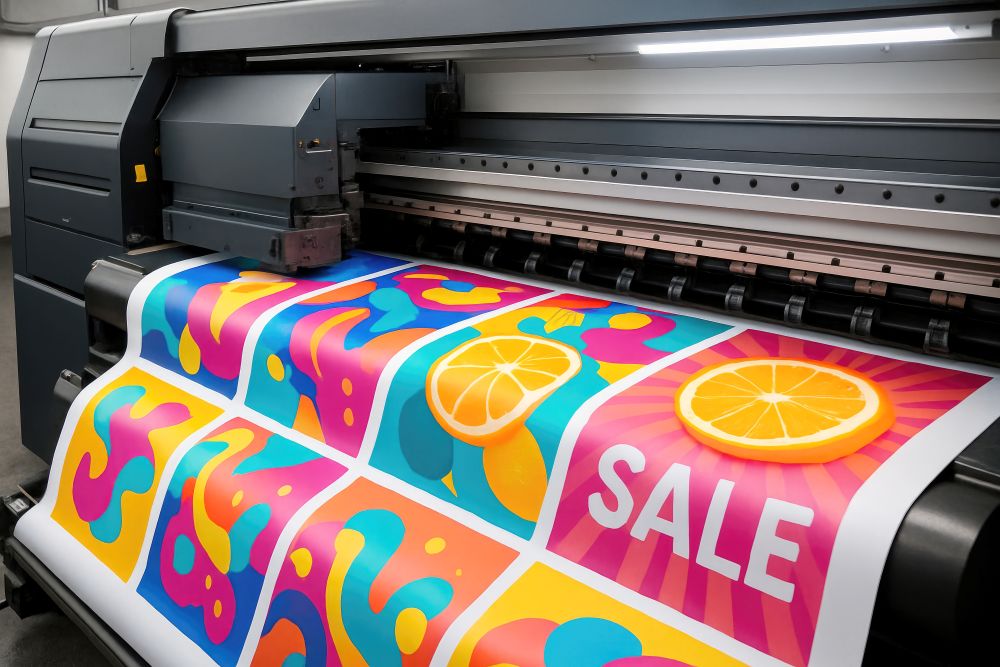
Every small business wants to stand out in a crowded market. Whether it’s catching the attention of people walking past your store or making a lasting impression at an event, visibility matters. Large-format printing can help make that happen.
From bold banners and window graphics to custom posters and vehicle wraps, large-format prints are powerful tools for promoting your brand. They draw attention, share your message clearly, and help people remember who you are. For small businesses looking to grow their reach, this form of advertising is both eye-catching and cost-effective.
In this guide, we’ll explore how large-format printing can boost your brand visibility and attract more customers. Read on for the details!
Partner With a Reliable Print Provider
Working with a professional print provider can make your marketing materials look polished and consistent. A reliable large-format printer can help you select the right materials, adjust color tones, and ensure your visuals align with your brand identity. They may also guide you on the best materials to use, depending on the design’s purpose and where it’ll be displayed.
Local print shops with large-format printers can offer hands-on advice about materials and finishing options. Some may specialize in digital large or wide-format printing, which can give your designs high-quality detail while keeping the printing cost reasonable. Building a good relationship with your printer can also make it easier to refresh your visuals when your business updates its campaigns.
When looking for a printing partner, choose a reputable provider, such as Wallace Print Kent, which has experience with both large-format printing and custom printing solutions. A good provider will offer expert advice to help you find the right balance between quality and cost.
Use Eye-Catching Storefront Graphics
Your storefront is often your best advertising space. Large window graphics or wall decals made through large-format printing can make your shop look lively and professional.
You can display your logo, slogan, or seasonal offers using adhesive vinyl materials that are easy to remove or replace. If your business is on a busy street, bright colors and bold designs can turn heads.
Choose clear, readable fonts and limit text to your key message. A professional poster printing setup or flatbed printers can give your designs sharp edges and vivid colors that look inviting from a distance. These touches can make passersby curious enough to step inside.
Design Branded Displays for Trade Shows and Events
Trade shows, markets, and community events can be valuable opportunities for small businesses to make a lasting impression. Large-format printing allows you to create branded backdrops, pull-up banners, and table covers that present your business in a professional manner.
These visuals attract attention and help people remember your brand long after the event. A well-designed booth with consistent branding can help you stand out among competitors and provide visitors with a clear idea of what you offer. Reusable displays can also save money over time while keeping your presentation sharp.
Take Advantage of Banners for Promotions and Events
Banners can be an affordable yet powerful way to spread your message. Whether you’re announcing promotional products, sponsoring an event, or celebrating a milestone, large-printed banners can reach a wide audience in public spaces.
Place banners in high-traffic areas where they’ll be visible to both drivers and pedestrians. A concise message, paired with a clean layout and a bold headline, can help people quickly understand what you’re offering. Reusable materials, such as vinyl, can also make it easier to store and re-display banners for recurring events or seasonal promotions.
Enhance Interiors With Branded Wall Graphics
Brand visibility doesn’t stop outside your business. Interior graphics can strengthen how customers experience your brand once they step in. Large-format wall prints, murals, or decals can display your logo, tagline, or even your brand’s story.
These visuals can make your space more inviting and memorable. For example, a café might use wall art featuring coffee beans or quotes about community, while a fitness studio could display motivational messages. Thoughtful interior prints can make your brand part of the atmosphere rather than just a name on a sign.
Create Standout Signage That Draws Attention
Signs are one of the most direct ways to improve brand visibility. A large, well-placed sign can make your business easily visible, even in a busy area. With large-format printing, you can customize signage for various purposes. This could include directional signs, building facades, or outdoor displays.
Consistent branding matters here. Use your logo, brand colors, and fonts to build recognition. Over time, customers may begin associating your visual style with your products or services. High-quality signs also send a message that your business is established and professional, helping build trust.
Use Point-Of-Sale Displays To Reinforce Your Message
Point-of-sale (POS) displays made through large-format printing can guide customers toward key products or big sale promotions. Posters or standees near checkout counters can encourage impulse purchases or highlight loyalty programs.
POS displays are most effective when they’re clear, engaging, and visually aligned with your brand. Even small-scale, large-format prints, such as countertop signs, can make a huge difference when strategically placed. The goal is to remind customers who you are and what makes your brand unique at every step of their visit.
Turn Vehicles Into Rolling Advertisements
Your car, van, or delivery vehicle can become a moving advertisement through large-format printing. Custom vehicle wraps or decals can feature your logo, slogan, website, and contact information. Each time you’re on the road, your brand can reach new potential customers.
This approach can be more effective for service-based businesses, such as plumbers, cleaners, or local delivery companies. Even partial wraps or small decals can boost brand visibility without requiring a complete design. It’s a cost-effective way to keep your brand present wherever you travel.
Conclusion
Large format printing offers small businesses an affordable way to increase visibility and attract customers. From banners and vehicle wraps to storefront graphics, these tools keep promoting your brand 24/7.
Start with one or two formats that align with your budget and goals, and then expand from there. With the help of a reliable print provider, you can create professional, eye-catching materials that reflect your brand’s personality and connect with more people.
8 Benefits of Combining Print‑on‑Demand with EDDM for Small Campaigns
The benefits of combining print on demand with EDDM (Every Door Direct Mail) show up in the little things you don’t notice at first. You don’t overprint. You don’t stash a ton of extras in a closet. You just make what you need and send it out – easy as that. And for anyone running a small campaign, this combination quietly takes the pressure off.
Intrigued? We thought so. That is why we have compiled 8 clear ways this approach makes small campaigns work better. On top of that, you will also get 8 practical strategies to plan and run your campaign with POD and EDDM together.
8 Proven Benefits Of Combining Print‑on‑Demand With Every Door Direct Mail
Here are 8 reasons why combining print-on-demand with EDDM works so well for local outreach.
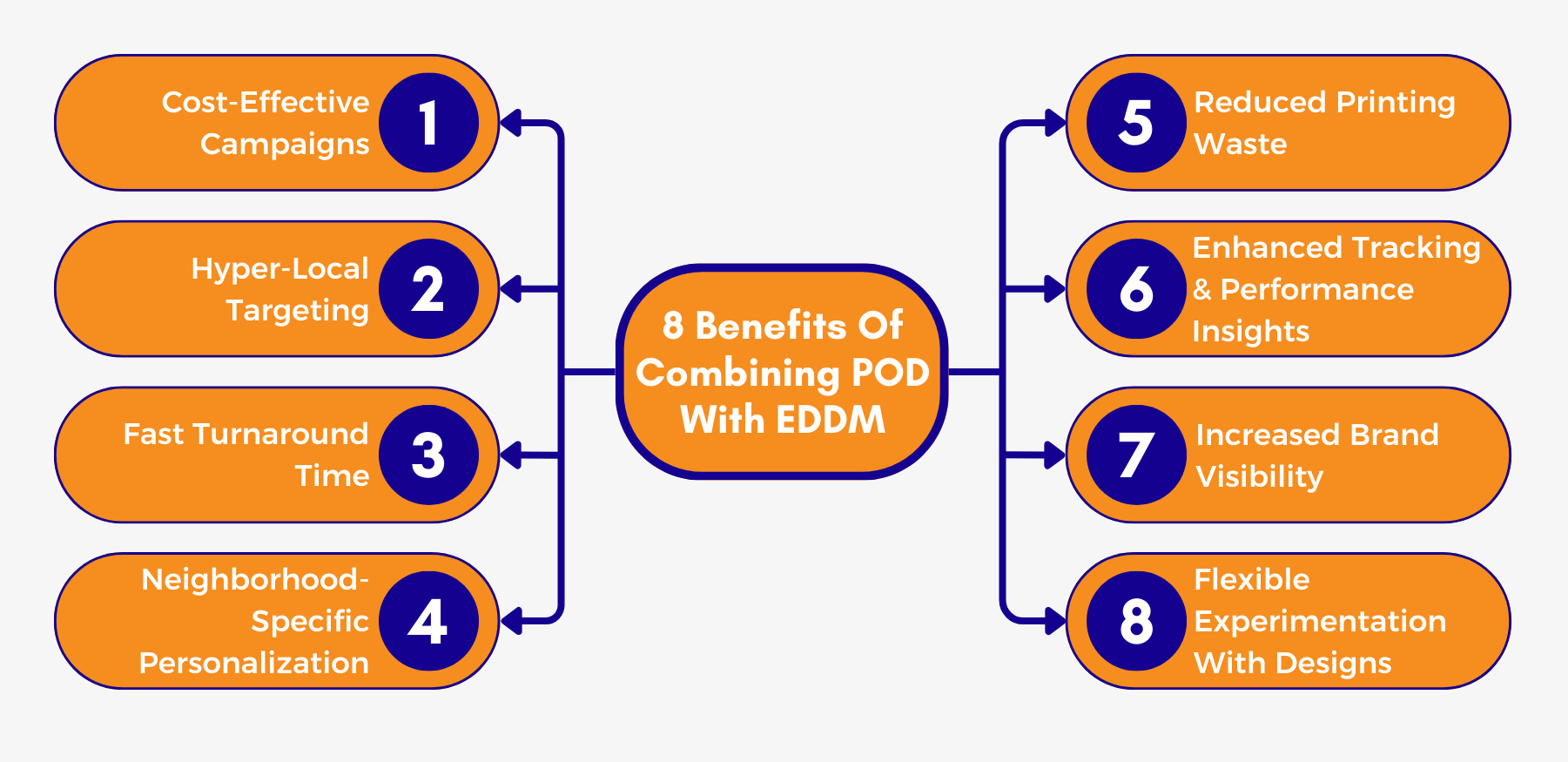
1. Cost-Effective Marketing Campaigns With Minimal Upfront Investment
The problem with traditional print ads is that you are forced to order thousands of pieces just to get a decent price per unit. Most of them are unused or end up in the trash. With print-on-demand, you cut that problem out entirely – you only print what you need right now.
Pair that with EDDM, and you don’t have to buy or rent a mailing list. The United States Postal Service (USPS) already has the delivery routes mapped out for you. For a small campaign, that means you stay lean and avoid the financial dead weight that usually eats into ROI.
Here’s how this marketing strategy works for local businesses:
A salon can print 300 postcards for one postal route instead of overordering 5,000.
A gym can test two different offers in two neighborhoods without paying extra for printing twice.
You spend less upfront and keep cash free for other parts of the campaign, including your ongoing digital efforts.
2. Hyper-Local Targeting Without A Mailing List
Buying a mailing list sounds good until you realize how messy it gets – outdated addresses, duplicates, and flat-out irrelevant. With EDDM, you skip all that. USPS delivers to every home or business on the route you choose.
For a small campaign, that is priceless. You decide exactly where your message goes – down to a few streets if you want. And when you tie this to print-on-demand, you can easily change what you are sending for different routes without ordering thousands of extra copies.
That means every drop feels tailored to the target audience you actually want to reach, not just whoever happens to be on a rented list.
Think about it like this:
A pizza shop can target every house within one ZIP code.
A cleaning service wants to target only residential routes, skipping businesses – that is an option too.
3. Fast Turnaround Time
One of the biggest headaches in small campaigns is timing. You get an idea for a promotion, but by the time the printed materials are ready to mail, the moment has passed. Print-on-demand cuts production down to just what you need, and EDDM works on USPS schedules that are already set.
That means you can move quickly from design to delivery. In many cases, you can have your postcards printed and on their way to mailboxes in under a week.
This is especially useful for:
Seasonal events (back-to-school specials, holiday sales, local festivals).
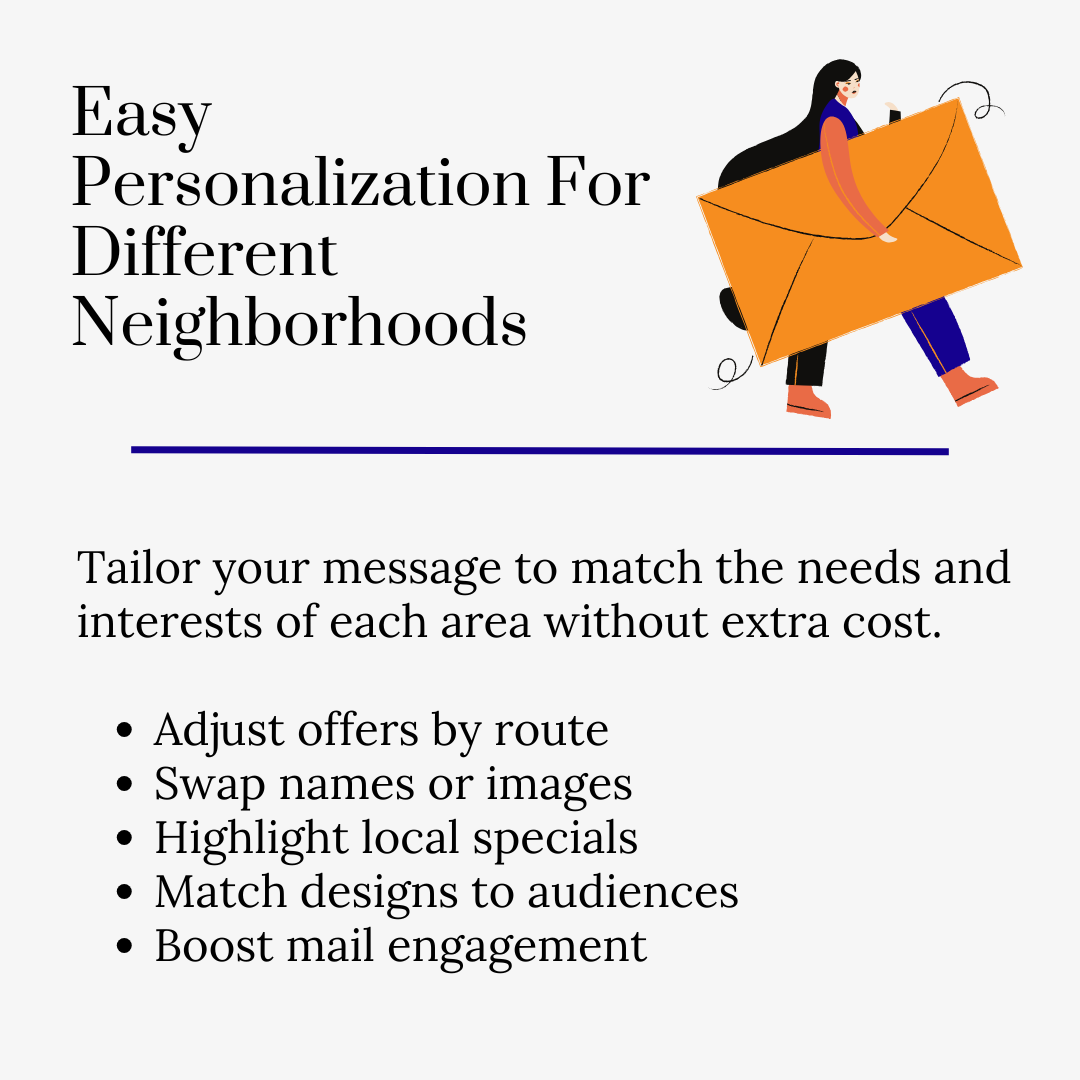
4. Easy Personalization For Different Neighborhoods
Not every neighborhood responds the same way. Maybe one neighborhood wants discounts, while another prefers community involvement. With print-on-demand, you can easily change your design or offer for each route.
And with variable data printing (VDP), you can even swap out details like names, images, or codes to make each piece more personal. Because you are not stuck with a massive bulk order, tweaking your campaign doesn’t cost extra.
Here’s how it works in practice:
A restaurant can promote “kids eat free” in family-heavy neighborhoods and “happy hour deals” in areas with more young professionals.
A landscaping service can highlight “lawn care specials” in suburban areas and “snow removal” in regions that need it during winter.
This makes your mail more relevant and increases the chances people actually read it instead of tossing it. And since EDDM gives you the delivery routes, it is easy to match each version with the right area.
5. Reduced Printing Waste & Inventory Risks
Nothing wastes a marketing budget faster than ordering 5,000 postcards and realizing you will only use half. Traditional print advertising locks you into bulk orders, and whatever doesn’t get used either clogs up storage or ends up in the trash. With print-on-demand, you only print what the campaign calls for.
EDDM adds another layer of control – you know exactly how many homes or businesses are on a given postal route before you place your order. If a route has 325 addresses, you print 325 pieces. This way, you can start with one or two routes. If the response looks good, print more and expand.
6. Enhanced Tracking & Performance Insights
A lot of people assume mail can’t be tracked. That is only true if you don’t set it up right. With POD and EDDM, you build the system into your mailers, just like in digital marketing campaigns.
Over time, you will know which neighborhoods are generating leadsand which ones aren’t pulling their weight. For small campaigns, that insight keeps you from repeating mistakes and lets you focus on what works.
7. Increased Brand Visibility In Local Communities
People don’t always buy the first time they see you. Sometimes they need 3 or 4 touches before they act. Every Door Direct Mail campaigns put you in mailboxes repeatedly, and POD makes it easy to refresh your design each round so you don’t look stale.
This is how local visibility builds:
First mailing → your local customer base notices your name.
Second mailing → they start to recognize you.
Third mailing → you are familiar enough that they consider you when they need your product or service.
It is about planting a flag in the neighborhood. When your piece keeps showing up in the same community, your business feels present and established, even if you are still small. This visibility also reinforces the consistency people see in both print and online ads, and makes your brand harder to forget.
8. Flexible Experimentation With Designs & Offers
The old way of commercial printing kills experimentation. Once you have printed thousands of pieces, you are stuck with that design, whether it works or not. With the POD + EDDM combination, you can split your runs or change your messaging to test what works best.
Some real ways small campaigns can use this:
One neighborhood gets “$10 off,” another gets “Buy 1 Get 1 Free.” See which converts better.
Bright colors vs. minimal design. Do people respond more to loud or clean?
“Call us today” vs. “Visit our website.” The tracking methods you set up (codes, QR, numbers) will show what works.
Because you are printing in smaller batches, the cost of testing is minimal. And the payoff is huge – you find out what actually works instead of guessing.
How To Plan A Small Campaign By Combining Print‑on‑Demand With EDDM
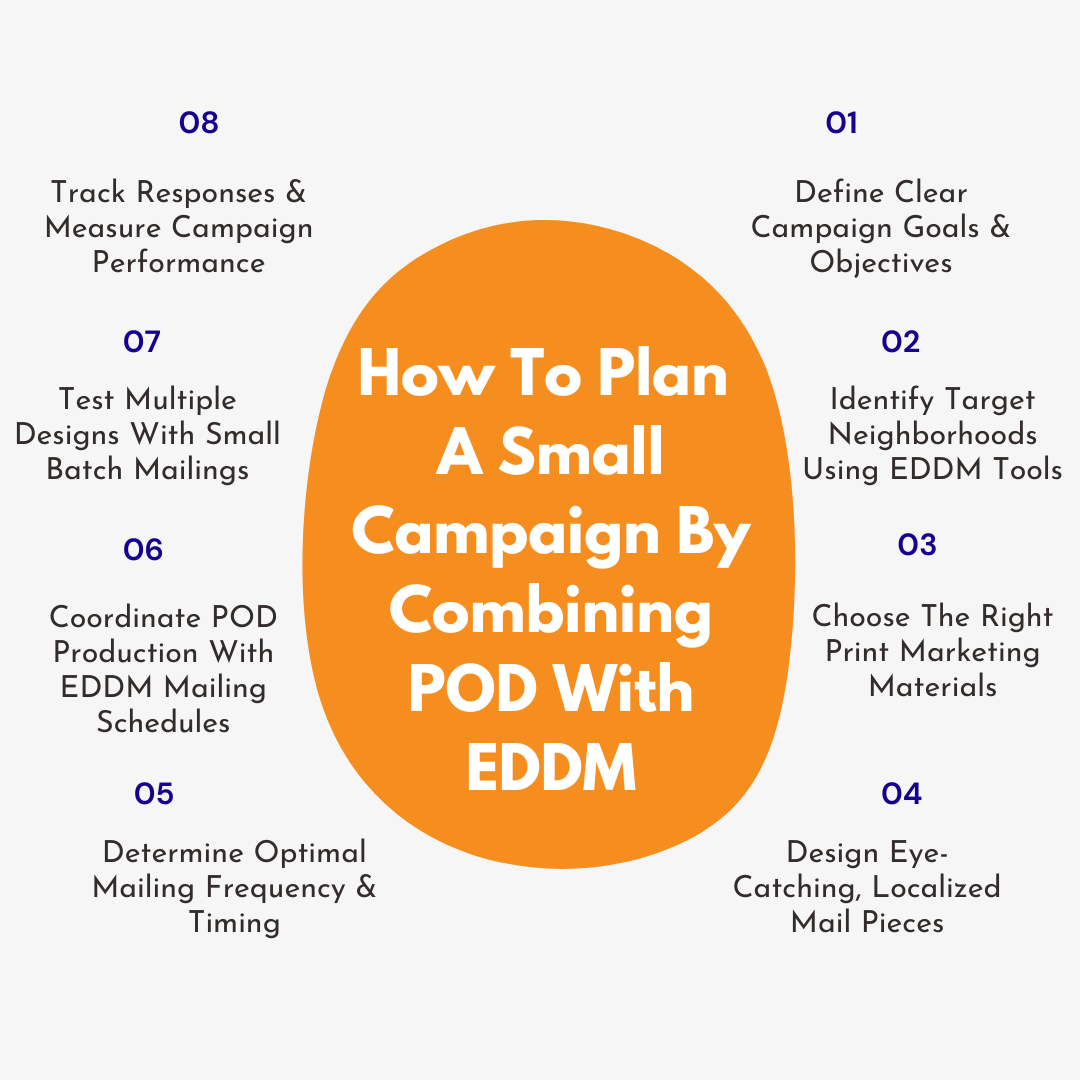
Here are 8 proven strategies that show you exactly how to plan and run a print-on-demand + EDDM campaign that is targeted and effective.
1. Define Clear Campaign Goals & Objectives
Before you start designing postcards or picking routes, you need clarity on what you want out of the campaign. Too many small campaigns fail because they are vague. And no, “get more customers” isn’t a goal.
Get specific:
Do you want 20 new leads within a month?
Are you pushing a seasonal promotion for a set weekend?
Is the goal to introduce your brand in a new area rather than get immediate sales?
Write down one primary goal and one secondary. This helps you decide how many routes to cover, what your offer should be, and how much to spend on printing.
2. Identify Target Neighborhoods Using USPS EDDM Tools
USPS EDDM provides an online tool that maps every postal route with demographic data. This lets you see the number of households and whether a route is mostly residential or commercial.
Here’s how to make the most of it:
Look at demographic filters like average household income, age brackets, or number of businesses vs. residences on a route.
Select only the routes that match your customer profile. For example, a daycare should focus on residential-heavy routes, while a B2B service might target business-heavy routes.
Keep it manageable. For a first run, limit yourself to 1–3 routes so you can measure results without overspending.
3. Choose The Right Print Marketing Materials For Your Campaign
Print-on-demand isn’t just about postcards. You have options, and the product you choose should match your marketing objectives.
Some examples are:
Postcards → Best for direct offers and coupons.
Flyers → More space for service lists or detailed event info.
Brochures → Useful if you are introducing a new business and need to tell your story.
Oversized pieces → Stand out in the mailbox and grab attention faster.
Pro tip: Don’t overcomplicate. Pick one format, and keep the quantity tight for your first run. Once you see response rates, you can expand into other products.
Now, what works for a pizza shop doesn’t work for a niche service. Take this real estate cost segregation study services. If they send out a standard postcard, they barely have room to explain what the service even is, let alone why a property owner should care. Same with flyers – they give more space, but they still feel like a quick pitch.
For something this technical and high-value, a well-designed brochure is the smarter move. It gives enough room to show real examples and answer the “why should I care?” question. A brochure feels more professional, too, which matters when you are talking about tax strategies and real estate investments.
The point is simple: match the material to the message. For cost segregation, a brochure beats a postcard every time. For a pizza coupon, the postcard wins. POD gives you flexibility, but the choice you make on format is what determines whether the campaign feels credible or forgettable.
4. Design Eye-Catching, Localized Mail Pieces
Use your design to tell a story that connects with each neighborhood. Digital storytelling techniques work just as well in print. So follow those methods, and people will remember your mailer and feel like it was made for them.
Remember, your design is the difference between someone throwing away your mailer or actually reading it. With POD, you can adjust quickly – so put that flexibility to use.
What works:
Clear, bold headline → State the offer or benefit right away (e.g., “20% Off Lawn Care This Month”).
Localized touches → Mention the neighborhood by name or include a local landmark photo to make it relevant.
One call-to-action → Too many instructions confuse people. Decide: call, visit, or scan.
Readable layout → Avoid cramming in long blocks of text. Use space so the main message stands out.
If you are not a designer, most POD platforms have templates that can be customized.
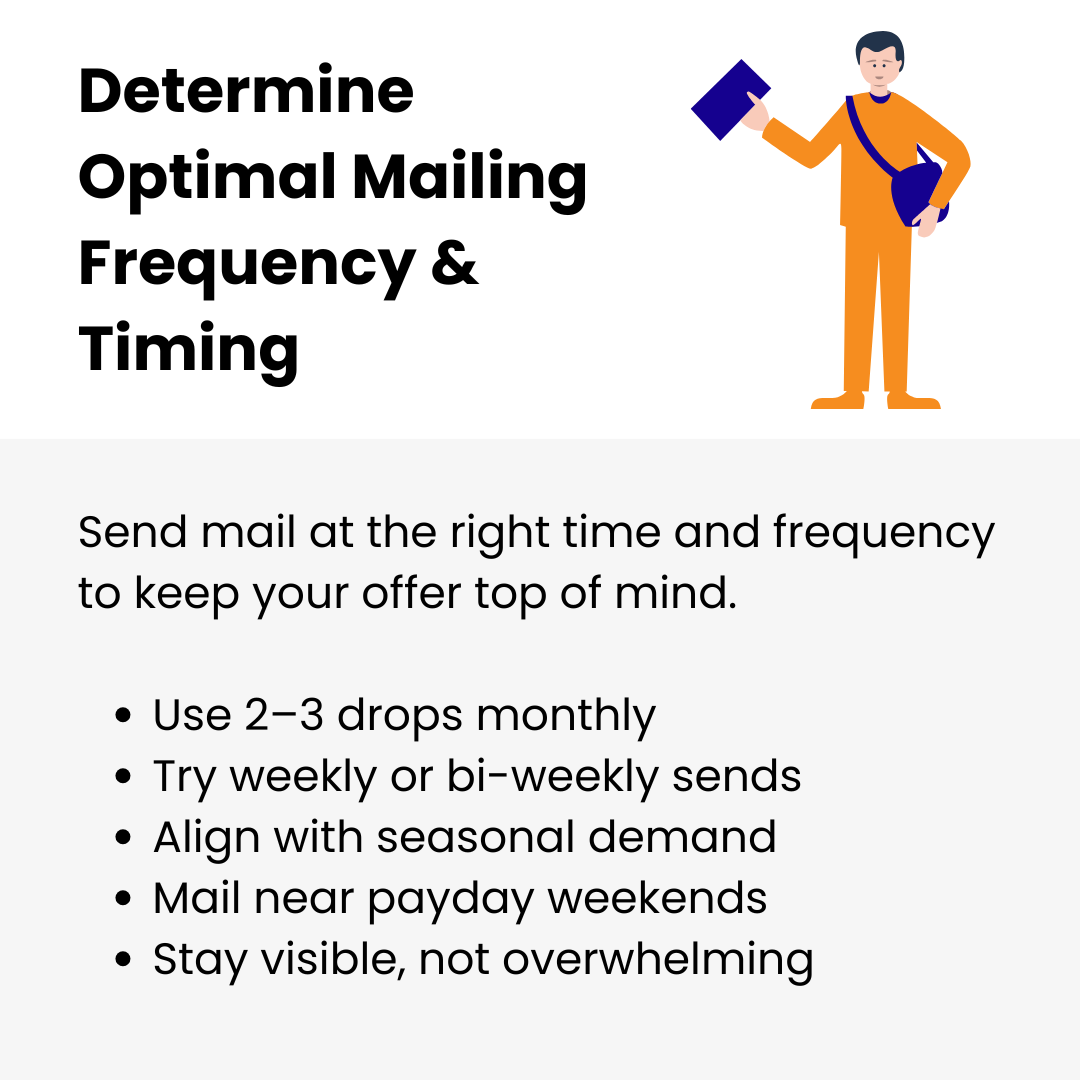
5. Determine Optimal Mailing Frequency & Timing
A single drop usually isn’t enough to make potential customers act. Mail gets noticed more when it shows up a few times, spaced out just right. For a small campaign, two to three drops across a month works better than one big blast.
Weekly or bi-weekly drops across the same routes keep your offer visible without overwhelming direct mail recipients.
Seasonal businesses should schedule campaigns around peak demand. For example, lawn care right before spring or holiday catering two weeks before December events.
Track your own local calendar. Mailing right after payday weekends boosts redemption for service-based offers.
Of course, this kind of precision matters across all industries, but it becomes absolutely critical when you are dealing with life-saving products. Take medical alert systems, for example. Families don’t just see one ad and place an order the same day. The decision carries weight because someone’s life may depend on it. That is why consistent exposure is so powerful.
When people are choosing mobile personal emergency response systems, they need to trust the brand. And trust doesn’t come from a single postcard or one online ad. It builds over time, as your name keeps showing up in the mailbox, and the design feels fresh each round.
That repeated presence makes your business look stable and dependable – two qualities buyers value most when the stakes are high. And here’s where POD combined with EDDM really works. You can adjust the message slightly each mailing – maybe one round focuses on reliability, the next on ease of use, and another on customer support.
By the time someone is ready to make the purchase, they have already connected your brand with safety and credibility.
6. Coordinate POD Production With EDDM Mailing Schedules
Print-on-demand gives you flexibility, but timing is everything. USPS has specific drop-off requirements, and if production is late, your campaign stalls. Always work backward from your planned drop date.
Place your POD orders at least 2–3 days before the planned USPS acceptance date.
Confirm the printer’s turnaround time and shipping speed to the local USPS entry unit.
For recurring campaigns, set up a repeating order schedule so new batches roll off automatically.
7. Test Multiple Designs With Small Batch Mailings
Making random calls on design is a fast way to waste money. POD makes testing cheap, so use it. Print a few hundred of two or three variations and spread them across different routes.
Here’s an example setup:
Version A: bold headline, minimal copy.
Version B: lifestyle image, short benefit statement.
Version C: heavy offer focus with a coupon.
Track which one pulls better. The winner becomes your template for larger runs. This way, every campaign doubles as research instead of just spending.
In some industries, if you skip testing and go with the wrong design, it can actually hurt your reputation. Let’s take the example of this emergency notification app from DialMyCalls. If they decide to run a POD + EDDM campaign in their local community, the way they frame their message matters a lot.
One design focuses too much on flashy graphics, but downplays how quickly the app can send alerts. Another puts all the emphasis on price, but forgets to highlight reliability. Both versions miss the mark.
If those mailers hit the wrong note, the audience might think the app is just another generic tool and not the reliable safety net it actually is. For a product tied directly to emergencies, that is a big problem – you don’t want your first impression to create doubt.
The smarter move is to use POD for what it is best at: low-risk testing. Send a smaller batch of each design, track the responses, and pay attention to what actually makes sense to the local community. That way, when you scale up, you are rolling out a proven message that builds trust instead of eroding it.
8. Track Responses & Measure Campaign Performance
Similar to digital channels, there is no way to tell what worked if you are not tracking. A simple system is enough, as long as it ties responses back to the mail piece.
Ways to track effectively:
Assign unique coupon codes for each route.
Use QR codes linked to route-specific landing pages.
Track call volume with route-specific phone numbers. Use VoIP as a secure channel to capture responses while protecting your main contact.
At the end of the campaign, measure response rates against the goals you set in step one. If one route or design outperformed the rest, you have a proven direction for your next mailing.
Now, here’s where a lot of small businesses stall out. On paper, tracking sounds easy, but setting up and actually monitoring every bit takes extra hand. And if you try to do it yourself, it slows everything down.
That is why it helps to augment your team just for this part of the job. Bring in a marketing assistant who can get everything done without distracting your main team, and you still end up with the insight you need to make sharper decisions for the next round.
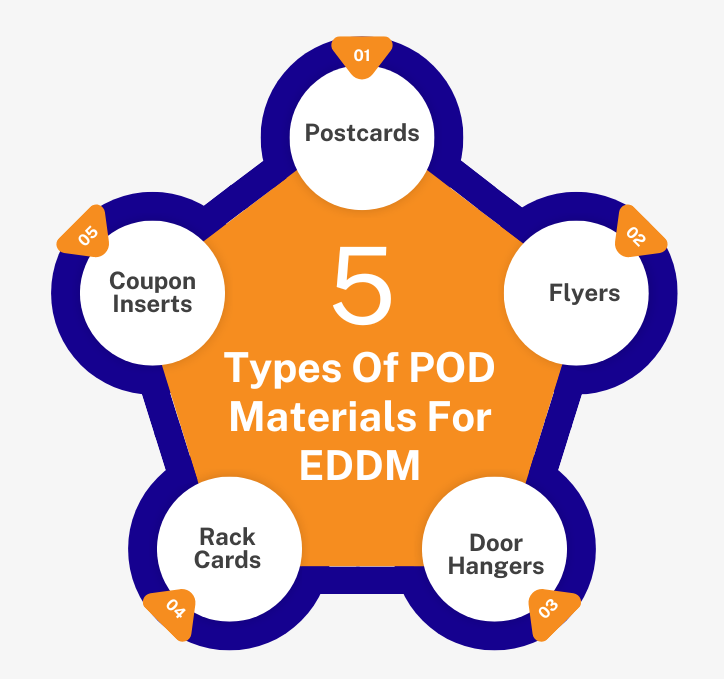
5 Types Of Print‑on‑Demand Materials Ideal For EDDM
Just like in digital strategies, not every print piece works the same way. To help you pick smart, here are 5 types of print-on-demand materials that fit perfectly with EDDM marketing efforts.
1. Postcards
Postcards are the perfect format for EDDM because they qualify for the lowest postage rates and hit the mailbox without an envelope hiding them. For small campaigns, oversized postcards (6.5” x 9” or bigger) usually get noticed faster than standard ones. They are best for straightforward offers like “20% off this month” or “Grand Opening.”
Pro Tip: Keep the headline short and bold on one side. Save details for the back. Don’t overload both sides – it weakens impact.
2. Flyers
Flyers give you more room when you need to explain something, like service menus, class schedules, or event lineups. They fold easily, so you can tuck in sections for different information. Flyers work well in neighborhoods where people might pin them to a fridge or bulletin board.
Pro Tip: When designing a flyer, use one clear section for the main offer and a secondary section for details. Too much text everywhere, and the piece goes unread.
3. Door Hangers
Door hangers don’t go through the mailbox, but they are still deliverable through targeted routes if you want to supplement EDDM. They are harder to ignore because they hang right at eye level. Restaurants, cleaning services, and local repair businesses see higher pickup rates with door hangers.
Pro Tip: Make the hole punch reinforced so it doesn’t tear. And always put the call-to-action at the bottom, where hands naturally land when removing it.
4. Rack Cards
Rack cards are slim but sturdy, which makes them perfect for concise messaging. They stand out in the stack of typical mail because of their vertical shape. They work best when you are pushing one or two services and don’t need a ton of copy.
Pro Tip: Use thick stock so they don’t bend. Keep the front clean with one key message. Put the fine print or extras on the back.
5. Coupon Inserts
If the goal is quick response, coupons do the job. POD makes it easy to test different versions ($5 off vs. 10% off) and see what actually gets redeemed. They are small, but people keep them longer than a flyer if the offer is good.
Pro Tip: Always add an expiration date. It creates urgency and also makes it easier to measure redemption within your campaign window.
Conclusion
The real benefits of combining print on demand with EDDM come down to control. You decide how many pieces leave the printer, and you choose exactly which routes will see your message. That is the flexibility most small campaigns rarely get. So to get the most out of these marketing channels, keep goals realistic and tweak things based on the results.
If you need someone to make the whole process easier, we at Catdi Printing can help. We’re a true one-stop print + EDDM shop, covering everything from postcards and flyers to door hangers and rack cards. Fast turnaround, affordable pricing, and human-centered service mean you get your campaign rolling without headaches.
Reach out now and get a free quote to put your next campaign in motion.
Using AI to Personalize Direct Mail: Increasing ROI 4X Over Standard Campaigns
Direct mail isn’t what it used to be. We are way past the “Hey [First Name]” thing. Brands now use AI for direct mail personalization to pull off things that feel eerie in a good way. Timing is spot on. The message is freakishly relevant. And that is how ROI just multiplies.
Intrigued? We thought so, and that is why we put this guide together. We will show you how AI connects online behavior to offline outreach and how you can use it to create moments that feel too perfect to be a coincidence.
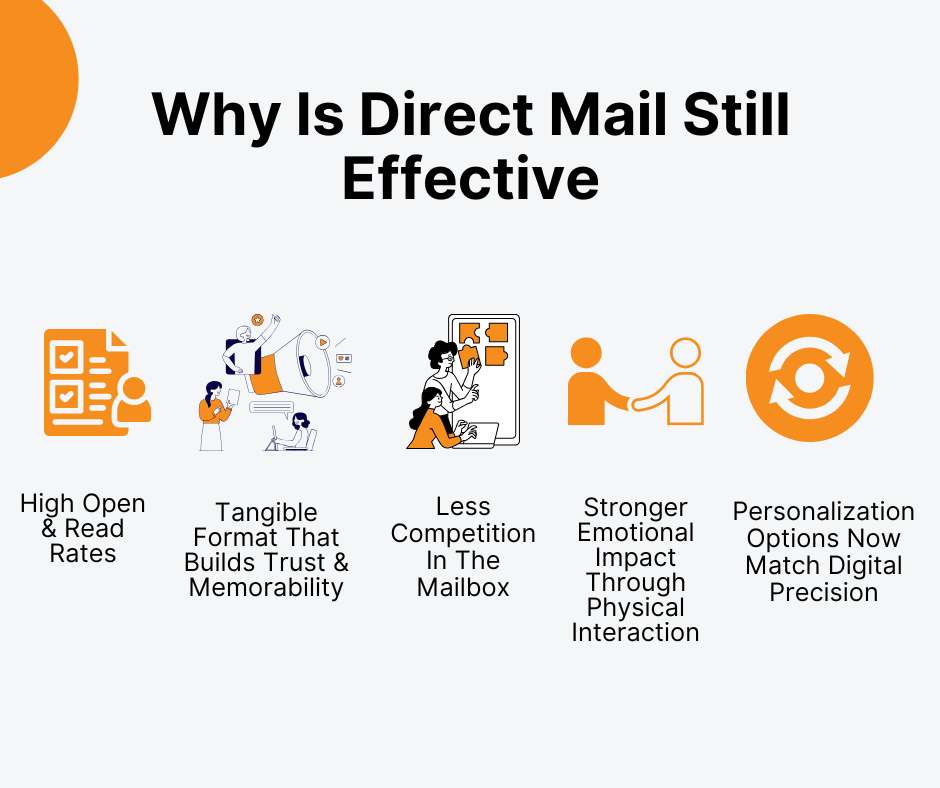
Why Is Direct Mail Still Effective For Brands & Consumers
People keep predicting the “death” of direct mail, but it is quietly outperforming in places where digital marketing channels are hitting a wall. It is not nostalgia, and it is not about being “old-school.” Let’s break down why it is still a heavy hitter for both brands and consumers.
1. High Open & Read Rates Compared To Email Marketing
Most marketing emails are lucky to get opened by 20% of recipients. But around 90% of direct mail gets opened, and people actually read it. There is no spam folder for your mailbox, and most people at least glance at every piece of mail they get.
For brands, that is a massive visibility advantage. For consumers, it means they are not bombarded with hundreds of competing messages at once.
2. Tangible Format That Builds Trust & Memorability
Holding something gives it weight – literally and figuratively. A postcard or brochure feels more “real” than a pop-up ad. Studies show people trust printed material more, and they are 70% more likely to remember it longer than an online ad. That tangibility makes the brand feel established and worth paying attention to.
3. Less Competition In The Mailbox Means Higher Visibility
Email inboxes are overflowing. Social feeds are endless. Your physical mailbox has a handful of items a day. That scarcity works in your favor. Fewer competitors in the mailbox means your marketing content is seen and, more importantly, noticed.
4. Stronger Emotional Impact Through Physical Interaction
There is a sensory experience in opening an envelope or flipping through a catalog. The texture, the colors, even the smell of fresh print – it is a different kind of engagement that triggers stronger emotional and meaningful connections. When something feels personal and crafted, people are more likely to form a bond with the brand.
5. Personalization Options Now Match Digital Precision
This is where it gets exciting. With AI tools for direct mail personalization, brands can target as sharply as they do online. Names, purchase history, browsing behavior, even life events – these can all be used in direct mail marketing that is perfectly timed and highly relevant.
The result is a stronger response rate and ROI that can blow past standard direct mail marketing campaigns.
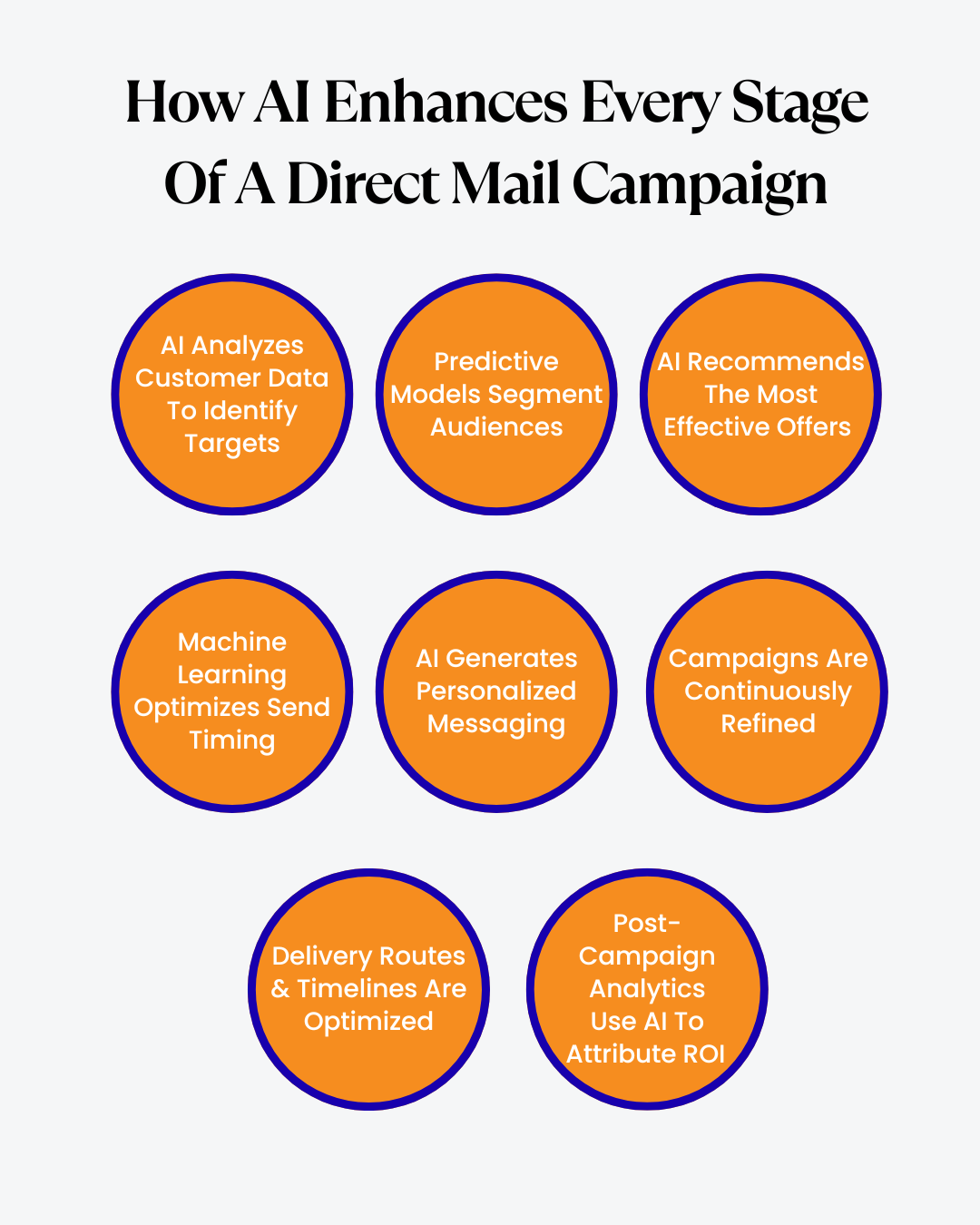
How AI Enhances Every Stage Of A Direct Mail Campaign
Artificial intelligence rewires the entire direct mail process. Instead of treating a campaign like one big blast to everyone on a list, AI turns it into a series of precise steps that make every piece of mail count. Here’s how AI in direct mail works at each stage.
1. AI Analyzes Customer Data To Identify High-Value Targets
Before any direct mail piece even hits a printer, AI is already at work going through massive amounts of historical data. We are talking purchase history, browsing patterns, loyalty program activity, email engagement, demographic details – basically, every digital breadcrumb someone leaves behind.
AI looks for deeper signals that separate casual customers from those who are likely to deliver serious, long-term value. For example, it can pick up on repeat purchase cycles or the kind of engagement that suggests a customer is about to move into a higher-spending bracket.
Instead of guessing who should be on your mailing list, AI integration helps pinpoint the exact people who are statistically most likely to spend and keep buying. That means your print budget isn’t wasted on people who barely remember your brand.
2. Predictive Models Segment Audiences Based On Behavior & Interests
Once the high-value targets are identified, predictive analytics sorts them into smaller, more accurate audience segments based on how they think and interact with your brand.
Behavior is a huge factor here. Someone who frequently engages with eco-friendly products isn’t going to react the same way as someone who always buys the latest tech. AI algorithms pick up on these patterns automatically and create segments that go far beyond basic age or location demographics.
It also factors in interests that might not be obvious at first glance. For instance, maybe a customer hasn’t directly bought running gear from you, but their browsing activity shows they have spent time looking at it. Predictive models notice those past interactions and group people accordingly, so you end up with more precise targeting from the start.
3. AI Recommends The Most Effective Offers For Each Customer Profile
Here’s where it gets interesting. It analyzes what each customer profile is most likely to respond to, then recommends the exact offers that will get the best reaction.
This isn’t just “send a discount to everyone.” AI considers how sensitive a customer is to price drops and whether they respond better to free shipping or early access. It can even show what product bundles might feel irresistible to them.
The perfect example here is a two-audience marketplace like BusinessForSale. They cater to two very different groups through direct mail – sellers who want maximum exposure for their listing, and buyers searching for the right investment opportunity.
Those two mindsets require completely different mail offers. A seller might respond to a postcard promoting a free premium listing upgrade, while a buyer might be swayed by a direct mail flyer offering early access to newly listed businesses in their preferred category. AI detects these differences instantly, so each mailing feels timely and relevant.
Even within one audience, AI uncovers micro-patterns. One buyer might only open direct mail about hospitality businesses under $500k, while another engages with anything related to manufacturing opportunities over $2M.
Instead of sending the same generic mailer, AI ensures each recipient gets an offer that matches their exact investment criteria. That is how a two-audience marketplace avoids wasted mailings and turns every single piece into a direct path toward conversion.
4. Machine Learning Optimizes Send Timing For Maximum Engagement
Even the most perfect offer can flop if it is sent at the wrong time. This is where machine learning figures out exactly when each segment or even each individual customer is most likely to engage with your physical mail piece.
It looks at past customer engagement patterns and timing of past successful responses to pinpoint optimal send windows. For example, some customers might be more receptive right before payday, while others respond better to weekend deliveries when they have time to browse and shop.
Over time, machine learning keeps refining its timing recommendations based on what actually works, so each new campaign gets sharper and more in tune with your audience’s real-world habits. That way, your mail arrives when people are most ready to act on it.
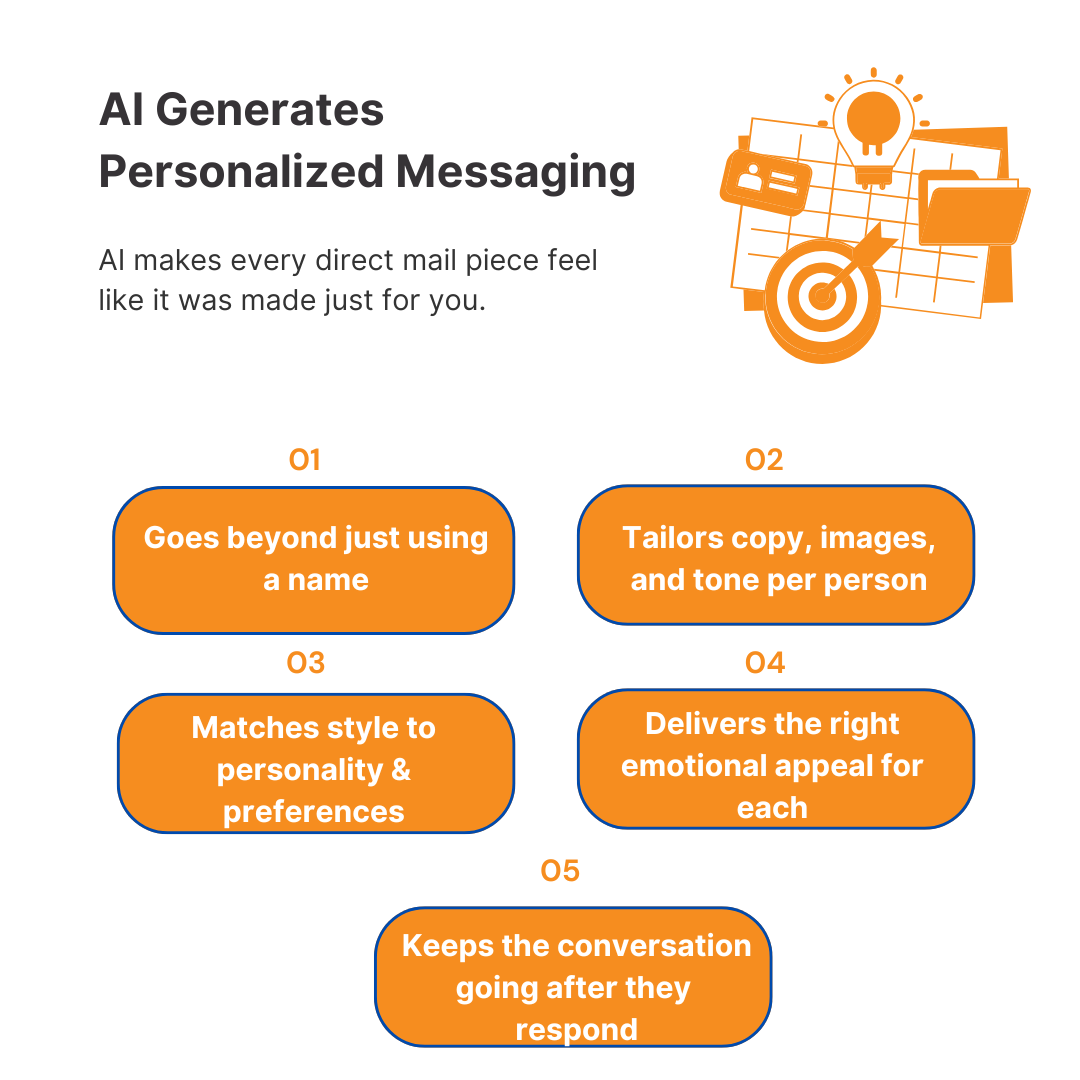
5. AI Generates Personalized Messaging For Each Recipient
When people hear “personalized,” they usually think, Oh, you mean putting my name at the top? Yeah… AI is working on a whole different level. It pulls in every scrap of insight it has on a person and then uses it to create highly personalized messages that are unique to them.
Two people could get mail about the exact same product, but the way it is written, the images shown, the headline, and even the tone could be completely different. One person might get a bold, high-energy pitch with short sentences and bright visuals. Another might see a calmer, story-driven piece that leans into quality and craftsmanship.
And the use of AI in personalization is just the starting point. When the customer responds to your direct mail offer, AI can keep the conversation alive and moving toward a conversion.
To understand it better, let’s consider Rosie. Through its AI-integrated call services. Rosie answers calls 24/7, even after hours, with a natural, human-like tone that is trained on your product and offer.
Every call is handled in context, so if someone is responding to a specific direct mail promotion, AI can capture that information and ask qualifying questions you have set in advance. It can even route the lead to the right next step.
This way, AI makes it easy to connect offline responses from direct mail to your online sales process without adding more workload to your team.
6. Campaigns Are Continuously Refined Through Automated A/B Testing
Old-school A/B testing was slow. You would pick two versions, send them out, wait weeks, and then maybe learn something for next time. AI isn’t that patient.
With automated A/B testing, the system is running dozens of micro-tests in the background the moment your campaign starts – all without you sitting there swapping things manually.
The second it sees one version pulling ahead, it shifts the rest of your active campaign toward the winning version right away. That means people who haven’t gotten your mail yet are already going to get the stronger, more effective version before the ink on the first batch has even dried.
7. Delivery Routes & Timelines Are Optimized Using AI Logistics
Once your mail is printed, it still has a journey to make, and that journey can be full of delays and inefficiencies.
AI handles the boring-but-critical logistics side and figures out the fastest, most reliable way to get each piece from printer to mailbox. It can pull in data from postal services and outside factors like weather forecasts or known bottlenecks in certain regions.
If that means rerouting through a different sorting facility or adjusting the mailing sequence so certain regions get priority, it will make the call. The result is more mail landing when it is supposed to and fewer “Where is my package?” complaints.
8. Post-Campaign Analytics Use AI To Attribute ROI & Guide Next Steps
Once it is all over, AI can analyze campaign performance and piece things together between someone receiving your mail and them taking action, even if that action happens weeks later. It can separate the people who bought because of your campaign from those who would have bought anyway.
And you can use it for identifying patterns, like a certain product unexpectedly driving a spike in repeat purchases.
This isn’t just about patting yourself on the back for a good ROI. It is about having a crystal-clear picture of what is working, so the next campaign is built on connected data that direct mail automation has already pieced together for you.
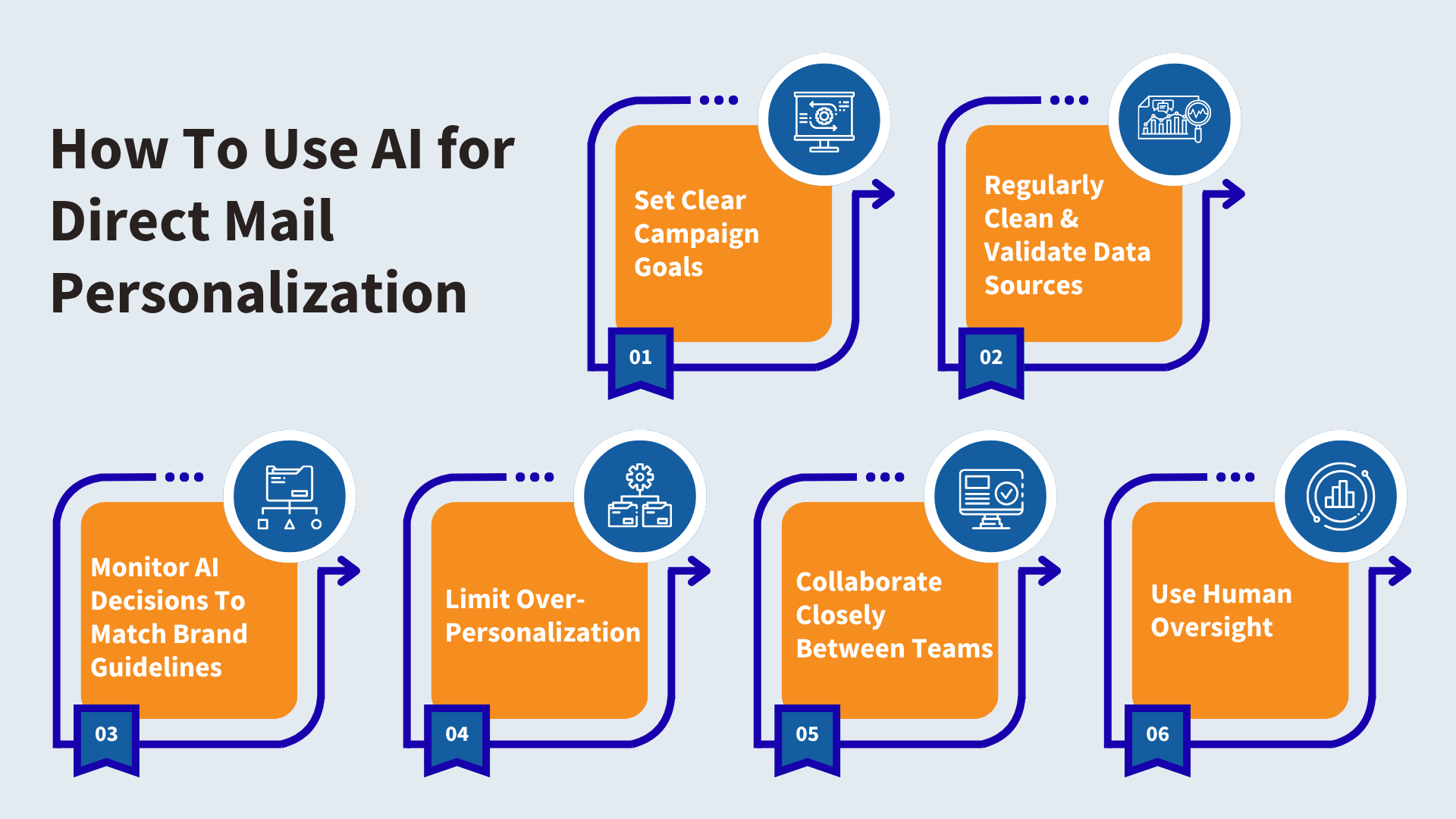
How To Use AI for Direct Mail Personalization: 6 Strategies Proven To 4X Your ROI
Here are 6 strategies to get the right mix of brains and brawn so your direct mail marketing campaign feels like it was written in the recipient’s head before it landed in their hands.
1. Set Clear Campaign Goals To Shape AI Optimization From The Start
AI is powerful, but it is not a mind reader. If you don’t tell it the purpose, it will just optimize based on whatever it assumes is important, and that can be completely different from what you actually want. Are you aiming for sales? Repeat purchases? Store visits? Newsletter signups?
When you firm up your goals before launch, AI can train its models on the right patterns and avoid wasting resources chasing the wrong outcomes.
What to Do:
Lock in the one outcome that matters most for this campaign – not three, not five, just one.
Put an actual number on it. “Better engagement” isn’t a goal; “30% lift in store redemptions” is.
Feed the AI past campaign data so it has a reference point for what is good vs. great.
Make sure every tweak or test ties back to that goal.
Revisit the goal mid-campaignprocess to confirm it is still the right target.
2. Regularly Clean & Validate Data Sources Before Feeding Into AI Models
AI can’t magically turn bad data into good results. If the data you are giving it is outdated or full of holes, your “personalization” will feel off, sometimes embarrassingly off.
And cleaning data isn’t just deleting duplicates once in a while. It is making sure addresses are correct, names are spelled right, and you are not mailing to people who haven’t engaged with you in years. The cleaner the data, the sharper the AI’s decisions.
What to Do:
Schedule data cleanups quarterly – fixed and non-negotiable.
Scrub out dead addresses, unsubscribes, and serial non-responders.
Run addresses through a validation tool before printing a single label.
Standardize how your fields are named and formatted so the AI doesn’t choke on it.
Keep a log of every cleaning cycle so you know when and what was done.
While it is important for all industries, it becomes even more critical for high-consideration investments. To put it in perspective, let’s consider the example of Nordvik’s outdoor saunas. These aren’t impulse purchases you pick up on a random afternoon.
That means your audience pool is smaller and the buying cycle is longer. One wrong name, outdated address, or irrelevant offer, and you have just burned a lead that took months (or even years) to warm up.
For this kind of product, you can’t afford to have AI crunching through messy, outdated data. If your records say someone is still at an address they moved away from two years ago, or that they are still in the market when they already bought elsewhere, your personalization efforts will actively erode trust.
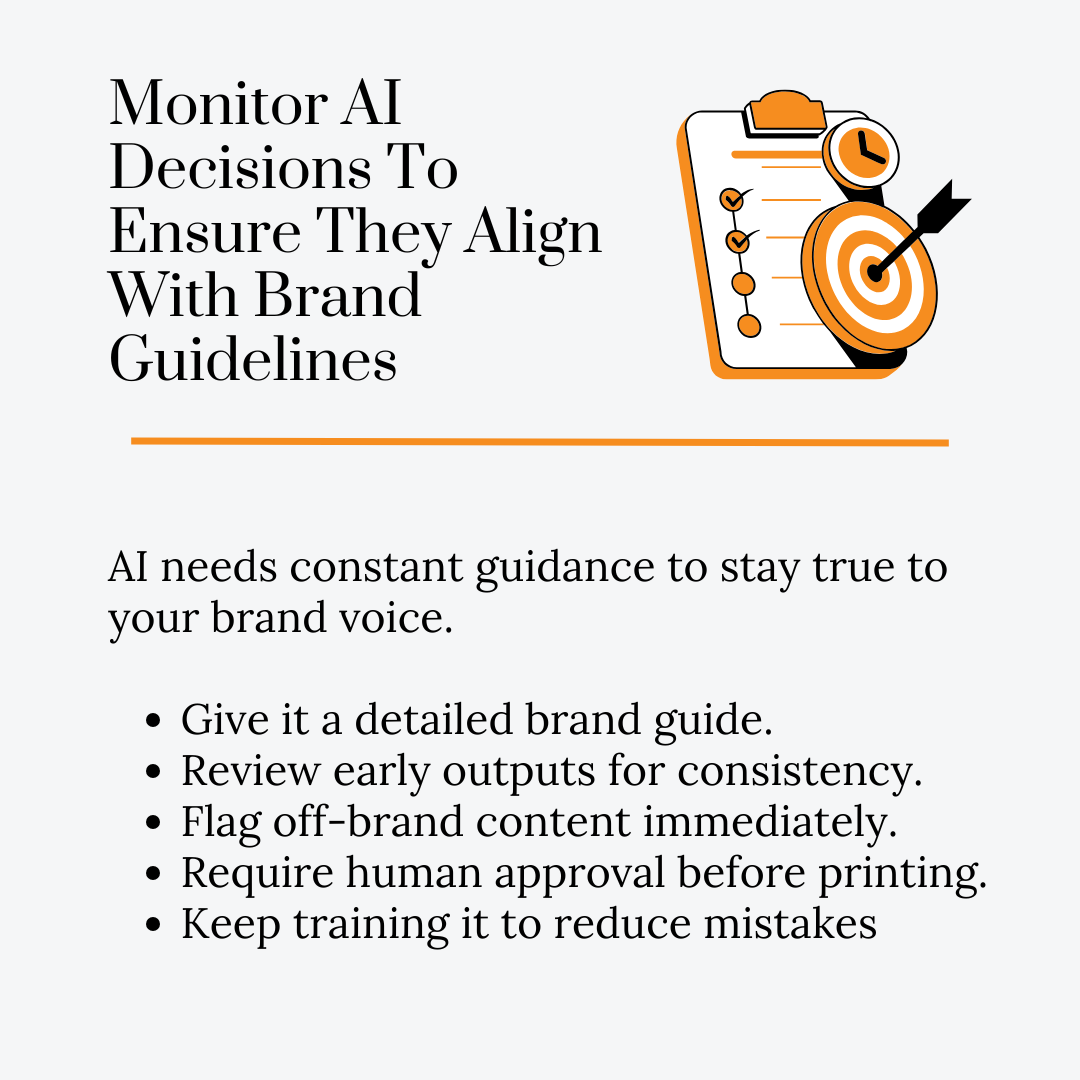
3. Monitor AI Decisions To Ensure They Align With Brand Guidelines
AI can be clever… and also completely miss the direction you want. Left unchecked, it might write something that technically “works” but makes your brand sound like a stranger at its own table.
You don’t want that. You want the AI to learn your brand’s pacing and style so it feels consistent no matter what it spits out. That only happens if you watch what it is doing and push it back on track when it drifts.
What to Do:
Give the AI a brand bible – tone, words you love, words you ban, style rules, all of it.
Skim early outputs before anything goes live so you can spot weirdness fast.
Flag anything that sounds wrong so the AI’s feedback loop can course-correct.
Lock in a human approval step before mass printing – always.
Train it over time so those off-brand moments happen less and less.
Keeping AI on-brand is a constant watch with a lot of micro-decisions. That kind of vigilance takes time you probably don’t have when you are already stuck planning campaigns and approving creatives.
You need someone who notices the subtle things you might miss. The best solution is to bring in a virtual assistant who is experienced in AI workflows and data management.
Contrary to popular perception, a virtual assistant in this setup isn’t just “extra help.” They are the human layer that AI can’t replace. They remember the tiny details AI tends to forget, like a seasonal nuance or a cultural cue, and make sure those land exactly how you want.
And because they are embedded in the process, they quietly keep the whole thing on track – campaigns go out sharper and more in sync with your brand’s actual voice.
4. Limit Over-Personalization To Avoid Creeping Out Recipients
Yes, AI can know an insane amount about your customers. But just because you can use all that customer information doesn’t mean you should.
The goal is for people to feel seen, not stalked. Overdo it, and they will be wondering why you know so much about their Tuesday night browsing habits. Keep personalization to what feels natural and relevant, and they will stay engaged instead of suspicious.
What to Do:
Personalize around broad customer preferences, not intimate details.
Don’t reference actions they never directly shared with you.
Test different levels of hyper-personalization to find the sweet spot.
Lead with relevance, not with proof of how much you know.
Ensure data privacy compliance and always make opting out simple and clear.
Some industries can get away with more personalization than others. In fashion retail, for example, customers expect a certain level of tailored recommendations. But for niche, tool-driven industries, the line between helpful and “too much” is razor thin.
This sewing machine parts business is a great example. A customer might browse replacement bobbins or motor belts for a specific model, but that doesn’t mean a direct mail piece should open with, “We noticed you viewed the replacement hook race for your Singer 201 on Wednesday afternoon.”
Instead, their direct mail could group preferences into broader categories – “parts to keep your vintage Singer running smoothly” or “most-requested upgrades for home quilting” – and show a curated selection that matches that interest.
The smart move for a brand like this is to make the personalization feel industry-savvy, not invasive. For example, rather than referencing the exact presser foot or bobbin case someone viewed, they could send a mailer featuring “5 most-used Singer accessories for garment construction” or “replacement parts every vintage Singer owner should keep on hand.”
This way, the content is still highly relevant but leaves enough breathing room so it doesn’t feel like you have been peering over their shoulder.
5. Collaborate Closely Between Data, Creative, & Marketing Teams
AI can be the most advanced tool in the room, but it still works best when the humans around it are actually talking to each other.
The data team might know the target audience inside out. The creative team knows how to make that audience feel something. The marketing team knows the timing and the bigger campaign goals. If those three groups don’t sync up, AI ends up getting pulled in different directions, and your personalization will feel disjointed.
What to Do:
Hold joint planning sessions so every team understands the campaign’s personalization goals.
Share AI insights with creatives in plain language instead of raw data tables.
Let direct mail marketers guide priorities so AI recommendations stay aligned with campaign timing and channels.
Keep feedback channels open – if AI results feel off, all three teams should review together.
Document what worked in past collaborations so each project gets smoother.
While collaboration is a no-brainer for every industry, there are some niches where it is the difference between making a sale and losing a customer.
For example, in the workout supplements space, the audience is chasing specific performance goals – muscle growth, faster recovery, endurance, or fat loss. If you send a generic message, you signal that you don’t get their discipline or routine.
To understand it better, consider Transparent Labs. Their lineup includes pre-workouts, proteins, amino acids, and more, each catering to a specific fitness outcome.
Their data team could flag customers who just purchased protein powder but haven’t tried a pre-workout. Creative could then develop a mailer headlined “Fuel the Set Before the Shake,” with visuals showing the synergy between the two products. Marketing would schedule this drop to hit during a common “training recommitment” window, like the post-holiday gym rush.
When those three groups collaborate instead of working in silos, AI becomes the muscle behind direct mailing campaigns that feel like they were made for that athlete’s exact training phase.
6. Use Human Oversight To Spot Irrelevant Or Biased AI Recommendations
AI doesn’t always understand context. It might spot a correlation that is technically correct but completely useless, or worse, base recommendations on biased data without realizing it. Left unchecked, that can lead to personalization that is tone-deaf or even alienating.
Human oversight is your safeguard. A person can look at an AI-generated offer or message and immediately see if it is off-base or insensitive. That gut check is something AI can’t do, because it doesn’t know your audience’s lived reality – it only knows the numbers.
What to Do:
Review AI recommendations for cultural fit, tone, and audience appropriateness before approval.
Watch for patterns that suggest bias, like favoring certain demographics disproportionately.
Gut-check whether the personalization actually adds value for the recipient or just feels forced.
Have a small panel (marketing + creative + customer-facing roles) sign off on final AI-driven assets.
Feed corrections back into the AI system so it can identify the most promising prospects.
Conclusion
When you use AI for direct mail personalization, you stop gambling on who might bite and start sending the exact thing, to the exact person, at the exact time they will care. So, let the AI pull the strings and stop your mail from being the stack they never open. This way, it becomes the one piece they actually act on. And that is where the money lives.
And when you are ready to do it, do it with Catdi Printing. We have the tech that makes it personal and the print quality that makes it impossible to ignore. This way, you can send out mail that feels like it was made for one person at a time, even if you are sending it to thousands. That is the formula that gets your mail opened, read, and acted on – exactly how you planned it.
Difference Between Engineering Prints and Architectural Prints
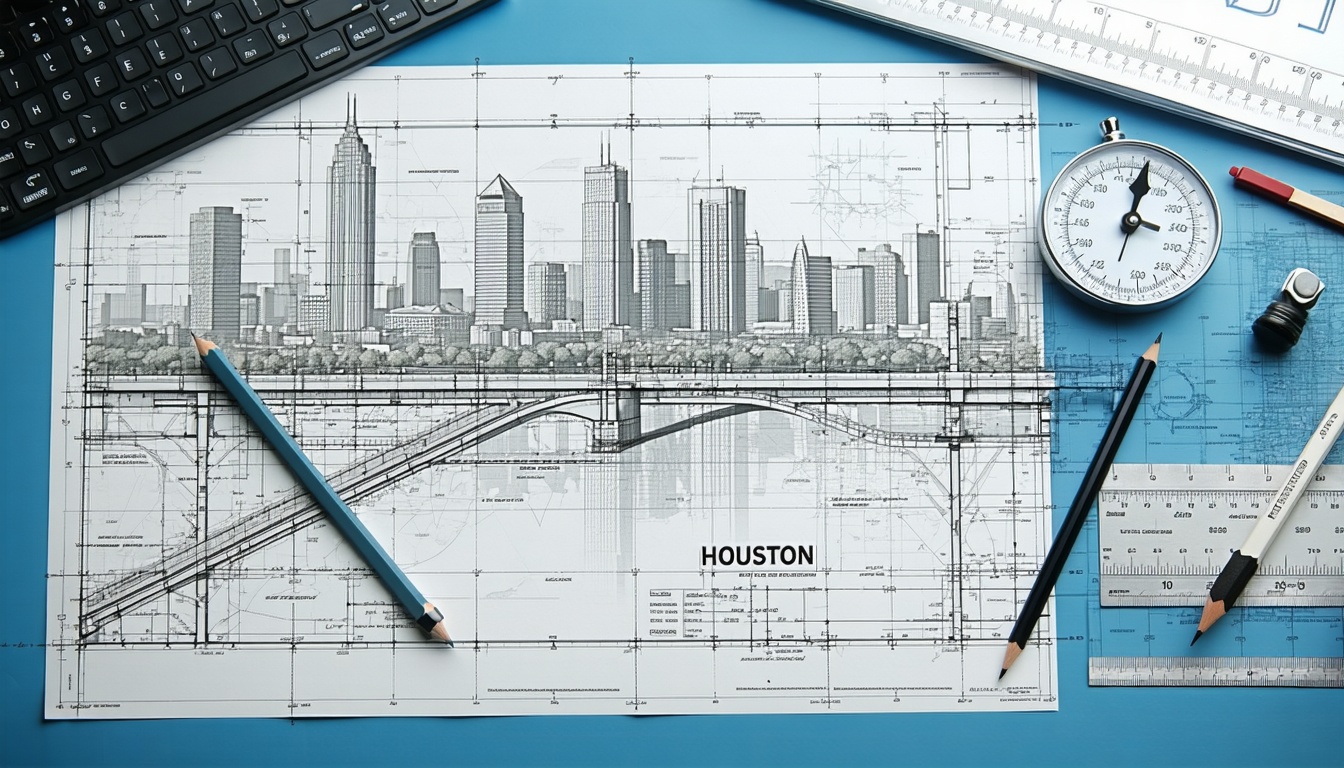
When you are working on a project that involves blueprints, understanding the differences between engineering prints and architectural prints is essential. These documents serve distinct purposes and play vital roles in the fields of architecture and construction, especially in Houston, where quality and precision are paramount.
Function and Purpose
Engineering prints focus on the technical specifications and functionality of a project. They include detailed depictions of structural elements, electrical systems, mechanical aspects, and plumbing layouts. They are crucial for ensuring that a project meets safety regulations and technical standards.
On the other hand, architectural prints emphasize the aesthetic and functional design of a building or structure. They showcase the visual representation of spaces, dimensions, and how the design interacts with its surroundings. Architectural prints are often used for presentations and approvals.
Content Differences
Aspect
Engineering Prints
Architectural Prints
Primary Focus
Technical specifications and functionality
Aesthetic design and layout
Detail Level
High detail on systems (MEP)
Focus on space design and flow
Common Elements
Schematics, technical drawings
Floor plans, elevations, renderings
Formatting and Presentation
Engineering prints often use standardized symbols and conventions to convey technical information clearly. They are typically formatted for precision and clarity, making them easier for engineers and contractors to interpret. Architectural prints adopt a more visual approach, including 3D renderings or artistic representations to convey the overall design vision.
Paper and Print Quality
The quality of the prints is essential in both fields. Engineering prints may require specific types of paper that can handle detailed line work, while architectural prints might utilize higher-quality, colored paper to enhance their visual appeal. Understanding the differences in print quality will help you choose the right blueprint printing services for your project needs.
Choosing the right type of print for your architectural or engineering needs can significantly impact your project’s success. Consider your audience, the purpose of the prints, and the type of information that needs to be conveyed when deciding between engineering and architectural prints. For more insights on effective printing solutions, check out our blueprint printing tips and discover how you can streamline your printing needs in Houston.
Standard Sizes for Engineering Drawings
When it comes to engineering drawings, the size of your prints can significantly affect their usability and clarity. Understanding standard sizes for engineering prints is essential for effective communication in the architecture and construction sectors.
Common Sizes for Engineering Drawings
Most engineering drawings adhere to a set of standardized sizes, which help streamline workflows and maintain consistency across projects. Below is a table outlining the most common standard sizes for engineering prints:
Size
Dimensions (inches)
Typical Use Case
A
8.5 x 11
General office documents
B
11 x 17
Design schematics and diagrams
C
17 x 22
Larger construction details
D
22 x 34
Architectural plans and layouts
E
34 x 44
Large format and site plans
E1
30 x 42
Custom for specific engineering needs
These sizes are widely accepted and utilized across various engineering fields. Choosing the correct size not only enhances visibility but also ensures that all necessary details are included and easily interpreted.
Considerations for Choosing Sizes
Project Requirements: Different projects may need different sizes based on specific details and scale.
Transportability: Consider how the prints will be used and the space available for transport or display.
Detail Visibility: Larger prints allow for more intricate details to be visible and easily understood.
When looking for quality printing services in Houston, consider reputable providers who are equipped to handle these sizes effectively. For your needs, explore options for blueprint printing Houston that offer a range of dimensions to suit any project requirement.
For further enhancements in your projects, ensure to check out our blueprint printing tips to ensure your prints meet the intended professional standards.
Common Use Cases (MEP, Civil, Structural)
In the realm of engineering prints, understanding common use cases is essential for maximizing the effectiveness of your technical documentation. Whether you are involved in mechanical, electrical, plumbing (MEP), civil engineering, or structural projects, each discipline has specific requirements and standards that dictate how prints are created and utilized.
MEP Engineering Prints
Mechanical, Electrical, and Plumbing (MEP) prints are essential for coordinating multidisciplinary projects. These prints illustrate the intricate details of mechanical systems, electrical layouts, and plumbing installations within buildings. Key features of MEP engineering prints include:
Detailed System Layouts: Clear representations of HVAC, plumbing, and electrical systems.
Coordination: Identifying potential conflicts between systems to avoid costly adjustments during construction.
Compliance: Ensuring all installations adhere to local codes and regulations.
Table 1: Common MEP Print Components
Component
Description
HVAC Plans
Diagrammatic representation of heating, ventilation, and air conditioning systems.
Electrical Layouts
Detailed diagrams showing wiring, outlets, and electrical panels.
Plumbing Schematics
Illustration of pipe layouts, water flow, and fixtures.
Civil Engineering Prints
Civil engineering prints play a critical role in the planning and execution of infrastructure projects, including roads, bridges, and utilities. These prints are designed to convey the project’s scope, specifications, and construction methods.
Key elements of civil engineering prints include:
Site Plans: Overview of land use, including roadways, drainage, and utilities.
Grading Plans: Details regarding the elevation and contour of the land for proper drainage.
Construction Details: In-depth drawings that provide specifications for construction methods and materials.
Table 2: Common Civil Engineering Print Types
Print Type
Purpose
Site Development Plans
Show how a piece of land will be developed or modified.
Stormwater Management Plans
Illustrate drainage systems and water management techniques.
Structural Plans
Provide details on foundations, retaining walls, and other structural components.
Structural Engineering Prints
Structural engineering prints focus on the design and integrity of buildings and structures. These prints ensure that structures can withstand various load conditions, including those imposed by gravity, wind, and seismic activity.
Key characteristics of structural engineering prints include:
Framing Plans: Detailed views of structural frameworks, including beams, columns, and load-bearing walls.
Foundation Plans: Specifications regarding foundation depth, materials, and reinforcements.
Connection Details: Guidelines for how different structural elements connect and support each other.
Table 3: Common Structural Engineering Print Elements
Element
Description
Load Calculations
Assessments determining the strength requirements for materials used.
Framing Diagrams
Illustrations detailing the arrangement of structural components.
Material Specifications
Guidelines for the types and grades of materials to be used in construction.
These various use cases demonstrate the importance of having high-quality and accurate engineering prints in Houston. When seeking blueprint printing services, it’s crucial to select a provider that understands your specific needs and delivers prints that meet the highest standards of quality and clarity. For more information on obtaining quality prints, visit our page on blueprint printing near me.
Line Weights and Scale Considerations
When creating engineering prints in Houston, understanding line weights and scale is crucial for effective communication and clarity in your designs. Proper representation of these elements ensures that your blueprints convey the necessary information to all stakeholders involved in your projects.
Line Weights
Line weights refer to the thickness of the lines used in your technical drawings. These weights can greatly impact the readability and visual hierarchy of your plans. Different line weights are used to distinguish between primary, secondary, and detail elements within a drawing.
Line Weight Type
Description
Thick Lines
Used for major elements such as walls and structural components.
Medium Lines
Indicate secondary components like doors and windows.
Thin Lines
Represent minor details, such as hatch patterns and annotations.
It is important to maintain consistency in the application of line weights to avoid confusion. Often, AEC firms rely on specifications for line weights when printing designs, making it essential to discuss these requirements with your printing service provider. Companies like Catdi Printing ensure that your engineering prints reflect your desired line weights with precision.
Scale Considerations
Scale is another vital aspect to consider. It refers to the ratio of the drawn measurements to the actual dimensions of the object or space being represented. The way you scale your drawings can affect how the details are perceived once printed. Common scales include:
Scale Type
Ratio
1:1
Full Scale
1:10
10 times smaller than actual size
1:100
100 times smaller than actual size
When selecting a scale, consider the complexity and size of your project. Using a consistent scale across your prints allows for greater accuracy and easier interpretation. Wide format printers, such as those from Stargel Office Solutions, can execute designs with both precision and clarity, ensuring that your scale considerations meet the needs of your architectural or engineering plans.
By paying close attention to line weights and scale details, you enhance the effectiveness of your engineering prints. Whether engaging in blueprint printing for architects or other related services, ensuring clarity in these elements is fundamental to successful project execution. For more information on best practices, consider reading our blueprint printing tips.
Paper Options for Technical Plans
When selecting paper for your engineering prints in Houston, you have several options tailored to meet the specific needs of your architectural and construction projects. Understanding these options can help you choose the best material for your prints, ensuring durability and clarity. Below, you’ll find detailed information on various paper types suitable for blueprints.
Blueprint Bond Paper
Blueprint bond paper is the most common choice for engineering and architectural plans. It is designed specifically for high-quality printing, providing a durable surface that can withstand handling on job sites. This paper is typically thicker than standard printing paper, ensuring that details remain sharp and clear.
Vellum Paper
Vellum paper is another option that offers a translucent finish, making it ideal for layering designs or presenting ideas in a soft light. It is particularly beneficial when you need to trace over plans or review multiple layers without reducing the visibility of underlying details.
Recycled Paper
If environmental sustainability is a priority for you, consider choosing recycled paper. Many printing services, including eco-friendly printing options in Houston, offer recycled blueprint papers that maintain quality while being gentle on the environment. This choice aligns with growing industry standards promoting sustainable practices.
Lightweight vs. Heavyweight Paper
When selecting paper, consider whether your project requires lightweight or heavyweight options. Lightweight paper is often easier to handle and distribute, while heavyweight paper provides added durability, making it suitable for plans that will undergo frequent use or need to be kept for extended periods.
Paper Type
Thickness
Best For
Blueprint Bond
20 lb – 24 lb
General engineering prints
Vellum
Varies
Overlaying designs
Recycled
20 lb – 24 lb
Eco-friendly projects
Lightweight
18 lb – 22 lb
Easy handling
Heavyweight
24 lb – 36 lb
Long-term durability
Catdi Printing offers a range of high-quality print formats using these papers, ensuring your architectural and engineering ideas are conveyed with precision. For more details on paper types and what best suits your project needs, visit our article on blueprint paper types.
By understanding the different paper options available, you can enhance the presentation of your engineering prints. Each choice can significantly impact how your plans are received by clients and contractors alike. For further insights into printing processes and other related services, check out our guide on blueprint printing process.
Color-Coding for Engineering Plans
Color-coding is an essential feature for engineering prints in Houston, as it enhances the clarity and understanding of complex plans. By using color-coding, you can differentiate between various components, systems, and phases of a project. This approach proves to be especially useful when coordinating efforts among teams, such as architects, engineers, and contractors.
Benefits of Color-Coding
Improved Clarity: Different colors can represent various systems or materials, making it easier for team members to identify critical information at a glance.
Enhanced Communication: Color-coded plans facilitate better discussions and decisions, as everyone can quickly understand the components being referenced.
Error Reduction: By visually distinguishing elements, you can minimize misinterpretations that could lead to costly mistakes.
Common Color-Coding Practices
Here’s a table summarizing common color codes used in engineering prints:
Color
Represents
Red
Electrical systems
Blue
Water and plumbing
Green
Landscaping and vegetation
Yellow
Gas lines
Orange
Temporary construction elements
Purple
Telecommunications
These color codes help streamline the design process and ensure everyone involved understands the project’s scope. This is vital for effective project management, especially when working on large and complex construction endeavors.
Implementation Tips
When implementing color-coding in your engineering prints, consider the following tips:
Establish a Standard: Create a consistent color-coding scheme that all team members can adopt. Document this scheme so everyone understands its significance.
Use Color in Legends: Always include a legend on your prints to explain the meaning of each color. This will ensure clarity for all users.
Be Mindful of Color Blindness: Consider using patterns or textures in conjunction with colors for team members who are color blind.
For a seamless printing experience with your engineering prints in Houston, it’s advisable to collaborate with a reliable printing service that understands color-coding and can offer valuable blueprint printing tips.
File Types Used in Engineering Prints
When you’re considering engineering prints in Houston, understanding the various file types used in creating blueprints is crucial. Different formats serve different purposes in the architecture and construction industries. Below, you will find an overview of the most common file types used for engineering prints.
Common File Formats
File Type
Description
Use Case
PDF
Portable Document Format is widely used for sharing high-quality documents. It preserves the layout of the original document.
Sharing final prints and ensuring consistent appearance across different devices.
DWG
A proprietary binary file format used for storing two and three-dimensional design data and metadata.
Used by CAD software for creating detailed designs and architectural blueprints.
DXF
Drawing Exchange Format allows for data interoperability between CAD software.
Facilitates file sharing and collaboration across different design platforms.
STL
Standard Tessellation Language is commonly used for 3D printing and computer-aided design.
Ideal for 3D modeling and prototypes that require manufacturing.
SVG
Scalable Vector Graphics is an XML-based vector image format used for two-dimensional graphics.
Great for logos, line drawings, and illustrations needing scalability without loss of quality.
These file types cater to different needs, from sharing final prints to collaborating on designs. By selecting the appropriate format, you can ensure that all stakeholders can view and utilize your prints effectively.
Importance of Choosing the Right File Type
Choosing the right file type can greatly influence the ease of collaboration and execution of your projects. For instance, while PDFs are perfect for sharing and printing, formats like DWG and DXF are essential when it comes to editing and detailed design work. Understanding these distinctions is beneficial for business owners in the fields of architecture and construction.
If you are interested in learning more about various aspects of blueprint printing, be sure to check our blueprint printing tips or explore services like CAD printing in Houston and fast blueprint printing.
Engineers We Serve in Houston
In Houston, there are numerous engineers who rely on precise and reliable printing services for their architectural and engineering projects. Catdi Printing offers tailored solutions for various engineering disciplines, ensuring that your blueprints are produced with the utmost accuracy. Below are some of the key engineering fields that benefit from our printing services.
Engineering Discipline
Description
Civil Engineering
Involves the design, construction, and maintenance of infrastructure like roads, bridges, and buildings, requiring detailed and precise engineering prints.
Mechanical Engineering
Focuses on designing mechanical systems, including machines and tools, often needing detailed schematics that must be printed accurately.
Electrical Engineering
Encompasses drafting electrical systems for buildings and electronic devices, demanding clear layouts that convey complex information efficiently.
Structural Engineering
Involves analyzing and designing structures that can withstand loads, where precision in the prints is critical for safety and functionality.
Environmental Engineering
Deals with projects aimed at improving environmental quality, requiring detailed plans and compliance documentation that must be accurately printed.
Our printing services cater specifically to blueprint printing for architects and blueprint printing for developers, ensuring that you have all the resources needed for successful project execution.
When you choose Catdi Printing, you benefit from customized blueprinting services that emphasize precision and quality. Every detail is critical in conveying intricate project specifications. Be sure to explore our options for fast blueprint printing in Houston and rush blueprint printing for urgent requests. We are equipped to handle diverse printing needs, and our range of sizes accommodates various project scales. For more information on pricing and processes, check out our guide on blueprint printing cost in Houston and our detailed overview of the blueprint printing process.
Catdi Printing is committed to assisting engineers, architects, and developers in turning their visions into reality by providing the high-quality prints necessary for effective project management. Your engineering prints are a foundation for success in your projects. For tailored printing services in Houston, learn more about our offerings.
Blueprint Packages for Projects
When it comes to handling your architectural and engineering needs, selecting the right blueprint package is essential for streamlining your projects. Whether you’re a small business owner or part of a larger firm, having a tailored solution can make a significant difference in efficiency and accuracy. Here’s what to consider when choosing a blueprint package in Houston.
Available Packages
Several printing services in Houston offer customized blueprint packages that cater to various project requirements. Understanding the options available can help you make an informed decision.
Package Type
Features
Ideal For
Basic Package
Standard prints, minimal revisions
Small projects or preliminary designs
Enhanced Package
Multiple revisions, color options
Medium-sized projects needing precise alterations
Premium Package
Highest resolution, comprehensive support
Large projects requiring utmost detail and accuracy
For more detailed specifications on available services, consider exploring options such as blueprint printing near me.
Precision and Quality
It’s crucial that the precision of your prints conveys intricate details accurately. Services like Catdi Printing offer tailored blueprinting solutions designed for engineering projects that demand high accuracy. Similarly, Thomas Printworks ensures quality output with a quick turnaround time.
Customization Options
Your blueprint package can also include customizable elements. Think about whether you need different paper types, color encoding, or additional features like variable data printing. ImageSet specializes in digital print-on-demand services, which can be particularly beneficial for projects with unique specifications.
Cost-Effectiveness
Understanding the costs associated with various packages is key. Engaging in discussions with providers can often yield flexible pricing options. For inquiries on specific blueprint printing costs, you may want to check out blueprint printing cost houston for additional insights.
By evaluating these aspects, you can select a blueprint package that aligns with your project goals, enhances workflow efficiency, and fulfills the specific needs of your architectural or engineering tasks in Houston. For further information on how to navigate the printing process, refer to our guide on how to print blueprints houston or consult our list of blueprint printing tips for best practices.
Order Your Engineering Prints from Catdi
When you need high-quality engineering prints in Houston, Catdi Printing is your go-to solution. Our blueprinting services are designed specifically for the architectural and construction industries, ensuring you receive precise and detailed print formats tailored to your unique project requirements. Whether you require black & white or color printing, we have the options to suit your preferences, using top-notch blueprint bond paper for durability and quality (Catdi Printing).
Why Choose Catdi for Your Engineering Prints?
Feature
Description
Precision
Our services emphasize accuracy in conveying intricate details essential for your projects.
Durability
We utilize quality blueprint bond paper to withstand the rigors of construction and review processes.
Customization
Choose from various sizes and formats to ensure your prints meet the specific needs of your projects.
Affordability
We are committed to delivering high-quality prints without compromising your budget.
Catdi understands the importance of every detail in transforming your architectural and engineering visions into reality. Our blueprinting services serve as the first crucial step in setting the groundwork for your ideas (Catdi Printing). We recognize that each project has its own scale and requirements, which is why we offer varied sizes for your blueprinting needs.
How to Place Your Order
Ordering your engineering prints with Catdi is straightforward. Simply follow these steps:
Visit our website to explore our services and options available for blueprint printing in Houston.
Choose your format – Select between black & white or color prints based on your project’s requirements.
Specify the dimensions of your prints to ensure they meet your specific standards. If you’re unsure, our team can assist you in selecting the appropriate sizes.
Upload your files through our user-friendly platform. Ensure your drawings are ready for print and meet our specifications.
Request a quote – We pride ourselves on transparent pricing. You can review costs before finalizing your order.
Finalize your order – Confirm your selections and receive your engineering prints promptly, with options for rush printing if needed.
Need to order blueprints? Let’s chat!
At Catdi, we’re dedicated to meeting your blueprinting needs with precision and care. Trust us to transform your ideas into tangible reality through our exceptional printing services.
Ready to get your project on the road? Get a quote today and experience the difference.
Print media advertising is a form of mass communication strategy that uses hard copy printed mediums like newspapers, direct mail, banners, billboards, and magazines to reach consumers. The advertising industry identifies print media as one of the oldest mediums used to promote products.
By advertising print services and brands, businesses target to attract and influence consumer buying habits. More so, marketers use print media advertising to reach out to prospects, existing customers, businesses, and the general public.
What Exactly Is Print Media?
In a world where screens dominate every waking moment, print media advertising remains a powerful and trusted way to cut through the digital noise. Whether it’s a beautifully designed brochure, a bold magazine ad, or a direct mail campaign, print materials have a unique way of:
Capturing attention in a visually overstimulated world
Building credibility and trust with physical, professional designs
Driving stronger engagement, often outperforming digital in response rates
According to recent industry data, print media advertising, particularly direct mail, consistently outperforms digital channels like email in response rates:
Direct mail averages a 4.4% response rate, while email lags behind at just 0.12% (Amra & Elma). That’s over 36 times higher.
Campaigns using house lists can achieve response rates up to 9%, while prospect lists average around 4.9% (Birdseye Post).
The Data & Marketing Association reports that direct mail response rates are 5 to 9 times higher than any other advertising channel, including email.
These figures make one thing clear, print media advertising doesn’t just compete—it consistently delivers stronger engagement and results.
These tactile marketing tools prove that print media advertising still packs a punch in 2025—offering brands a tangible way to stand out and stay memorable.
But what exactly is print media, and why does it still matter today?
Print media is a written or pictorial form of mass communication. It is mechanically or electronically generated through methods like impression or photocopying. Modern printers can now produce these communications using automated digital technology, streamlining the creation of vibrant, high-quality materials.
At its core, print media involves the creation and distribution of news, advertising, or educational content through tangible publications—what we often call “hard copies.” These physical formats—such as newspapers, magazines, brochures, pamphlets, posters, and books—allow for a tactile experience that digital channels simply can’t replicate.
One of the standout advantages of print media lies in its ability to capture and reproduce visuals with remarkable precision. Whether in vivid color or crisp black and white, printed images command attention and leave a lasting impression.
Just as importantly, printed materials encourage a deeper, more personal level of interaction. Readers can:
Feel the texture of the paper
Flip through pages at their own pace
Highlight, annotate, or clip sections for future reference
This sensory experience supports stronger recall and comprehension, making print a particularly effective medium for delivering important messages.
Even as digital media continues to evolve, the availability and impact of print remains undeniable. By combining visual appeal with a physical presence, print media continues to engage a broad range of audiences—ensuring that your message is not just seen, but felt.
Examples of Print Media
It is typical for printers to display print media on paper. However, printing firms may also use various substrates such as canvas, fabric, vinyl, and more. The majority of readers, advertisers, and other media users are familiar with the following examples of print media.
Newspapers and Weeklies
Newspapers are good examples of print media where advertisers have a wide variety of options available. The various types of newspapers include weekly, local, regional, evening, or Sunday editions.
Who are the top consumers of newspapers? This print media attracts a wide range of readers. They include individuals with different interests such as sports, business, entertainment, fashion, politics, local and international news.
Furthermore, newspapers sell space to advertisers who need help displaying ads in text, graphics, photographs, and other illustrations. Some advertising agencies spend a fortune to buy double-page spreads, while others pay smaller amounts for classified ads that contain text only.
Magazines
There are various types of magazines advertisers can use for publicizing services and brands. Trade magazines promote specific industries such as electronics, manufacturing finance, and more. Consumer magazines publicize numerous interests, including fashion, health, sport, hobbies, and current affairs.
Other magazines focus on publications for managers and careers such as marketing professionals, engineers, human resource executives, and more.
A majority of magazines are published weekly, monthly or quarterly. Even so, advertisers can still buy space to place adverts either in black and white or color.
Billboards
Billboards and posters are types of print media that allow promoters to reach consumers on the go. They are are typically large prints and graphics and are placed on the outdoors. Placing these banners in strategic positions such as near malls helps advertisers influence consumers close to the selling counters.
Advertising agents place billboards in public places such as airports and train stations to reach larger groups of patrons. The size of these gigantic boards makes it almost impossible for anyone to miss the advert.
Furthermore, promoters can combine digital and print to alter messages, slogans, or pictures on billboards at their set times.
Is Print Media Still Effective in 2025?
News, fashion, manufacturing, and other industries still rely on traditional print media advertising, even as digital platforms continue to dominate marketing budgets. While there has been a modest decline in overall print ad spend, this medium is far from obsolete—in fact, it’s experiencing a strategic comeback.
Promoters continue to embrace print media advertising for its tangible value, longevity, and ability to drive deeper brand engagement. Unlike digital ads that vanish with a scroll or click, a well-designed brochure or flyer can linger in a customer’s hands, office, or kitchen counter—revisited multiple times. This stickiness gives print a unique edge: staying power.
One of the key drivers of print’s comeback is variable data printing, which enables personalization at scale. Businesses can now deliver tailored messaging—by name, location, or preference—making print feel more relevant and valuable to consumers.
Another game-changer is eco-conscious branding. Sustainability is no longer a differentiator—it’s a baseline expectation. Many brands are switching to recycled paper, soy-based inks, and carbon-neutral printing processes, aligning their values with today’s environmentally aware audiences (MBA Group, EssenceMediaCom).
Direct Mail: A Trustworthy Channel in an Oversaturated World
Direct mail is enjoying a resurgence as audiences experience digital fatigue. With inboxes overflowing and social feeds jam-packed, something as simple as a postcard now feels refreshingly personal. Recent data shows that direct mail now commands a 9% average response rate, far exceeding the 1% (or less) seen in many digital formats (Passive Secrets).
Latest Innovation in Print Advertising
Tools like QR codes, near-field communication (NFC), and augmented reality (AR) are transforming static materials into interactive, trackable marketing assets that seamlessly guide consumers from paper to pixel. This shift reflects a broader evolution in marketing strategies where print is no longer a standalone tool, but a powerful amplifier when integrated with digital experiences.
Print Advertising is Still Booming in 2025
Retailers are recognizing this shift. While earlier studies noted that 68% of retail stores favored print for its trust and reach, modern insights show that combining print with digital strategies can boost campaign effectiveness by up to 400%. This figure has been confirmed across multiple industry reports and marketing publications, highlighting the dramatic lift in reach, engagement, and conversions when both channels are used together (SoCal News Group, McClatchy, Spartan Marketing)
What’s more, the global print advertising market is projected to grow from $348.31 billion in 2024 to $359.53 billion by the end of 2025 (TBR Blog)., with steady growth expected into the next decade. This growth isn’t just in legacy formats like newspapers and magazines—it’s also in innovative uses like personalized direct mail, smart packaging, and loyalty-focused print campaigns that integrate with CRM and digital tracking systems.
Not Just Print—Smart Print
Modern print media advertising is about more than putting ink on paper. It’s about building memorable experiences through:
Interactive packaging
Personalized loyalty mailers
Print-to-digital hybrid campaigns
Direct mail that integrates with CRMs and analytics tools
Print today is measurable, strategic, and digitally integrated—a far cry from the static formats of the past.
The Bottom Line
Is print dead? Not even close.
The better question is: How are you using print media advertising in 2025?
The most successful brands don’t see print and digital as competitors—they use them together, strategically, to increase trust, boost conversions, and meet customers where they are (offline and online). Whether it’s a QR-driven postcard or an eco-friendly flyer that doubles as a digital coupon, print is once again at the center of the marketing conversation.
Print media is the older channel of mass communication as compared to the electronic version, which is current and more advanced.
It results through publications, while electronic media produces via a computerized medium.
The traditional media requires the reader to be literate to read the information. However, literacy is not a priority to go through electronic media because consumers can watch the video or listen to the audio version.
Readers pay more for print media than for electronic media subscriptions. With print media, you only buy what you need when you need it. You can also refer to your print at a later time. Electronic subscriptions expire after a specific duration, and you need to renew even when you may only read it once.
It is easy to fully pay more attention to a print article than to an electronic medium. Reading an online publication can be distracted by live chat pop-ups, social account messages, or even power outages.
Print media is not instant or available 24/7. For example, printers produce newspapers daily, weekly, or monthly. However, electronic media is readily available “live.” You can receive news or commercial updates as they happen through your smartphone, television, or news channel.
Unlike electronic media that offer large to limitless space, newspapers, magazines, billboards, and other print mediums have a limited area of coverage.
Which Print Media Is Best for Advertising?
You can decide which print media is best for promoting your brand depending on your target audience and your advertising budget. Even so, newspapers and brochures are the most preferred channels of print media. More so, these print mediums have a high rate of consumer confidence.
Newspaper
This print media is considered one of the best mediums of print advertising. Furthermore, newspaper ads are the oldest campaign tools recorded in the history of the industry. In 1704, Boston News-Letter published a newspaper advertisement selling real estate on Oyster Bay Long Island.
For example, a report by NielsenIQ shows that in the U.S, 71% of those aged 18-24 have subscribed to electronic newspaper content. However, 65% of those aged 35 and above in the same demographic read print newspapers from Sunday to Monday.
Regardless of the statistics, this type of print media is the oldest medium for advertising. The newspapers have been a means of advertising for over a century. Businesses find daily journals less costly when compared to other alternatives like billboards, magazines, and postcards.
Brochures
Some promoters prefer to use brochures as the best print media for advertising. Besides the simplicity in design, brochures are informative and tell your customers about your brand or services.
Printing brochures is less costly than other print media like magazines. More so, they cost nothing to disseminate. This print media is the best reminder you can give to your customers after a meeting.
Brochures continue to influence your prospects long after physical contact. Some clients find it faster to read print media than it is to visit a website.
Direct Mail
Direct mail stands out as an effective and enduring tool within the realm of print media advertising. By allowing businesses to send physical marketing materials directly to the homes or offices of targeted individuals, direct mail offers a tangible touchpoint that digital channels cannot replicate.
This form of advertising capitalizes on the personal connection and the tactile experience of receiving and interacting with a physical item. When executed with strategic precision, direct mail can yield impressive response rates and return on investment, especially when the messaging is tailored to the interests and needs of the recipient.
Advancements in printing technologies such as digital printing and data analytics have enhanced the capability of direct mail campaigns to be both creatively captivating and highly personalized, further solidifying its place as a powerful component of any comprehensive marketing strategy.
According to research, the older generation of the U.S population has confidence in printed ads. They consider handheld advertisements more credible than their electronic counterparts. More so, millennials also trust print media even though they frequently interact with digital advertising.
Consumer and market research indicates that 60% of interviewed respondents showed confidence in newspapers while 58% preferred magazines. Consumers trust print media more than electronic media because the internet contains high levels of misleading information.
The public tends to believe that print media originates from a reputable source or company. More so, effective flyer print marketing can help drive traffic to your website to create conversions and brand awareness.
Findings from Nielson IQ indicate that the top 5 most trusted mediums by the public include TV ads, newspaper ads, magazine ads, billboards, and radio ads.
High Conversion Rates
As indicated in a report by the Chief Marketing Officer (CMO) council, about 80% of consumers respond to direct mail ads. This rate is higher than that of shoppers who react to email ads.
The high response rate experienced in direct mail is why print marketing is more costly than digital marketing. Other print media types such as banners, newspaper ads, brochures, and business cards trigger the same consumer response as direct mail.
Print Helps You Reach Your Ideal Audience
Marketers know that placing ads in print media such as magazines, newspapers, and brochures can help reach your target market or the general public.
Promoters take advantage of the population tally to strategically place adverts in the right place in front of the ideal audience.
Take the example of a physical fitness service provider. A marketer will reach out to sportspeople and individuals who need to stay physically fit by placing an advert on the sports page.
Flexibility
It is the best advertising medium to use when you need to target a specific audience. Print media allows you to choose which section of magazine or newspaper your intended group is likely to read.
This channel of mass communication is not only strategic. But have digital copies, which give marketers more opportunity to reach a wider audience.
Magazines, brochures, publications, and other print mediums are tangible or hard copy. These items last longer in workplaces and residences, unlike the electronic versions that readers can delete, ignore, or skip with ease.
Readers are likely to keep magazines for a long time and possibly revisit ads more than once or twice.
Substantial Attention Span
Reading from a mobile phone screen is often distracted by pop-up messages or incoming calls. However, consumers consider magazines and newspapers a better medium to read ads because one can focus without being distracted by notifications.
Disadvantages of Print Media
Pay for Your Target Market
High-caliber magazines feature glossy covers, top-notch writers, seasoned photographers, and standout design—all of which come at a price. Advertisers pay premium rates for this level of professionalism and production quality. For example, the average cost to reach 1,000 people with print is over $22, compared to just $3–$10 for digital ads. This makes print a costly option, especially for small businesses with limited marketing budgets. However, the investment ensures your message reaches a more refined and targeted audience.
Timing and Flexibility
Print advertising is inherently slower than digital. Campaigns must be planned well in advance, with content finalized weeks—or even months—before it ever reaches the public. Once an ad goes to print, there’s no opportunity to make edits, respond to current events, or adjust based on feedback. In contrast, digital campaigns can be launched, tested, paused, and optimized in real time. For businesses needing to pivot quickly, print lacks the flexibility today’s fast-paced market often demands.
Decreased Popularity and Reach
The shift toward digital communication continues to accelerate, with more consumers subscribing to email newsletters, mobile updates, and social feeds for instant information. Digital content is also far more shareable, expanding its reach organically through social platforms. As a result, print media is experiencing a decline in popularity, especially among younger, tech-savvy consumers.
That said, print still holds value for specific demographics—particularly older generations such as Baby Boomers, who continue to trust and engage with physical publications. This makes print useful for brands catering to that audience, though overall, it’s becoming harder to reach large-scale audiences through print alone.
Limited Placement Control
Unlike digital platforms, where ads can be precisely placed by behavior, location, and demographic data, print offers far less control over placement. An ad may appear in a section of a publication that doesn’t resonate with the reader, reducing its effectiveness.
Measurement Challenges
One of the biggest drawbacks of print is tracking. While QR codes and unique promo codes have helped bridge the gap, print still lacks the advanced analytics that digital marketing offers—such as click-through rates, conversion tracking, and user behavior insights. This makes it harder to gauge ROI and refine future campaigns.
Risk of Human Error
In the digital space, a typo can be quickly corrected. In print, a single error—whether it’s a misspelled word, incorrect phone number, or layout flaw—can become a costly mistake once distributed. There’s no backspace button after the presses roll.
Creative Limitations
Though print offers a unique tactile experience, color reproduction and design capabilities can be limited. Certain effects—like animations, dynamic content, or precise brand color matching—are easier to achieve in digital environments. This can restrict creativity for brands that rely heavily on strong visual identity.
A Balanced Perspective
Despite these disadvantages, print media is far from obsolete. It offers tangible benefits like credibility, longevity, and physical presence—qualities that digital ads sometimes lack. In 2025, the most effective marketers are those who balance the reach and agility of digital with the trust and impact of print, aligning each medium with the right audience and message.
Conclusion
Print media advertising is the oldest means of marketing that businesses have used to promote their brands. Newspaper ads date back to 1708 and are still here today, but better, bolder, colorful, and on point. Today, with state-of-the-art technology, the print industry is more advanced and vibrant.
More so, printers print media ads on a variety of substrates such as photo paper, fabric, canvas, vinyl, and more. Today, advertisers display adverts on numerous mediums such as billboards, flyers, brochures, business cards, postcards, door hangers, letterheads, envelopes, wrappers, and more.
Print media influences consumer habits in more ways than compared to electronic media. Finally, print is still the best way to grow your brand awareness. And you can trust that by advertising through this industry, your brand or service can move to the next level.
Houston is a thriving metropolis where businesses continually strive to distinguish themselves in a competitive market. One of the most effective ways to ensure your brand stands out is by leveraging high-quality Houston commercial printing. This article explores how Houston businesses can thrive by using essential collateral, ranging from printed materials to direct mail and digital strategies.
The Competitive Edge in Houston
Understanding the Market Pulse
Houston’s business environment is fast-paced and ever-changing. Companies need to stay ahead by continually adapting their marketing strategies. Whether it’s a small startup or an established enterprise, every business must communicate its brand message effectively. High-quality print materials not only reinforce a company’s image but also establish credibility in the eyes of potential customers.
Why Collateral Materials Matter
In a digital world where online ads and social media posts are ubiquitous, tangible print materials offer a refreshing touch. Brochures, flyers, business cards, and banners provide a physical representation of a brand that can be held, examined, and remembered. These printed pieces act as silent ambassadors for your business, often leaving a long-lasting impression compared to digital ads that can be quickly forgotten. High-quality collateral can spark curiosity and trust, ultimately driving consumer engagement and sales.
The Power of Commercial Printing (and why it matters)
The Evolution of Commercial Printing
Commercial printing has come a long way from its humble beginnings. Historically, print materials were the primary method of communication for businesses. Over time, as digital media emerged, the role of printed collateral shifted—but never diminished. Today, modern printing techniques blend traditional craftsmanship with digital innovation to produce materials that are both visually appealing and highly effective.
Traditional vs Digital Printing Techniques
Traditional printing methods, such as offset printing, are still widely used due to their cost-effectiveness for large-volume orders and their superior color accuracy. On the other hand, digital printing offers faster turnaround times and greater flexibility for small-batch jobs and customized projects. Both methods have their distinct advantages, and the choice between them depends on the specific needs of your campaign. By understanding these differences, businesses can make informed decisions that enhance their marketing efforts.
Enhancing Brand Visibility with Quality Print Materials
Quality printed collateral does more than just convey information—it tells your brand’s story. In Houston’s competitive market, every detail counts. A well-designed brochure or an eye-catching flyer can significantly boost your brand’s visibility and reputation. It’s not just about aesthetics; it’s about ensuring that every piece of collateral reflects the values, professionalism, and creativity of your business.
Credibility: Professionally printed materials signal to customers that your business is established and reliable.
Tangibility: Unlike digital content, print materials offer a physical presence that can be revisited time and again.
Versatility: Whether distributed door-to-door or handed out at local events, print collateral adapts to various marketing strategies.
Integrating Direct Mail and Print Solutions
One of the standout strategies in Houston is the use of direct mail campaigns, particularly through Every Door Direct Mail (EDDM). This service allows businesses to send out printed materials to targeted neighborhoods without the need for an existing mailing list. By combining EDDM with quality print collateral, companies can maximize their local outreach and generate impressive returns on investment. For example, many Houston businesses are turning to innovative EDDM solutions that streamline the process and ensure that every piece of mail carries the brand’s professional image.
Setting the Stage for Success
Creating a Cohesive Brand Image
Consistency is key when it comes to building a strong brand identity. Every piece of marketing material—from your website to your printed brochures—should echo the same message and aesthetic. This uniformity reinforces brand recognition and fosters trust among your audience.
As businesses navigate the complexities of today’s market, integrating commercial printing into their marketing mix ensures that their brand image remains both consistent and compelling.
The Role of Community Engagement
Houston is not just a business hub; it’s a community. Engaging with local communities through printed collateral can be incredibly effective. Sponsoring local events, participating in community activities, or even hosting workshops are great ways to make your brand memorable.
These initiatives not only provide exposure but also demonstrate your company’s commitment to the local community—a factor that resonates well with customers in the region.
Bridging Traditional and Digital Marketing
While print collateral is indispensable, it works best when complemented by a robust digital strategy. Businesses that master the art of blending traditional print methods with online marketing techniques are the ones that truly stand out. High-quality printed materials paired with an optimized digital presence create a multi-channel marketing approach that reaches consumers on every front.
Local SEO Integration: By aligning your print materials with your digital strategies, such as implementing local SEO strategies, your business can enjoy enhanced online visibility and drive more traffic to your digital platforms.
Comprehensive Marketing: The synergy between offline and online efforts allows for a more comprehensive marketing strategy, ensuring that your message is not only seen but also remembered.
Benefits of Commercial Printing
Businesses in Houston have a golden ticket with commercial printing, giving them the edge to stand tall in the bustling market. We’re talking variety in printing styles, budget-friendly quality, and a wide range of industry uses.
Versatility in Printing Methods
When it comes to printing, they’ve got more tricks up their sleeve than a magician. Offset, digital, or giant-size printing—take your pick. Whatever your heart (or business) desires.
Offset Printing: Your go-to for when you need heaps of copies with a crisp finish.
Digital Printing: Great for small jobs you need right away.
Large-Format Printing: Perfect for when you want to go big or go home with banners and posters.
This buffet of options means businesses can mix and match to fit their marketing mojo. Curious about local Houston printing wonders? Get the scoop at houston printing solutions.
Cost-Effectiveness and Quality
Commercial printing is a wallet’s best friend. Bulk orders mean bang-for-your-buck quality without burning through cash. This is a lifesaver for companies wanting to dazzle with premium quality without the premium price tag. Going big on orders means you can afford expanding your reach across many suburbs within Houston.
Printing Method
Cost Smarts
Blooming Quality
Offset Printing
Top-notch Value
Super Slick
Digital Printing
Middle Ground
Pretty Decent
Large-Format Printing
Swinging
Tops – Brilliant
Factors Impacting Commercial Printing
Printing Costs Considerations
When it comes to the cost of commercial printing in Houston, several elements come into play. Companies need to think about how many prints they need, what type and quality of paper they want, the printing method they choose, how colorful the prints will be, and any extra finishing touches they add.
Factor
Think About This
Quantity of Prints
Ordering more prints usually means paying less per piece.
Paper Type and Quality
Fancy paper often costs more.
Printing Method
Some ways of printing are pricier than others.
Color Complexity
All those colors? They can raise the price.
Print Finishing
Extras like a shiny coat (lamination) mean more money.
Knowing these factors helps businesses make smart spending decisions to get top-notch printed stuff that suits their goals.
Printing Material Variety
The materials you choose for printing matter a lot. Options like paper, cardstock, vinyl, and fabric can give different looks and feels, each serving a specific purpose. Here’s some common stuff used in Houston’s printing scene:
Standard Paper: Cheap and perfect for basic items like flyers and brochures.
Cardstock: Thicker and tougher, great for business cards and postcards.
Vinyl: The go-to for banners and outdoor signs; it’s tough against the weather.
Fabric: Popular for trade show displays and printing on clothes.
Picking the right material helps achieve the quality and functionality you want.
Printing Methods Influence
The way you decide to print can really shape the quality and cost. In Houston, folks typically go for one of these methods:
Offset Printing: Best for big jobs, as it keeps the quality up and costs down.
Digital Printing: Handy for smaller orders, quick to finish, and easy to tweak.
Screen Printing: Mainly used for textiles or anything big.
Flexography: Works well for packaging, especially in industries that manufacture products.
Each has its perks, so businesses choose based on what’s best for their needs.
Commercial Printing Benefits
Commercial printing brings a range of perks that can supercharge a company’s marketing and brand game. Here’s the good stuff:
Versatility: Lots of printing ways cover different sizes, from cards to giant banners.
Cost-Effectiveness: Big orders mean savings per piece, so buying in bulk won’t break the bank
Quality: The latest tech brings bright colors and sharp images.
Industry Application: Used across sectors like advertising, retail, and manufacturing for branding and promotions
By tapping into these perks, businesses can create standout materials that boost customer connections. For more know-how, check out our detailed guides on professional printing in Houston and the different printing packages we offer.
Size is often a conversation topic and this article will answer the question of whether A3 is bigger than A4. It seems easy, but there are more details to consider.
A3 is bigger! It’s 11.7 x 16.5 inches or 297 x 420 mm. A4 is 8.3 x 11.7 inches or 210 x 297 mm. Width and height are both bigger with A3.
Which one is best depends on what you need it for. A3 is best for posters, presentations, and architectural drawings that need lots of space. A4 is great for letters, resumes, and other printing that needs to be handled and stored easily.
A3 may be bigger, but it also needs more space for storage and transportation.
Explanation of A3 and A4
A3 and A4 are paper sizes used around the globe. A3 measures 11.7 x 16.5 inches. A4 is 8.3 x 11.7 inches. A3 is larger than A4 in width and height.
To get a better understanding of the sizes, let’s have a closer look. Here’s a comparison of A3 and A4 in a table:
Paper Size
Width (inches)
Height (inches)
A3
11.7
16.5
A4
8.3
11.7
More details: these paper sizes belong to the ISO 216 standard. It’s used internationally for printing.
A3 is suitable for posters, newsletters, and architectural plans. This is because it has a larger format, allowing more material on one page. A4 is commonly used for letters, resumes, and reports. Why? It has a compact, easy-to-read design.
Need help printing something?
Explore Catdi Printing’s expert services—from eye-catching custom posters (A3) to crisp professional documents (A4). Visit Catdi today and print sustainably with confidence! Get a quote.
Size Comparison: A3 vs A4
A3 and A4 are two popular paper sizes used globally. A3 is larger than A4, giving more space for printing and designing. Let’s look at a size comparison!
Table:
A3
A4
Width
11.69 in
8.27 in
Height
16.54 in
11.69 in
A3 measures 11.69 inches in width and 16.54 inches in height. A4 is smaller at 8.27 inches by 11.69 inches. This difference allows for different document formats, such as posters, diagrams, or larger prints.
These two sizes belong to the ISO “A” series standard for paper measurements. This series follows a geometric progression, where each size is half the area of its predecessor.
Also, A3 paper size is a staple in print marketing, especially in industries like real estate, education, healthcare, and retail. Its larger format makes it ideal for creating eye-catching posters and detailed presentations. Conversely, A4 is the go-to size for brochures, flyers, newsletters, and everyday office documents, favored by businesses for its practicality and versatility. These paper sizes help companies effectively communicate and engage with their target audiences through diverse marketing materials.
Differences between A3 and A4
A3 and A4 are two common paper sizes – A3 being bigger. Let’s compare them to show the differences:
Dimensions:
A3: 11.69 x 16.54 inches
A4: 8.3 x 11.7 inches
Uses:
A3: Posters, drawings, architectural plans
A4: Letters, documents, brochures
Apart from size, these paper sizes are also used differently in various settings. For example, A3 is useful for creating posters, drawings & architectural plans. A4 is more suitable for everyday office tasks like letters, documents & brochures.
Pros and Cons of A3
Let’s take a more detailed look at the A3 paper size to better understand its practical applications and potential drawbacks. Here’s a comprehensive overview:
Pros
Cons
Ample Space for Visuals: Ideal for posters, presentations, and technical drawings due to its larger dimensions, providing clarity and detailed representation
Higher Cost: A3 paper tends to be more expensive than standard A4, influencing both initial paper cost and printing expenses
Enhanced Visibility: Particularly beneficial for group presentations and materials where clear, detailed visuals are crucial
Storage Challenges: The larger size requires more physical storage, potentially posing inconvenience for bulk storage or smaller office spaces
Versatility: Can be easily folded into A4-sized booklets or effectively used in multi-page brochures, adding flexibility to marketing campaigns
Printer Compatibility: Many standard printers and copiers are not A3-compatible, necessitating specialized equipment and investments
Professional Appeal: Provides an impressive, professional appearance, enhancing the impact of marketing materials such as catalogs, brochures, and architectural blueprints
Larger Footprint: A3-compatible printers and devices generally occupy more office space due to their bulkier dimensions
Creative Freedom: Offers sufficient room for intricate designs, charts, infographics, and detailed visuals, making it highly favored by architects, designers, and marketers
Maintenance Costs: Printers capable of handling A3 paper usually incur higher ongoing maintenance expenses compared to those limited to A4 sizes
Practical Applications
A3 paper is highly beneficial in several real-world scenarios, including:
Posters and promotional displays for events
Architectural and engineering blueprints
Folded brochures and comprehensive marketing materials
Modern Advantages
Advancements in A3-compatible printers, such as Lexmark’s new 9-Series, have significantly improved efficiency, sustainability, and versatility. Modern A3 printers now integrate cloud services, advanced security, and energy-saving features, aligning well with contemporary workplace demands.
Digital Adaptation
A3’s dimensions translate effectively into high-resolution digital formats, boasting dimensions of 3508 x 2480 pixels at 300 dpi. This feature is especially critical for professional printing, graphic design, and high-quality image reproduction.
Environmental Considerations
Businesses today can choose eco-friendly A3 paper options, optimizing their use and reducing waste, thereby minimizing environmental impact.
Decision-Making Tips
When deciding between A3 and other sizes:
Choose A3 for projects where visual impact and clarity are essential.
Opt against A3 if portability, storage convenience, or budget constraints are primary concerns.
Engagement Suggestions
Incorporating visuals such as side-by-side size comparisons (e.g., with a laptop or standard A4 sheet) can help contextualize the dimensions of A3 paper.
Interactive tools allowing users to calculate and compare the cost-effectiveness of A3 versus A4 formats based on their specific project requirements can significantly enhance user engagement.
By considering these comprehensive insights, you can confidently decide whether the A3 size is the best choice for your specific needs and applications.
Pros and Cons of A4
A4 paper size is a popular norm in many nations. It has various pros and cons that professionals should consider when selecting the proper paper for their needs.
Efficient and handy:A4 paper is well-known for its flexibility, as it can be quickly folded or cut to fit different purposes. Its dimensions (210 x 297 mm) make it suitable for printing documents like letters, reports, and invoices without taking up too much room.
Compatibility: It is compatible with the majority of printers and copiers, making sure of smooth compatibility across multiple devices. This makes it a popular option for companies and individuals.
Cost-efficient: A4 paper is usually more affordable when compared to other sizes, making it a cost-effective solution for bulk printing needs. Its abundance also adds to its affordability.
Convenient storage: Because of its standardized dimensions, A4 paper can be kept efficiently in folders, binders, and filing cabinets with no difficulty. This assists in organizing paperwork effectively.
International standard: A4 is the worldwide standard for paper size, which implies that documents printed on A4 can be readily exchanged between various countries without any compatibility issues.
Also, it’s significant to remember that while A4 is extensively used and has several advantages, there might be certain scenarios where other paper sizes could be more suitable depending on individual requirements. For example, bigger paper sizes like A3 provide more room for detailed graphics or layouts.
To sum up, the pros of using A4 are its efficiency, compatibility with printers and copiers, cost-effectiveness, convenient storage options, and international standardization. However, individual preferences and particular use cases may prompt some people or businesses to choose alternative paper sizes such as A3 when needed.
Emerging Printing Trends
Today, printing practices are evolving rapidly, with an emphasis on eco-friendly and sustainable printing. Businesses are increasingly prioritizing green practices, not only to enhance brand image but also to meet growing regulatory requirements and consumer expectations. Here are key trends shaping modern printing practices in a business context:
Eco-friendly materials: Both A3 and A4 sizes can effectively utilize recycled paper and environmentally friendly inks, supporting businesses committed to reducing their environmental impact. Companies adopting these practices benefit from cost savings associated with waste reduction and improved market positioning.
Consumer preference: Sustainable printing helps companies align with the growing consumer demand for responsible and ethical brands. Demonstrating commitment to sustainability can attract environmentally conscious consumers and strengthen customer loyalty.
Smart office technologies: AI-driven printers and IoT integration optimize printing processes for A3 and A4 formats. These technologies can streamline operations, reduce manual tasks, and improve overall productivity, helping businesses to manage resources more efficiently.
Enhanced efficiency: Multi-function printers powered by artificial intelligence automatically adjust settings for optimal print quality and reduced waste. This results in lower operational costs, improved document accuracy, and a significant reduction in paper and ink usage, which supports both sustainability goals and budget management.
BONUS: Integrated sustainability practices: Businesses are incorporating comprehensive sustainability practices throughout their supply chains. Selecting vendors and partners committed to sustainable practices, such as Catdi Printing, can amplify these benefits, creating a fully integrated approach to responsible printing.
By embracing these emerging trends, businesses can improve operational efficiency, reduce their environmental footprint, and enhance their reputation as forward-thinking, responsible brands.
The A3 and A4 sizes belong to ISO 216. A3 is 297 × 420 millimeters (11.7 × 16.5 inches). A4 is 210 × 297 millimeters (8.3 × 11.7 inches). So, A3 offers more space.
This distinction has practical implications in industries like graphic design and printing. For posters or brochures, A3 is better. For documents such as letters or reports, A4 is more suitable.
Also, these size differences apply to digital displays and online content design. Starting with the right physical dimensions is important for scalability and visual aesthetics.
Frequently Asked Questions
FAQs about A3 and A4 Paper Sizes
Q: Is A3 bigger than A4?
A: Yes, A3 is bigger than A4. A3 paper measures 297 x 420 millimeters, while A4 paper measures 210 x 297 millimeters. A3 is twice the size of A4 in terms of area.
A: Yes, you can print A4 documents on A3 paper. A3 paper can accommodate A4 size content, but there will be some empty space around the edges. You may need to adjust the print settings to fit the content properly.
A: A4 paper is the most commonly used size for printing documents. It is the standard size in many countries and is widely compatible with printers and copiers. A3 paper is typically used for larger documents or for printing posters and graphics.
Q: Can I cut an A3 sheet to make it A4 size?
A: Yes, it is possible to cut an A3 sheet to make it A4 size. By halving the longer side of the A3 sheet, you can obtain two A4 sheets. However, it is important to ensure precise cutting to maintain the proper aspect ratio and dimensions.
Q: Are there any other paper sizes larger than A3?
A: Yes, there are paper sizes larger than A3. The next standard size, A2, is twice the size of A3. Additionally, there are larger sizes like A1, A0, and even larger formats commonly used for architectural or engineering drawings.
Q: Can I resize an A4 document to A3 without losing content?
A: Resizing an A4 document to A3 without losing content may require some adjustments. The aspect ratio of A3 is different from A4, so stretching the content to fit A3 may distort the proportions. It is advisable to design documents specifically for the desired paper size to ensure accurate and optimized printing.
Paper sizes can be a confusing topic, especially for those who are not familiar with the different standards used around the world. If you’re looking to create professional printed materials, it’s important to understand the various paper sizes available, and how they can be used to create high-quality materials. In this article, we’ll be exploring JIS B5 paper size, including its dimensions, uses, and benefits.
What is JIS B5 Paper Size?
JIS B5 paper size is a standard paper size used in Japan and other Asian countries. The JIS B5 size measures 182mm x 257mm, which is slightly smaller than the ISO B5 size (176mm x 250mm). The JIS B5 size is part of the JIS (Japanese Industrial Standards) system, which was established in 1949 and is used for a wide range of products in Japan.
Need help with your printing?
If you’re looking for high-quality JIS B5 paper size, Catdi is the best supplier for your printing needs. They offer a wide range of printing services and materials, including JIS B5 paper size, and can help you create professional and effective printed materials. Get a free quote today.
Modern Applications of JIS B5 Paper
Digital Printing Trends
In today’s digital age, JIS B5 paper continues to find modern relevance across a variety of applications. It has become a popular choice in digital printing projects, especially for custom notebook designs and personalized stationery—two categories experiencing rapid growth in e-commerce. This format offers an ideal balance between portability and writing space, making it a favorite for both creatives and professionals.
Sustainability Practices
There is also a noticeable shift towards sustainable printing practices, and JIS B5 paper is no exception. Many suppliers now offer recycled or FSC-certified (Forest Stewardship Council) options to meet the increasing demand for environmentally conscious materials.
Hybrid Use Cases
Furthermore, JIS B5 plays a unique role in hybrid workflows that blend print and digital. For instance, businesses often use JIS B5 brochures with QR codes or scannable links that connect customers directly to online content—bridging the gap between physical materials and digital engagement in marketing campaigns.
Dimensions of JIS B5 Paper Size
As mentioned, the dimensions of JIS B5 paper size are 182mm x 257mm. This makes it slightly larger than a typical A5 sheet (148mm x 210mm) but smaller than the ISO B5 size. The aspect ratio of JIS B5 paper size is 1.414, which is the same as the ISO B series and the North American Letter size.
Paper Size
Dimensions (mm)
Dimensions (inches)
Aspect Ratio
JIS B5
182 x 257
7.17 x 10.12
1.414
ISO B5
176 x 250
6.93 x 9.84
1.414
A5
148 x 210
5.83 x 8.27
1.414
North American Letter
216 x 279
8.5 x 11.0
1.294
Notes:
The JIS B5 paper size is part of the Japanese Industrial Standards and measures 182mm by 257mm.
The ISO B5 size, according to the International Organization for Standardization, is slightly smaller at 176mm by 250mm.
The A5 size is commonly used internationally and measures 148mm by 210mm.
The North American Letter size, widely used in the United States and Canada, measures 216 mm by 279 mm.
All sizes except the North American Letter share an aspect ratio of approximately 1.414, which is the square root of 2. This consistent aspect ratio allows for easy scaling between sizes in the A and B series. In contrast, the North American Letter size has a different aspect ratio of approximately 1.294.
Uses of JIS B5 Paper Size
JIS B5 paper size is used for a wide range of printed materials in Japan and other Asian countries. Some of the most common uses of JIS B5 paper size include:
Books and Magazines: JIS B5 paper size is often used for printing books and magazines, especially in Japan. The slightly larger size allows for more content per page, making it a popular choice for books with a lot of text.
Brochures and Flyers: JIS B5 paper size is also commonly used for creating brochures, flyers, and other marketing materials. The size is easy to handle and transport, making it a great choice for promotional materials that need to be distributed to a large audience.
Invitations and Stationery: JIS B5 paper size is a popular choice for creating invitations, letterhead, and other stationery items. The size is elegant and professional, making it a great choice for formal documents and correspondence.
Technical Drawings: JIS B5 paper size is also used for technical drawings and diagrams, especially in the engineering and architecture fields. The size is convenient for displaying detailed drawings with clear and legible text.
Benefits of JIS B5 Paper Size
There are several benefits to using JIS B5 paper size for your printed materials. Some of the key benefits include:
Versatility: JIS B5 paper size is a versatile size that can be used for a wide range of printed materials. Whether you’re creating a book, brochure, or invitation, JIS B5 paper size can accommodate your needs.
Professionalism: The slightly larger size of JIS B5 paper size gives your materials a professional look and feel. Whether you’re creating marketing materials or formal correspondence, JIS B5 paper size can help you make a great impression.
Portability: JIS B5 paper size is easy to handle and transport, making it a great choice for materials that need to be distributed to a large audience. Whether you’re mailing brochures or handing out flyers, JIS B5 paper size is a practical and convenient choice.
Cost-Effective: JIS B5 paper size is more cost-effective than some other paper sizes, especially for printing larger quantities. If you’re looking to create high-quality printed materials on a budget, JIS B5 paper size is a great choice.
Compatibility: Because JIS B5 paper size is a standard size in Japan and other Asian countries, it’s widely available and compatible with a wide range of printing equipment. This makes it easy to find suppliers and ensures that your printed materials will look great every time.
How to Choose the Right Paper Size
When choosing a paper size for your printed materials, there are several factors to consider. Some of the key factors include:
Purpose: What is the purpose of your printed materials? Are you creating a book, a brochure, or a flyer? Different materials may require different paper sizes to achieve the desired result.
Content: How much content will your printed materials contain? If you’re printing a book with a lot of text, a slightly larger paper size may be more appropriate. On the other hand, if you’re creating a flyer with a small amount of text, a smaller paper size may be more practical.
Design: What is the design of your printed materials? Does it require a specific paper size to achieve the desired layout and aesthetic? Consider how the paper size will impact the overall design of your materials.
Budget: Finally, consider your budget. Larger paper sizes may be more expensive, especially if you’re printing in smaller quantities. If cost is a concern, consider using a more cost-effective paper size like JIS B5.
Conclusion
In conclusion, JIS B5 paper size is a standard paper size used in Japan and other Asian countries. Its dimensions of 182mm x 257mm make it slightly larger than a typical A5 sheet and smaller than the ISO B5 size. JIS B5 paper size is versatile, professional, portable, cost-effective, and widely compatible. It’s commonly used for books, magazines, brochures, flyers, invitations, stationery, technical drawings, and more. When choosing a paper size for your printed materials, consider factors like the purpose, content, design, and budget to determine the best option for your needs.
In this post, we’ll cover all you need to know about A4 size paper and provide insights on when to use each for your printing needs. Whether you’re drafting a resume, designing a brochure, or preparing documents for international clients, a solid grasp of A4 paper dimensions and applications will enhance the professionalism and compatibility of your work.
Did you know that A4 size paper, measuring 210 x 297 mm ( 8.3 inches by 11.7 inches), is the most widely used paper size globally, especially outside North America? While Letter size (8.5 x 11 inches) is prevalent in the United States and Canada, A4 serves as the international standard for a multitude of documents, from business reports to creative projects. Understanding the distinctions between these paper sizes is crucial for professionals and creatives who operate across different regions.
A4 Paper Size
The first thing to note is that the default printer paper size is not identical to the A4 paper size. They are, however, very close.
Default print jobs are formatted to fit an 8.5-inch by 11-inch piece of paper. Depending on what type of document you’re printing and what program you’re using to print it, it may be labeled “Letter.” A4 size paper, on the other hand, is closer to 8.25-inches by 11.75-inches (but most designers use 8.3 inches by 11.7 inches as their go-to size).
This slight difference stems from cultural differences. Specifically, it reflects the difference between countries that use the metric system and countries that use the imperial system. In the United States and other countries that use the imperial system of measurement, our machines are designed to measure print jobs in inches.
In most of Europe, Asia, and Australia, however, people and machines alike tend to measure print jobs in centimeters. Using metric measurements, the A4 paper size is a more exact 21cm by 29cm.
The printing industry uses the metric system of paper sizes for a couple of reasons.
One, it’s more accessible internationally. The International Organization for Standardization (ISO) designed the A-system of paper measurement with this goal in mind. Even in the United States, Letter paper is a comparable size to A4 paper.
Two, metric paper sizes are intuitive and proportionate. As you increase from A4 all the way up to A1 on the scale, the paper doubles in size.
For example, A3 paper is 29cm by 42cm. The longest side of the A4 paper, which is also 29cm, becomes the shortest side of the A3 paper. Likewise, A2 paper is 42cm by 59.5cm.
Moving down the size chart from A4 to A7, the paper cuts itself in half. For example, the short side of the A4 paper (21cm) becomes the long side of A5 paper.
Need something printed fast?
We do almost everything! From professional reports and brochures to impactful marketing materials, our top-shelf services will get the job done right.
A4 paper is the international standard for a reason—its size and proportions make it incredibly versatile for a wide range of everyday and professional documents. Thanks to its slightly taller and narrower dimensions compared to U.S. Letter size, A4 is ideal for content that benefits from a cleaner, more elongated layout.
Some of the most common documents printed on A4 paper include:
Resumes and Cover Letters: In countries that follow ISO standards, A4 is the default for professional job application materials.
Academic Papers and Reports: From school assignments to university research, A4 is the standard format for written academic work.
Official Forms and Contracts: A4’s clean dimensions allow for more streamlined formatting, especially when including tables, signatures, or multiple sections.
Business Letters and Memos: A4 is widely used in offices across Europe, Australia, and Asia for internal and external communications.
Manuals and Instruction Booklets: The size makes A4 convenient for printing detailed documents with images or diagrams.
Because A4 is used globally, it’s often the go-to choice for any document that needs to be shared internationally or printed abroad. If you’re working with international clients, suppliers, or collaborators, choosing A4 can help avoid formatting issues down the line.
If you plan on scanning your document to another person or machine, A4 size is your best bet and you’re pretty much guaranteed that the recipient will be able to handle that paper size.
The same is true for physical mailing. Large envelopes are designed to comfortably fit A4 paper without folding or creasing. Likewise, regular envelopes are designed to fit a tri-folded page of A4 paper.
Tips for digital creators and designers:it’s also helpful to know the A4 paper size in pixels when working at 300 DPI: 2480 × 3508 pixels, making it easy to prepare print-ready PDFs or templates that will look polished on any printer using the metric standard.
A4 Size Paper: Full Specs For Print and Digital Projects
Whether you’re designing for print or preparing documents digitally, having precise A4 paper dimensions across various units is essential. Below is a quick-reference table covering all the key measurements you’ll need when working with A4 paper.
A4 Paper Dimensions
Certainly! Here’s a table summarizing the dimensions of A4 paper across various units and resolutions:
Measurement Unit
Width
Height
Millimeters
210 mm
297 mm
Centimeters
21.0 cm
29.7 cm
Inches
8.3 inches
11.7 inches
Pixels at 72 DPI
595 pixels
842 pixels
Pixels at 96 DPI
794 pixels
1123 pixels
Pixels at 150 DPI
1240 pixels
1754 pixels
Pixels at 300 DPI
2480 pixels
3508 pixels
Pixels at 600 DPI
4960 pixels
7016 pixels
Note: DPI stands for Dots Per Inch, indicating the resolution for digital and print formats.
This table provides a clear overview of A4 paper dimensions, facilitating accurate design and printing processes.
Quick Tips for Designers:
For professional-quality print, always use 300 DPI resolution (2480 × 3508 pixels).
Use 72 DPI only for screen-based applications where file size needs to stay low.
Bleed and margin settings: When designing for print, add at least 3mm (0.125 in) bleed on all sides to avoid content getting trimmed.
For templates or PDF exports, ensure your software is set to A4 (210 × 297 mm) to maintain proper formatting across devices and printers.
IMPORTANT: While these are standardized measurements, we advised you consult with your printing service provider before sending through your document as some printing companies have different bleed and trim requirements.
Illustration of A4 size paper specs
Other Paper Sizes and Printers
Just because A4 paper is the most common paper size doesn’t mean that it is appropriate for every situation.
The international printer standard addresses most of the paper sizes you’ll need for day-to-day business purposes. A7, which is about 3-inches by 4-inches, is perfect for business cards. A6, which is about 4.1-inches by 5.8-inches, is ideal for postcards and notes. If you need something a little bigger, like a menu or a pamphlet, go up to A5 (about 5.8-inches by 8.3-inches).
On the other end of the spectrum, it’s possible that you’ll need to print something on Legal paper, which is 8.5-inches by 14-inches. The width of the short side of Legal paper is the same as that for Letter paper, but it’s a bit longer. This makes it impossible to print on a standard A4 printer.
If you’re working with maps, large flowcharts, or other diagrams, you may need something even larger. Depending on how detailed you want your print job to appear, you can go all the way up to A1.
For smaller print jobs, simply print on smaller paper size. This doesn’t necessarily mean you have to buy smaller paper, just that you’ll need to reconfigure your printer’s settings. (If you’re a PC user, here’s a quick walkthrough of how to change your print settings manually.)
For Legal printing, you should invest in an A3 printer. For anything larger than that, you may need to hire a third-party. Printing companies are equipped to handle larger printer jobs, and you can customize your order to meet your pricing limitations.
Why A4 Remains Relevant in a Digital World
Despite the rise of digitalization, A4 paper remains indispensable in many industries. The education sector still relies on it for assignments, exam papers, and research materials. In government and legal environments, physical documentation continues to play a vital role, and A4 serves as the standard for contracts, forms, and case files. Corporate offices use A4 daily for reports, presentations, and marketing materials.
Even creatives have embraced A4. It’s a go-to format for graphic designers crafting brochures and flyers, as well as artists working on sketches, scrapbooks, and printable templates.
Emerging Trends in A4 Paper Usage
The global shift toward sustainability has had a major impact on paper consumption. There’s a growing preference for eco-friendly A4 paper, especially those made from recycled or responsibly sourced materials. Businesses are increasingly conscious of their carbon footprint and see sustainable paper choices as a small but meaningful step toward greener practices.
From a technology perspective, modern high-speed inkjet and laser printers are designed to work seamlessly with A4 dimensions. These printers, found in both offices and commercial printing setups, enhance productivity and reduce paper waste with features like duplex printing and low-energy consumption.
All Your Printing Needs Addressed in One Convenient Location
Printing from your home isn’t always the best option.
Whether you need standard A4 printing, a print job the size of a stamp, or a banner that can cover the side of a building, it may be better to use a professional printing service.
To check out the possibilities, visit Catdi.com or message a representative through the contact page.
Houston TX Printing Companies play a vital role in elevating your business image through high-quality printed materials. In today’s competitive market, your printed assets—from business cards and brochures to banners and direct mail pieces—serve as tangible representations of your brand. With the right printing partner, your marketing efforts can be both cost-effective and impactful.
How Quality Printing Can Impact Your Marketing Strategy
When it comes to capturing your target audience’s attention, nothing compares to the tactile appeal of well-crafted print materials. Quality printing isn’t just about producing vibrant colors and crisp text; it’s about conveying your brand’s professionalism and credibility. For businesses in Houston, partnering with a reliable provider ensures that every print piece tells your story with clarity and consistency.
Why High-Quality Print Materials Matter
First Impressions Count: A potential client’s first encounter with your brand may well be through your printed collateral. Poor print quality can send the wrong message about your business.
Enhanced Brand Recognition: Consistent, high-quality materials build brand familiarity and trust over time.
Effective Communication: Whether you’re promoting a new product or announcing an event, well-produced print materials capture attention and communicate your message clearly.
Common Challenges When Choosing a Printing Partner
Business owners often face challenges when seeking a printing solution that meets their unique needs. Some of the key issues include:
Inconsistent Quality: Fluctuating print standards can damage your brand’s reputation.
Lack of Transparency: Hidden costs and vague timelines often lead to frustration.
Limited Customization: A one-size-fits-all approach rarely meets specific branding requirements.
Unresponsive Service: Tight deadlines demand prompt and reliable customer support.
Outdated Equipment: Advanced technology is crucial for ensuring high-quality results and fast turnarounds.
Understanding these common pitfalls is essential for making an informed decision when selecting a printing partner.
Let’s Look Into The Houston Printing Landscape
Houston is a bustling hub for businesses, and its local printing scene is as diverse as the market itself. Many local providers offer tailored services designed to cater to the unique demands of the Houston market. For instance, while some national chains may lack a nuanced understanding of local trends, local experts bring in-depth market knowledge that can be a game changer for your business.
Key Considerations for Houston-Based Businesses
Local Expertise: Working with a provider that understands the Houston market can help tailor your marketing materials to resonate with local consumers.
Competitive Turnaround Times: Proximity can translate into faster production and delivery schedules.
Personalized Customer Service: A hands-on approach ensures that your vision is clearly communicated and executed.
In a competitive market, it’s also important to consider your options. For example, while Disc Pro Graphics is known for its high-end services, and Minuteman Press offers extensive customization options, choosing a partner that aligns with your specific needs is crucial. Many Houston businesses have found success by opting for local solutions that combine competitive pricing with personalized support—just like the standout services offered by Catdi Printing.
Keeping It Local: Enhancing Your Business with Local Expertise
Houston TX Printing Companies are known for combining industry know-how with local insights that can transform your marketing efforts. In this section, we explore the key service features to look for, how to evaluate a printing partner, and how local expertise can address common business pain points.
Key Service Features That Matter
When selecting a printing partner, it’s essential to focus on the aspects that directly impact your business. High-quality print materials aren’t just visually appealing—they ensure your brand’s message is conveyed with consistency and professionalism. Here are the features that can make all the difference:
Consistent Quality: Reliable print output builds trust and reinforces your brand identity.
Transparent Pricing: Clear, upfront costs help in budgeting without unexpected fees.
Fast Turnaround: Quick service is crucial, especially for time-sensitive marketing campaigns.
Customization Options: Tailored print solutions ensure your materials truly reflect your unique brand.
Responsive Customer Service: Prompt support and communication are essential for addressing issues swiftly.
Local Market Knowledge: Understanding Houston’s market nuances helps in creating materials that resonate with your audience.
Evaluating Your Printing Partner
Choosing the right printing partner can alleviate many common frustrations, such as inconsistent quality and hidden costs. When evaluating potential providers, consider the following:
Request Samples: Always ask for print samples to verify quality and color consistency.
Review Client Testimonials: Genuine feedback from other Houston businesses can provide insight into reliability.
Discuss Deadlines: Ensure the provider can meet your timelines without compromising quality.
Assess Customization Capabilities: Confirm that they can handle unique project requirements and branding needs.
Comparing Top Houston Printing Companies
Feature
Kinkos (FedEx Office)
UPS Print Center
Disc Pro Graphics
Minuteman Press
Catdi Printing
Quality
Inconsistent; mixed reviews
Reliable but costly
High-quality; advanced equipment
Generally good; tailored solutions
Exceptional; locally focused
Customization Options
Limited for unique branding needs
Moderate; good for standard projects
Limited for some products
Extensive customization available
Fully customizable solutions
Pricing
Higher than local providers
Expensive; additional fees common
Competitive pricing
Varies; requires deposit upfront
Affordable without hidden costs
Customer Service
Mixed experiences; some helpful staff
Adequate but impersonal at times
Friendly but occasionally unwelcoming
Responsive and reliable service
Highly personalized support
Local Expertise
National chain; limited local focus
National chain; limited local focus
Strong local presence
Franchise with local ownership
Deep understanding of Houston market trends
Service Features and Business Solutions
Below is a table that outlines essential service features, why they matter, and how they address common pain points experienced by business owners:
Service Feature
Why It Matters
How it helps
Consistent Quality
Maintains a professional image and brand integrity
Eliminates misrepresentations and inconsistent results
Transparent Pricing
Facilitates accurate budgeting and cost control
Prevents unexpected fees and financial surprises
Fast Turnaround
Ensures timely delivery for campaigns
Avoids delays that can derail marketing schedules
Customization Options
Reflects unique brand identity
Provides tailored solutions for standout materials
Responsive Customer Service
Offers support and adaptability
Enables quick problem resolution and personalized help
Local Market Knowledge
Aligns print materials with regional trends
Enhances relevance and connection with local audiences
Leveraging Local Expertise for Better Results
Local printing partners understand the specific challenges and opportunities in the Houston market. They often provide:
Flexible Solutions: Adaptable services that fit the unique needs of Houston-based businesses.
Community Insights: Recommendations and design tips that resonate with local trends.
Personalized Attention: Direct communication that ensures your project is managed with care.
By focusing on these key areas, you can overcome the common frustrations associated with printing services, such as hidden costs and outdated equipment. The tailored approach of local providers ensures that your print materials not only meet but exceed your expectations.
Why Choose Catdi Printing?
Catdi Printing is your trusted partner for local marketing success in Houston. Here’s some of the ways we provide value to local businesses in Houston.
Unmatched Local Expertise: With a focus on Houston businesses, Catdi understands the nuances of the local market better than national chains like Kinkos or UPS.
Affordable & Transparent Pricing: Catdi offers cost-effective solutions without hidden fees or surprise charges.
Comprehensive Services: From design to delivery, Catdi provides end-to-end support tailored to your unique needs.
Exceptional Customer Service: Catdi prioritizes your satisfaction with responsive communication and personalized attention.
Sustainability Focus: As part of its commitment to quality, Catdi uses eco-friendly practices wherever possible.
Empower your marketing strategy today by choosing Catdi Printing—a provider dedicated to helping Houston businesses thrive through high-quality print solutions!
Houston Texas Printing Services: A Rundown for business owners
Houston, Texas is quite the hotspot for budding entrepreneurs hunting for cost-effective, top-notch printing options to jazz up their local advertising game. Let’s check out some of the star Houston Texas Printing Services and what they’re bringing to the table.
Top Printing Shops in Houston
A few printing shops in Houston shine brighter than others, known for ace quality, a broad service range, and happy clients. Meet some of the standout names:
Catdi Printing: With a knack for reaching far and wide, Catdi Printing dishes out a smorgasbord of printing solutions paired with a handy online design and order system. They offer swift turnaround and wallet-friendly prices are hard to beat.
Prestige Printers: They’ve got the magic touch in large format, digital, sheet-fed, and commercial offset printing. From eye-catching magazines to vehicle wraps and tiny stickers, they offer printing services in Houston.
Disc Pro Graphics: Since ’99, they’ve been unleashing their prowess in offset, digital, and large format printing. Thanks to their mighty 6-color Heidelberg press, big print tasks get done in a jiffy.
The Print Authority: With two-plus decades in the biz, they’ve got everything from business cards to training manuals on lock.
What Services Houston Printers Roll Out
In Houston, printers are ready with a bunch of services, each catering to specific business demands. Here’s the scoop on what they offer:
Service Type
The Lowdown
Offset Printing
The go-to for big print orders, known for quality and repeatability.
Digital Printing
Quick and perfect for smaller tasks like flyers and brochures.
Large Format Printing
Got something loud and proud, like banners or vehicle wraps? This is your ticket.
Graphic Design
They add that custom flair to make sure everything syncs with your brand.
Web-to-Print
Design and order your way through a convenient online portal.
Marketing Collateral
Crafting brochures, business cards, flyers, catalogs – all to boost your biz.
Mailing and Fulfillment
From printing to packaging to getting it into the hands it needs to be, they’re on it.
Need specifics on any service? Dive deeper into Houston tx printing companies and Houston printing center. They’re packed with insights and detailed rundowns on what these pros offer in Houston’s printing scene.
Picking the Best Printing Service
Finding the right printing service isn’t just about pushing paper; it’s about making your business look sharp without wiping out your wallet. For business folks hanging their hat in Houston, Texas, weighing up a few key points and unique offerings can turn your decision into a winning strategy.
What to Look Out For
If you’re on the hunt for Houston Texas printing services, there are some things you gotta keep in mind. These will make sure you get the bang for your buck without scrimping on quality.
Thing to Consider
What’s It All About?
Quality
Peek at some samples or scroll through reviews. Make sure the work is top-notch across the board, be it for banners, cards, or marketing stuff. Here’s more on Houston printing quality.
Price
Look into their pricing mojo. You’ll find some places offering great deals with no sneaky fees. Catdi Printing is known for sweet deals and quick turnarounds.
Speed
How fast can they get stuff done? For speed demons, companies like Catdi churn things out in no time, thanks to their nine plant setups across the country..
Service Variety
Check what all’s on offer. From business cards and stationery, to offset printing with cool options like embossing, you want flexibility.
Customer Help
Friendly service goes a long way. Pick a place that guides you from start to finish, helping out with designs and picking the right templates.
Street Cred
Hunt down reviews and client comments. A company known for good work is your best bet. Learn more with Houston commercial printing.
What Unique Services Are Out There
Businesses have a mixed bag of needs, and some specialty services can really highlight one printing shop over another. Let’s check out what Houston printing companies can roll out for you:
Cool Service
What’s the Deal?
Banner Printing
Perfect for grabbing attention in big spaces. Companies like Catdi Printing serve up banners that catch eyes at events.
Offset Printing
Best for churning out loads, with spot-on colors and details. Options like embossing add a nice touch to any print job (Catdi Printing).
Digital Printing
Awesome for short and custom print runs. Quick to adjust and budget-friendly for small batches.
Business Cards
Opt for sturdy materials that scream professionalism. Go for finishes like gloss or matte for an extra edge (Catdi).
Custom Stationery
Spruce up your brand’s look with personalized stationery, from letterheads to notepads. Loads of templates and custom designs are a plus.
Promo Stuff
Boost your marketing with brochures, flyers, and postcards. Prioritize quick turnaround and good pricing.
Finding the printer that checks all your boxes and has a broad menu of services can transform your business look and marketing vibe. Get the lowdown on more options at Houston printing center or browse Houston professional printing.
Importance of Quality Printing
How It Shapes Business Branding
In the bustling arena of Houston, Texas, top-notch printing is a game-changer for businesses looking to wow their audience. Imagine handing over a sleek, perfectly-crafted business card at a networking event—it silently speaks volumes about your brand’s attention to detail and professionalism. Rich, vibrant brochures and banners wrap up your brand story in a way screens just can’t match.
Printed materials like:
Business Cards: Set the scene for future connections. A well-designed card can be the difference between remembered or forgotten.
Promotional Materials: Flyers, brochures, and posters tell your story and boost your marketing mojo.
Large-Format Prints: Banners and signs are your loudest shout-out at fairs or inside storefronts.
Here’s a quick peek at how different print materials play a role:
Print Material
Branding Perk
Business Cards
Kickstarts connections and first vibes
Promotional Flyers
Perfect for face-to-face info sharing
Brochures
Gives a deep dive into what’s on offer
Large-Format Banners
Catch all eyes in buzzing spots
If you’re on the lookout for stellar printing services, check out Houston professional printing to keep your brand standards soaring.
Boosting Marketing Material Appeal
Quality prints don’t just look pretty—they amplify your marketing punch. Printers in Houston aren’t just cranking out copies; they’re crafting attention-grabbers like banners, brochures, and promotional material.
Here’s how different materials hit the mark:
Flyers/Brochures: Perfect for splashing your message locally or giving it out at events. They shine when they’re vivid and to the point.
Posters/Banners: Think of these as visual beacons at events or sales—great print equals staying power and allure.
Promo Swag: Branded stuff like pens, mugs, and t-shirts keep your name at the top of everyone’s list.
Want to be the banner ad everyone talks about? Lean on the know-how of local legends like Jita Marketing & Printing, who blend custom service with everything a printer ought to deliver.
Whether it’s signage for a construction zone or a sleek brochure for the real estate game, local print shops, such as Houston TX printing companies, get what you’re after. For a peek into options catering to your wallet and needs, pop over to our lowdown on Houston printing quotes.
Digital Marketing Strategies for Print Businesses
Print businesses in Houston are eager to expand their reach and get more customers. To achieve this, they should be using some smart digital marketing tricks. These strategies are vital for making your brand visible and making the most of SEO and content marketing.
Building Brand Visibility
Being noticed is the goal, especially with the cost of online ads going up. A trusty brand-first mindset helps keep your business visible and your customers coming back. Building a strong brand makes your business stand out and boosts the return you get from marketing dollars. Houston’s print services need to “woo” the locals, and social media is the way to do it. Sites like Facebook and Instagram allow businesses to show off what they’re about and connect with the younger folks who hold purchasing power.
Email marketing is like a secret weapon to keep audiences hooked. When print businesses share personalized content, it builds relationships and increases sales chances. Tools like Lead Intelligence Tracking (LIT) offer a peek into what customers dig and where they come from, making sure every ad dollar counts.
Leveraging SEO and Content Marketing
If you want your printing business to be easy to find online, SEO is your new best friend. Using search terms like ‘Houston Texas printing services’ and crafting top-notch content drives more clicks. Watching how well your site performs and how users interact ensures your SEO efforts are getting results.
Regularly churning out valuable content made for your crowd can bump up your search rankings. Think blogs, case studies, and happy customer stories about Houston’s commercial printing scene. Smart internal linking keeps folks browsing your site, ramping up your SEO standing.
SEO Tools
Benefits
Keyword Planner
Finds top-searched words
Analytics Platforms
Tracks site performance
Seo Curation
Fine-tunes content for best results
By tapping into these digital marketing plans, print businesses in Houston can boost their profile, pull in fresh customers, and keep the regulars happy. For more tips on shoring up your print business marketing game, check out our other reads on Houston’s print scene.
Need a hand? Catdi’s got you covered!
At Catdi, we understand the challenges Houston businesses face when it comes to printing. We save you time, money, and hassle by ensuring that your printed materials are of unbeatable quality and delivered on schedule. With our expertise, your marketing collateral becomes a powerful asset in building a strong brand presence.
Get a Quote today and discover how partnering with Catdi can elevate your business with quality, reliability, and a personal touch that makes all the difference.
Catdi Printing has a knack for meeting local business needs with their wide range of options. They’re known for top-notch business cards in all shapes, sizes, and styles. You want a card that stands out? They’ve most likely got it. Here’s what’s in their toolbox:
Standard Business Cards
Gloss & Matte Business Cards
Extra-Thick Business Cards
Uncoated Business Cards
Linen Business Cards
Premium Business Cards
Silk Laminated Business Cards
Folded Business Cards
Oval Business Cards
Slim Business Cards
Plastic Business Cards
Magnetic Business Cards
With such a lineup, finding a card that suits your style and wallet is a breeze.
Catdi also ups the game with long-lasting materials and fancy finishes like foil, gloss, UV, or matte. These aren’t just print pieces; they’re professional statements (Catdi). Waterproof choices and tons of templates mean you can showcase your business with flair and finesse.
Marketing and Graphic Design
On top of printing, Catdi is a whiz at marketing and graphic design. They’re like the buffet of business promo tools. What sets them apart? It’s all in the details: clear business names, thorough contact details, and logos that pack a punch. It’s because of this attention to detail that their designs stick with people.
Great business cards are like a handshake—they build your brand and spark connections. Catdi nails it with customized, commanding cards that won’t empty your pockets (Catdi). All businesses, whether big or small, can showcase a sharp and current look thanks to their design flexibility.
Business Card Type
Cool Factor
Standard
Budget-friendly basics
Gloss & Matte
Withstand the elements with style
Extra-Thick
Feels fancy and lasts
Uncoated
Au Naturel
Linen
Classy with a touch of texture
Premium
Top of the line, best finishes
Silk Laminated
So smooth
Folded
Fits more info
Oval
Stand out with style
Slim
Modern and sleek
Plastic
Sturdy and tough
Magnetic
Always within reach
Want more details on the Houston professional printing services Catdi offers? Check out all they have on the table, including hot marketing trends.
Catdi’s got more than just print jobs covered—they’re about full-court marketing support, from brainstorm to the final touches. Their knack for detail and versatility makes them a favorite Houston printing company, especially for those who demand stellar and dependable services.
Choosing the Right Houston Printing Service
Picking the best printing service for your business in Houston can make all the difference when it comes to local advertising. So, it’s key to know what to look out for to avoid any unpleasant surprises with your print materials.
Factors to Consider
When you’re looking for a Houston printing company for your business marketing needs, it’s all about finding top-notch quality and a smooth experience. Here are some things to consider:
Quality of Printing
A snazzy print job is a must for your professional look and feel. Check out samples and see what others are saying about the service.
Range of Services
The more you can get under one roof, the better. Whether it’s brochures, catalogs, posters, or direct mail, there’s a lot that can meet your needs (Catdi Printing).
Equipment and Technology
Gotta love some high-tech magic! Whether it’s offset or digital, make sure they got the goods to keep things efficient and looking sharp.
Turnaround Time
Time’s a-ticking! Look for those who promise to get your stuff ready pronto without cutting corners.
Customer Service
Nobody likes a customer service headache. Go with a company that’s got your back from start to finish.
Cost
Don’t break the bank but still get your bang for the buck. Check out some Houston printing quotes to see what’s the going rate.
4 Essential Printing Solutions Businesses Need to Stand Out
You want results that speak directly to your goals, and that’s where the magic happens. Different jobs call for different approaches.
Graphic Design Services: Graphic design can make your print pop like nobody’s business. Spots like Catdi Houston Printing press got you covered for eye-catching marketing stuff.
Direct Mail Campaigns: Direct mail isn’t going anywhere. EDDM and postcard printing are where it’s at when you’re looking to boost those numbers. A postcard might have a response rate around 9%, which is twice as high as online ads.
Large Format Printing: Want to grab attention? Go big or go home with banners, posters, and signage that do the talking in crowded spots.
Custom Printing Options: Stand out with custom options. Whether it’s unique finishes, nifty die-cuts, or special coatings, memorable is the name of the game.
If you’re running a business in Houston and want to give your advertising a local boost, you’ll need top-notch printing services. Luckily, local print shops are ready and waiting with everything your business heart could desire.
Finding a Trustworthy Local Printing Team
Getting hooked up with a good local printer is key for businesses hunting for crisp and clean print materials. In Houston, places like Catdi Printing have got you covered from big ol’ banners to eye-catching postcards. If your business hangs its hat in The Woodlands, Spring, Sugarland, or Conroe, these print wizards ensure you get your goodies without fuss.
Printing Services
Area Served
Banner Printing
Houston and beyond
Postcard Printing
Woodlands, Spring, Sugarland, Conroe
Direct Mail
Houston metros to wherever you need
Local champs like Catdi Printing really get Houston’s scene, making sure your final product fits just right with what locals love.
Why Market Research Matters
Market research is like your trusty compass in the wild world of local advertising. Knowing what tickles your audience’s fancy can make your print stuff really stand out. Catdi Printing knows that postcards are marketing gold, clocking in with a sweet 9% return, smacking email marketing’s 0.6% out of the park.
Companies should keep these numbers in mind when cooking up marketing plans. Throwing a well-aimed dart (AKA targeted campaign) beats wild guesswork every time.
Frequent stops at spots like Houston Printing Professionals and Houston Printing Experts will fill your noggin with the latest and greatest trends for making print marketing magic. By sticking to market intel, businesses can squeeze every bit of juice out of local printing.
Commercial Printing Materials
Getting a grip on the various stuff thrown into commercial printing is key for businesses looking to spruce up their marketing game. Each type of material and ink is more than just a component; it’s a make-or-break element in pulling off a top-notch print job. Let’s dive into the nitty-gritty details.
Materials Used in Commercial Printing
Commercial printers aren’t just pressing buttons; they’re mixing up a cocktail of materials and gadgets to whip up top-tier prints for their clients. Check out the must-haves in the printshop:
Printing Press Machines: The backbone for digital and offset printing, with types and capabilities as diverse as a candy store.
Printing Press Inks: Different inks for different strokes—each ink type finds its perfect match in a specific printing style.
Cutting Systems: These bad boys make sure everything’s cut to perfection, right down to the last detail.
Computer and Graphic Design Software: Think of it as the brainiac behind all those eye-popping designs.
Binding Equipment: The cherry on top for books, magazines, and brochures, sealing the deal with style.
Material/Equipment
What It Does
Printing Press Machines
Does the printing dance, both digital and offset
Printing Press Inks
Matches ink type to its perfect print technique
Cutting Systems
Masters of precision in trimming print goodies
Graphic Design Software
The artist that crafts the magic
Binding Equipment
The finisher for books, mags, and brochures
Hop over to Houston Printing Solutions to peek at how these materials work their mojo for local marketing.
Importance of Different Printing Inks
In the world of printing, inks aren’t just slapped on; they’re the special sauce in the quality and utility of printed materials. Let’s break down the usual suspects in inkville:
Offset Inks: Whether it’s sheetfed or web offset (hot or not), these inks are speed demons, cranking out up to 20,000 sheets in an hour (City Press Inc).
Digital Inks: The go-to for personalized pieces—offering stellar quality in direct mail, custom marketing materials, or short-print jaunts (City Press Inc).
Liquid Inks: The packaging pros flex their muscles here with flexographic and gravure inks, adaptable with water, solvent, or UV-cure applications (City Press Inc).
Ink Type
Where It Shines
Offset Inks
Fast, furious, and made for commercial runs
Digital Inks
For those personal-touch and short-batch jobs
Liquid Inks
Packaging wizardry with flex and gravure inks
Each ink struts its stuff in its own way, tailored for the project at hand. Discover the perks of offset printing for those big jobs and the impact of digital inks in Houston’s print scene.
With this know-how, businesses can make smart choices to ace their local marketing efforts. For print vibes that match your biz, scope out our Houston Texas printing services.
Digital Printing vs. Offset Printing
Picking the right printing method for your business can seem like picking the best chocolate in a candy shop—it’s all good, but each has its own sweet spot. Digital and offset printing both have standout features that can help you get the print quality and efficiency you want.
Digital Printing Technology
Digital printing is shaking things up in the print world. It uses various digital inks and shines brightest when you have job-specific prints that need changing on the fly. If you’re running short to medium batches and you need them done yesterday, digital printing’s quick setup and fast turnaround will have you smiling from ear to ear.
Digital printing is your best buddy when:
You want short batches instead of the whole enchilada.
Personalized and custom-designed prints are your jam.
You need speed like grandma needs her glasses.
Feature
Details
Setup Time
Barely there
Best For
Short to medium runs, personalized prints
Turnaround
Lightning fast
Print Quality
Top-notch for detailed jobs
Because it’s so adaptable, digital printing is a crowd-pleaser among Houston Texas printing services. If you need top-tier prints without the fuss, digital’s where it’s at.
Advantages of Offset Printing
Offset printing might be old school, but it’s still a hero in the printing biz. Using offset inks such as sheetfed and cold-set, its secret sauce lies in knocking out big batches at high speed (City Press Inc). It’s perfect for those huge print jobs thanks to its quality and consistency, and won’t break the bank if you’re printing a ton.
Offset printing shines in:
Massive print runs with no funny business.
Consistent quality, page after page.
Cost-friendly when you’re rolling out the red carpet for thousands.
Feature
Details
Setup Time
Takes a moment
Best For
Ground-shaking volumes
Turnaround
Longer upfront, then fast
Print Quality
Clothes iron standard—smooth and consistent
Got heaps of flyers or posters to crank out? Offset printing will treat you right. If you’re in the game for big numbers without compromising on quality, popping into Houston commercial printing spots using offset might just rock your world.
When you suss out the perks of digital vs. offset, you’ll be better set to decide what’s right for your needs. Whether you lean towards the snappy tech of digital or the proven reliability of offset printing, Houston has no shortage of places ready to print your dreams. Check out our more talkative guides on houston printing solutions and houston printing quality for the full scoop.
Specialized Printing Services
Houston business folks might wanna perk up to the specialized printing services kicking around town that could seriously amp up their local advertising game. Two biggies to get familiar with: large-format printing and some jazzy personalization and customization actions.
Large-Format Printing
Ever hear of large-format printing? Some call it wide-format printing, but who’s counting? It’s a solid move for businesses hoping to throw some major shade on their advertising prowess. This kind of printing is the secret sauce behind those eye-popping materials that practically holler at passersby to come take a closer look. Think about all those massive banners, gigantic billboards, snappy posters, and trade show extravaganzas.
When it comes to making heads turn on a bustling street, large-format’s your go-to. Companies in Houston can really pop out like a pop-up ad at the most competitive fairground. These high-caliber prints snag the eye and tuck themselves into folks’ memories, making your brand the talk of the town—good luck shaking that from people’s noggins (City Press Inc).
Product Type
Average Size (inches)
Typical Use
Banners
24 x 36
Storefronts, Events
Billboards
14 x 48
Highways, City Centers
Posters
18 x 24
Indoor Promotions
Trade Show Displays
Varies
Exhibitions, Conferences
If you need that big and bold printing magic crafted just for you, swing by a nearby Houston printing center. The experts there are pros at getting you set up with whatever you need.
Personalization and Customization Options
Let’s talk personalization and customization—these are pretty hot in the printing biz right now. Basically, it’s all about making those print materials scream your brand’s name, catching the eyes and hearts of your target peeps. Throw in a splash of names, images, or tailor-made messages to jazz up your marketing buzz.
These customized options work wonders on a bunch of stuff—from business cards and flyers to brochures and even those larger-than-life prints. Personal touches up the engagement game and give customers something worth remembering.
For those in Houston itching to cash in on personalized printing vibes, why not hitch your wagon to a skilled Houston printing company? They know their stuff and can help deliver exactly the oomph you need in your marketing materials.
In a nutshell, if a Houston printing shop is shooting for the top of the printing service charts, large-format and personalized options are absolutely where it’s at. By diving into these bespoke services, businesses can snag attention and send powerful messages that stick. For more tricks to maximize your buzz-making potential, check out our resources on Houston printing solutions and Houston commercial printing.
In the Texas competitive business landscape, Houston printing quality is a cornerstone of successful marketing. Whether you’re launching an innovative campaign or refreshing your brand’s image, every printed piece must reflect excellence. Poor printing quality not only undermines your message but can also damage your reputation. This article delves into the key pre-printing checks every Houston business should perform to avoid common pitfalls and ensure that every print project is a resounding success.
Why Houston Printing Quality is Crucial
Houston is a vibrant city with a diverse market where businesses compete fiercely for consumer attention. In such a dynamic environment, print materials—from brochures and postcards to direct mail pieces—must stand out. Quality printing reinforces brand credibility and helps your message resonate with your target audience. Missing even the slightest detail in your pre-printing process can lead to miscommunications and lost opportunities.
Understanding the Pre-Printing Process
Before any print job begins, careful planning and rigorous checks are essential. Pre-printing is more than just sending files off; it’s a comprehensive process that sets the stage for flawless execution.
Artwork Quality: The Foundation of Great Prints
Your artwork is the heart of any print project. High-resolution images, clear graphics, and well-thought-out design are imperative for capturing attention. Any flaws in the artwork can become glaring red flags during the printing process. Houston businesses must invest time in crafting visually appealing designs that communicate their brand message clearly. Ensuring artwork quality from the start can significantly reduce costly reprints and revisions later.
File Format Fundamentals: Ensuring Smooth Transfers
Selecting the right file format is critical. Using universally accepted formats like PDF preserves design integrity and guarantees that every element—from images to text—transfers seamlessly to the printer. This step eliminates the risk of misinterpretation by printing software and prevents potential delays. By preparing files meticulously, you can safeguard against unexpected hiccups in the printing process.
Color and Font Setup: Capturing Your Brand’s Essence
Accurate color reproduction and font consistency are essential in maintaining brand identity. Before submitting your print job, verify that your color settings are calibrated for print and that your fonts are properly embedded or outlined. This attention to detail ensures that the final product mirrors your original design. For businesses seeking a comprehensive approach to print quality, partnering with a leader in the field like Catdi Printing can provide the expertise needed to navigate these complexities.
Proofreading: Catching Errors Before They Print
Even the most stunning design can falter if the content is riddled with errors. A thorough proofreading process is non-negotiable. Every element—from headlines to body text—must be reviewed meticulously. Typos, grammatical mistakes, or layout inconsistencies not only look unprofessional but can also confuse your audience. Taking the extra time to proofread your materials will save you from costly mistakes and ensure that your message is conveyed accurately.
The Impact of Pre-Printing Checks on Business Success
Pre-printing checks are not just technical necessities; they directly impact your business’s success. A well-executed print project enhances your brand’s image and helps drive customer engagement. In contrast, overlooking these details can lead to significant setbacks, including increased costs and missed deadlines. By addressing these red flags early in the process, you’re investing in the long-term reputation and reliability of your marketing efforts.
For businesses looking to leverage direct mail effectively, incorporating affordable EDDM solutions can be a game changer. This integrated approach not only optimizes print quality but also streamlines the overall campaign, ensuring that every printed piece contributes to your broader marketing strategy.
Navigating the Printing Process – Quality and Pitfalls
Once your pre-printing preparations are complete, the project shifts to the production phase—a critical juncture where many vulnerabilities can emerge. Business owners in Houston must stay vigilant during this stage, as even minor oversights can lead to costly delays, subpar results, and a negative impact on your brand’s reputation.
Monitoring Print Quality in Real-Time
During production, ensuring consistent print quality is paramount. This phase is when design intentions are transformed into physical media, and issues can surface if the process isn’t closely monitored. Key aspects to watch include:
Image Clarity: Low-resolution files or equipment mishaps can cause images to appear blurry or pixelated.
Color Calibration: Consistent color reproduction is essential. A miscalibrated press can result in color shifts that distort your brand’s identity.
Proof Comparisons: Regularly comparing printed proofs to the approved design helps catch discrepancies early. A quality control checklist can guide this process effectively.
Common Red Flags in Production
Understanding the typical red flags during printing can help you act swiftly and minimize losses. Consider these critical warning signs:
Misregistration: Colors that are out of alignment in multi-color jobs indicate potential issues with the printing press setup.
Ink Inconsistencies: Variations in ink density might result in uneven prints, leading to a patchy or unprofessional look.
Equipment Downtime: Outdated or poorly maintained machines can cause unexpected delays, making it hard to meet tight deadlines.
Proofing Delays: A lack of timely updates or substandard proofing processes can signal deeper issues in production control.
For further insight into these challenges, business owners can refer to common printing challenges that many companies face during this stage.
Scheduling Challenges
A significant vulnerability in the printing process is the scarcity of high-quality production resources. Here’s why scheduling can be a major pain point:
Limited Production Slots: High-quality printing facilities often operate at full capacity. Delays in booking or unexpected machine downtime can mean waiting longer than anticipated.
Urgency vs. Quality: When deadlines are tight, businesses might be tempted to compromise on quality to get their materials out faster, which can be detrimental in the long run.
Supply Chain Disruptions: Shortages of essential materials (like specialty inks or paper types) can affect turnaround times, making it crucial to plan well in advance.
Actionable Steps to Mitigate Risks
To navigate these vulnerabilities successfully, consider the following best practices:
Regular Updates: Insist on frequent progress reports during production. Staying in the loop helps catch issues early.
On-Site Supervision: If feasible, visit the print facility to monitor quality control measures firsthand.
Leverage Technology: Use digital proofing tools that allow for real-time comparisons and adjustments. A detailed print proof checklist can be invaluable.
Negotiate Buffer Times: Build extra time into your project schedule to accommodate unforeseen delays, ensuring your campaign launches on time.
Choose Quality Over Cost: While budget constraints are real, the cheapest option may lead to higher long-term expenses due to reprints and wasted materials.
By addressing these pain points head-on, businesses can safeguard their print projects from common production pitfalls. The right approach during this stage not only preserves your budget but also upholds the integrity of your brand’s presentation.
Why Print Matters
Getting great prints in your marketing materials is a big deal for businesses around Houston. Good printing can make or break how folks see your brand, and a few tried-and-true tricks can really take print quality up a notch.
What Customers Think
The quality of printed stuff can mess with customer happiness, trust, and how they see your business as a whole. When your prints look sharp, it gives a boost to your brand. People see you as trustworthy and wanna stick around, tell their friends, and keep coming back, which is great for your bottom line.
Businesses can see what impact print quality has by asking for feedback on things like clarity and color. Keeping an eye on repeat business and any gripes or returns also helps get a grip on things.
Why High-Quality Prints Rock:
First Impressions Count: Leaves a solid mark.
Clear Messages: Easier to get your point across.
Spiffed-Up Image: Looks neat and professional.
Built to Last: Sticks around longer, so you don’t need to redo things all the time.
Saves Dough: Less redoing means more savings.
Leveling Up Your Print Game
To up your print quality, there’s a handful of moves you can make, like tweaking designs, tightening checks, and always looking for ways to do better. Good approaches include things like the Plan-Do-Check-Act cycle, Six Sigma, and Lean methods.
Ways to Boost Print Quality:
Smart Design: Use sharp images and right color formats for best print results.
Checks, Checks, Checks: Keep quality an ongoing focus and inspect for any print troublemakers.
Keep Improving: Regularly reassess and better your print steps using methods like Plan-Do-Check-Act.
Get commercial printing done right with Catdi
Catdi Printing isn’t just a name; it’s a powerhouse in the commercial printing world, especially in Houston. No matter where you come from—with hubs in Houston, Arlington, and Miami (Catdi Printing). Offering from giant prints for standout signs and graphics to postcard campaigns, Catdi Printing covers the spectrum of services to turbocharge marketing goals.
What Catdi brings to the table:
Large-Size Prints: Perfect for custom signs and artsy graphics, they’re all about making businesses pop.
Direct Mail Magic: With two decades under their belt, they boost marketing mojo with Every Door Direct Mail, zooming right into the neighborhood lanes.
Custom Graphic Wizardry: From brainstorming to final touches, their creative services craft eye-catching materials fit for any audience.
Full Spectrum Printing Services: Handy with skills like embossing for texture, foil stamping for the bling, and all sorts of finishing touches like die-cutting, binding, and debossing to give projects that slick sheen.
For those wanting to rev up local advertising using postcards, Catdi Printing’s comprehensive custom postcard solutions is your ace in the hole. Business owners get exclusive access to Houston’s best printing and mailing services, putting them ahead of their rivals.
For Houston entrepreneurs looking to crank up their marketing volume, Catdi Printing’s postcards are a smart bet. Investing in stellar postcard marketing might just be the ticket to pulling away from the pack and ramping up your business’ success story.
If you’re in Houston, printing shops are your business’s secret weapon to nail EDDM or face-to-face advertising and promotional goals. Here, we’ll break down what businesses need for printing and why local solutions in Houston are a big deal.
Reason1: Business Printing Needs
In Houston, businesses have all kinds of printing needs. We’re not just talking about business cards but everything from promotional goodies to office essentials. Here’s what businesses usually look for:
Corporate Stationery: You can’t skimp on business cards, letterheads, envelopes, and notepads. These pieces keep your business looking sharp and professional.
Event Materials: Planning an event? You’ll need branded invites, programs, and some snazzy promotional items.
Point of Sale Displays:Retail businesses thrive on killer displays, signage, and packaging. Make sure they’re drawing customers in and making shopping a blast.
In Houston, you’ve got plenty of local shops to hit up for printing jobs. Why go local? Here’s the scoop:
Personal Touch: Local print shops get what you need and can customize stuff just how you want it.
Fast Results: Being nearby means quicker service, perfect if you’re in a rush.
Boost the Local Economy: Spending locally benefits your community and helps tighten business ties.
Direct Quality Checks: You can chat with local printers and keep tabs on quality, making sure it’s just right.
These are some of the essentials hat Catdi has to offer. Choosing your local printing really has an impact on the quality and effectiveness of your marketing collateral. The right one gives you ace-quality, professional prints that vibe with your brand and promotional swagger.
For your tailored needs, check out these strategies and how Catdi can help you make a bold impression.
Reason 2: The Impact of Quality Printing on Your Brand
Quality printed materials go far beyond mere ink on paper—they are an essential extension of your brand identity. When your business uses professionally produced marketing collateral, you signal to your audience that you care about every detail. This dedication to quality helps build trust and credibility with customers, making your brand memorable in a crowded marketplace.
Benefits of a Professional Houston Printing Shop
Working with a professional printing partner offers numerous advantages, including:
Consistent Quality: Every piece of printed material reflects your brand’s commitment to excellence.
Innovative Design Options: Stay ahead of market trends with cutting-edge printing techniques.
Timely Production: Meet critical deadlines with a partner that understands the pace of business.
Personalized Service: Enjoy dedicated support tailored to the unique needs of Houston businesses.
Reason 3: Local Expertise and Market Insight
One of the most significant advantages of working with a local Houston printing shop is their intimate understanding of the regional market. Local providers bring invaluable insights into the preferences and trends that resonate with the Houston audience. Their on-the-ground expertise ensures that your printed materials not only look great but also speak directly to your target demographic.
For instance, a provider like Houston Printing Solutions can offer tailored advice and solutions that perfectly align with the local culture and market dynamics. This local perspective allows for:
Faster Turnaround Times: Proximity often translates to quicker delivery and more responsive customer service.
Customized Solutions: Local shops tend to be more flexible, offering bespoke services that meet your unique branding needs.
Relevant Marketing Strategies: They can recommend the most effective printing options based on what works best in Houston.
The Business Case for Investing in a Quality Printing Partner
Investing in a reputable Houston printing shop is not just about aesthetics; it’s a strategic decision that can influence the success of your marketing campaigns. Here’s why making an informed choice is essential:
Brand Consistency: High-quality prints reinforce your brand’s message, ensuring consistency across all marketing channels.
Enhanced Credibility: Professional printing signals reliability and attention to detail—qualities that can boost customer confidence.
Cost Efficiency: Although quality printing may come at a premium, the long-term benefits of a positive brand image can far outweigh the initial investment.
Time Savings: A dependable printing partner minimizes the risk of delays and errors, allowing you to focus on your core business activities.
To help you make a well-informed decision, consider reviewing this comprehensive guide for additional insights into selecting the best printing partner. Equally useful is this detailed article, which offers practical tips on what to look for in a printing shop.
Overcoming Common Pain Points in Your Houston Printing Shop Partnership
A successful partnership with a Houston printing shop hinges on recognizing and addressing potential challenges before they escalate into major issues. In this section, we explore common pain points that Houston businesses frequently encounter when selecting a printing partner and offer practical strategies to overcome these hurdles.
Recognizing Red Flags Early On
Identifying warning signs in a printing partner can save your business both time and money. Here are some key red flags to watch for:
Inconsistent Quality: Inconsistencies in print quality can diminish your brand’s professional image. Request multiple samples from the provider to ensure they consistently deliver high-standard results.
Limited Customization Options: Some providers may offer only standard templates and limited design flexibility. If a shop cannot accommodate unique branding requirements, it may hinder your ability to stand out in a competitive market.
Delayed Turnaround Times: Meeting deadlines is critical. Providers known for frequent delays may disrupt your marketing campaigns. Always inquire about their production timeline and ask for references.
Poor Customer Service: Communication is key in any business relationship. A lack of responsiveness or transparency can lead to misunderstandings and project delays. Look for a partner who offers dedicated support throughout the process.
Hidden Costs: Unexpected fees can inflate your budget. Ensure the pricing is transparent and clearly outlined in the contract, with no hidden surcharges.
Outdated Technology: Modern printing requires up-to-date equipment. A provider using obsolete technology might not deliver the vibrant, crisp results that modern marketing materials demand.
Strategies for Mitigating These Challenges
To avoid the pitfalls mentioned above, consider implementing the following strategies:
Conduct Thorough Research
Review Case Studies: Look for detailed case studies or testimonials that demonstrate the provider’s ability to handle diverse projects. For instance, exploring this guide to choosing the best printing partner can offer valuable insights into what to expect from a top-tier service.
Ask for Samples: Request tangible examples of past work to verify quality consistency across different materials and projects.
Foster Open Communication
Schedule Consultations: Engage in direct conversations with potential printing partners. Ask questions about their process, turnaround times, and customization capabilities. This upfront dialogue helps set expectations and builds a foundation of trust.
Clarify Project Timelines: Establish clear milestones and deadlines to ensure that all parties are aligned on project expectations from the start.
Evaluate Technological Capabilities
Assess Equipment Quality: Inquire about the type and age of the printing equipment used. Providers who invest in modern technology are more likely to offer innovative solutions and consistent quality.
Request a Technology Overview: Some shops offer a behind-the-scenes look at their printing process, which can give you confidence in their technical capabilities and commitment to quality.
Transparent Pricing and Value for Money
Obtain Detailed Quotes: Ensure that the quote you receive breaks down all costs. A reputable provider will be upfront about pricing and any additional fees.
Compare Multiple Providers: Don’t settle on the first option. Comparing multiple Houston printing shops can reveal significant differences in service, cost, and quality.
Enhancing Your Business’s Marketing Impact
Beyond avoiding pitfalls, a strategic approach to choosing a printing partner can significantly boost your marketing efforts. When you work with a printing shop that understands your brand and local market dynamics, you benefit from:
Tailored Solutions: Custom print materials that reflect your unique brand identity.
Streamlined Processes: Reduced stress and administrative overhead thanks to a partner who manages the entire process—from design to delivery.
Increased Credibility: High-quality prints that reinforce your reputation and professionalism in the Houston business community.
Key Takeaways for a Seamless Partnership
Before finalizing your decision, remember these actionable steps:
Research extensively using reliable resources.
Communicate openly about your specific needs and deadlines.
Prioritize quality and transparency in every interaction.
Compare providers to ensure you’re getting the best value.
By addressing these common challenges head-on, your business can forge a productive, long-term relationship with a printing partner who understands your unique requirements. This proactive approach not only safeguards your brand’s reputation but also paves the way for more effective and visually compelling marketing campaigns.
The Houston printing industry scene in Houston is bursting with choices, giving local businesses lots of ways to get their message out there. Business owners here have a ton of printing options at their fingertips to help boost their marketing and advertising goals.
5 Printing and How They Help Businesses
In Houston, you won’t lack for options when it comes to printing jobs. Whether it’s old-school offset printing or new digital methods, they’ve got you covered for all your flyers and promo stuff. Check out what you can tap into:
Printing Type
What It Does
Offset Printing
Go big or go home; best for loads of copies with top-notch quality.
Digital Printing
Great for smaller quantities—fast and flexible.
Large Format Printing
Need something big? Banners, posters, signs—they’ve got impact written all over them.
Direct Mail Printing
Want to target folks with your marketing? Personalize it.
Custom Printing
Make it yours: business cards to brochures—it’s all possible.
For anyone eyeing special, intricate print tasks, Houston print pros are kitted out with the newest gadgets for those intricate designs and tricky orders.
Local Print Pros
Houston’s got its own set of local printing whizzes ready to roll up their sleeves for your business needs. Whether it’s a small boutique outfit or a big-bucks commercial enterprise, they’ve got something to fit every business size and type.
A full range of printing services—EDDM and business marketing.
AlphaGraphics
This chain does a bit of everything in printing and marketing.
Minuteman Press
All sorts of printing, copying, and graphic designs.
Local print shops often bring that personalized touch and quicker speeds than those far-off giants. They’re vital for the quick turnaround demands of Houston businesses, helping them snatch that edge in a jam-packed market.
And there’s more. Houston is buzzing with innovation spots like the East End Maker Hub and other support groups, giving these print outfits a leg up with resources and workspaces. This energy keeps the local printing industry lively and expanding.
When it comes to getting your printing needs covered in Houston, Catdi Printing’s got your back. With more than two decades under their belt, they are a go-to for top-notch printing services that won’t break the bank. From mom-and-pop shops to booming businesses, Catdi’s been the reliable pal for everyone in Texas.
Comprehensive Printing Services
Catdi’s got an answer to any print itch you want to scratch. They’ve loaded up on services just for the Houston business crowd. Check it out:
Offset Printing: This one’s for churning out big batches without emptying your wallet.
Business Cards: Put your best foot forward with custom-made cards.
Stationery: Letterheads and envelopes that mean business.
Foil Stamping: Bring on the bling with a touch of class.
Bindery Services: Wrap up your prints with style options like embossing.
On top of all that, Catdi hooks you up with direct mail marketing, beefed up by fresh graphic design to make your campaigns pop (Catdi Printing).
Service
What’s it do for you?
Offset Printing
Crank out those large orders without a sweat
Business Cards
Be seen and remembered in the biz world
Stationery
Dress your papers with promise
Foil Stamping
Spruce up your prints with shine
Bindery Services
Finish it off with flair and texture
Need the scoop on more of their services? Check out our Houston printing solutions for business.
Large Format Printing Solutions
Catdi’s got the big guns too, perfect for those attention-grabbing signs and graphics. Whether it’s a promo or event, make sure all eyes are on you.
Custom Signs: Shaped up to match your brand’s voice.
Graphics: Bring your visuals to life in HD.
Banners: Tough, show-stealers for events and shopfronts.
With their large format skills, businesses in Houston can really shine above the noise. Cutting-edge tech makes sure your stuff looks sharp (Catdi Printing).
To up your local advertising game, dive into their wide array of services under Houston printing solutions.
Catdi Printing is the hub for high-grade printing for Houston’s businesses, from your daily essentials to those sprawling marketing pushes. For those wanting to see what else is cooking, swing by Houston commercial printing for more goodies and a treasure trove of info.
Commercial Printing Trends
Innovation and Sustainability
The Houston printing industry is shaking things up with new ideas and eco-friendly focuses that really change how it fits into the market. The big move is towards being green in all things print, with more use of recycled stuff, being smart with energy, and choosing water-based inks (Gelato). Not only do these moves cut down harm to Mother Earth, but they also catch the eye of businesses and folks who care about the planet.
Keeping ahead of the game, local printers are jumping on the bandwagon of personalization. Custom print jobs let businesses hit the bullseye when trying to connect with certain customers, making what they print really grab attention. Plus, this fits right in with online marketing to create a whole new way of getting noticed.
Eco-friendly Practices
Benefit
Recycled Materials
Cuts down on waste and saves resources
Energy-efficient Processes
Makes the place greener with a smaller carbon trail
Water-based Inks
Reduces nasty chemicals floating around
Technological Advancements
New tech is turning the Houston commercial printing world on its head. With smart gadgets like artificial intelligence (AI) and machine learning (ML), the printing game is speeding up and getting cooler and more custom than ever. Automation, custom outputs, top-notch quality, and clever upkeep are all on the menu thanks to these savvy technologies.
Digital is the new kid on the block, making old-school methods look like yesterday’s news. With digital solutions, businesses can explore a treasure trove of marketing avenues. High-tech digital printers and fancy design software are making it a breeze to whip up flawless custom prints.
Technological Advancements
Impact
Artificial Intelligence (AI)
Better speed and made-to-order prints
Machine Learning (ML)
Top-notch prints and smart upkeep
Digital Printing
Crisp prints and lots of options
Looking ahead, if Houston’s printing world wants to stay on top, it’s all about staying fresh and green. By jumping on new tech and being planet-friendly, the industry continues to dish out top services to local businesses. For more on how these trends are shaping commercial printing, drop by our houston professional printing page.
Future of Houston Printing
Digital Transformation
The Houston printing industry is in the midst of a digital overhaul. Even with hiccups like COVID-19, the digital printing scene in Houston has been on an upward climb. Local printers are getting smarter, blending new tech with old-school methods to create magical print results that hit just right with today’s digital touch.
Power couple AI and ML are the MVPs in this game, boosting everything from speed to creativity. With these tech partners, your prints are not just a shot in the dark anymore—they’re made to impress. They’re helping print folks keep things running like clockwork while adding some flair and personalization along the way (Gelato).
Don’t scoff at those classic printers just yet! They’re getting a makeover too. Custom print jobs are now more adaptable than ever, letting businesses make waves with truly personal marketing shenanigans. This is how brands mix up the ‘real’ prints with ‘virtual’ ads, making sure they grab your attention both on and offline.
Adapting to Industry Shifts
Houston print shops are rising to the occasion, shaking things up and staying green while they’re at it. There’s a visible shift towards the eco-friendly route, with many printers going green to keep our planet breathing easy.
In with the new, right? Smart factory tech is flipping the game, letting print companies churn out stuff faster and smarter. This tech twist means less waste, more efficiency, and better handling of the print-on-demand craze. Personalized print? You got it.
Diversification is the name of the game if printers want to stay on top. Covering everything from jumbo prints to nitty-gritty digital work helps them cater to whatever the customer’s heart desires. For more on those top-notch print services, hop over to our piece on houston professional printing.
The future for Houston TX printing companies is all about trying new things and keeping up with the times. If they keep this up—embracing tech, going green, and innovating—they’ll keep delivering the goods to businesses around the block. For some insights on trends and updates, peep our sections on houston printing business and houston printing experts.
Latest Trends
Impact on Houston Printing Industry
AI & ML Integration
Boosts efficiency, sparks creativity, adds a personal touch
Houston’s buzzing with printing companies ready to make your business shine. Finding the right fit might seem like a game-changer for your local marketing.
Prominent Printing Companies
Let’s highlight a few big names in the Houston print scene:
Catdi Printing: This Houston gem’s got it all—commercial print jobs and direct mail. They’re rolling out a new online design tool that’ll make ordering hassle-free. Check out more options on our Houston tx printing companies page.
Mittera: Masters at mixing print with tech, they just got bigger by snapping up Rex3 in Florida. It’s like printing with a tech twist.
Houston Printing Services: They’re the five-star folks locals love, handling everything from T-shirts to direct mail.
For a deeper dive into local print shops, we’ve got you covered on our Houston printing center page.
Diverse Printing Solutions
Houston’s print shops offer a range of services to fit every business need under the sun. Whether it’s a flashy banner or a broader marketing push, you’ve got choices.
Service Type
Provided By
What’s Included
Custom Banners
Houston Printing Services
Different materials and sizes
Direct Mail
Catdi Printing
National and local coverage
Apparel Printing
Houston Printing Services
Personalized T-shirts and uniforms
Book Printing
Houston Printing Services
Pro-level binding and printing
Print Meets Tech
Mittera
Printing intertwined with technology
Companies like Catdi Printing dish out detailed solutions like direct mail marketing. If you’re after signs and banners, peek at our Houston printing solutions to check out the materials and styles.
Catdi Printing is one heck of a Houston printing company, based in the heart of Texas but making waves all the way up to Richmond, Texas and across to Toronto, Ontario (Catdi Printing). With nine facilities sprinkled around the U.S., they whip up print orders faster than you can say “Wow, that’s quick!” Businesses in and around the Houston Metro Area lean on Catdi for their rapid shipping and wallet-friendly prices (Catdi).
Wide Range of Printing Offerings
Catdi’s got the goods when it comes to printing; they cover pretty much anything a business could dream up:
Business Cards
Flyers
Postcards
EDDM (Every Door Direct Mail) Marketing
Door Hangers
Brochures
Envelopes
With these options, brands can strut their stuff, giving customers something snazzy to remember. Be it sleek business cards or standout brochures, they’re on it. Curious types should poke around the houston printing solutions for more ideas (Catdi Printing).
Specialized Printing Solutions
Catdi’s not just a one-trick pony. They go the extra mile with goodies like:
Printing
Graphic Design
Large Format
Direct Mail
EDDM
Web Design
These services open up a world of opportunities for small to mid-sized businesses, getting every marketing dollar working hard (Catdi Printing). Think stunning graphic designs paired with killer direct mail campaigns that actually hit the mark.
Catdi shines brightest with postcard printing, leaving a mark from The Woodlands to Spring, Sugarland, Conroe, Victoria, and beyond. They’ve got the chops for big projects, stretching across the nation and internationally (Catdi). They’re just the partner any business eyeing houston commercial printing could ask for.
Hankering for more details? Mosey on down to their houston printing shop and see what’s cooking!
Mittera Printing Overview
Mittera’s making waves as a niched Houston printing company that offers a variety of solutions.
Acquisitions and Expansion
One highlight being their acquisition of Rex3, a well-known print place. With Rex3 in the bag, Mittera’s offerings and skills are growing like a snowball rolling downhill. This move has Mittera flexing its muscles as a heavyweight in the Houston professional printing circuit.
Expanding like this isn’t just throwing darts at a map; it’s about planting factories across the U.S. just right—to crank out everything from quick custom jobs to those massive mail-outs. It’s all about speed, bulk, and getting the nitty-gritty details right in their complex print projects.
Integrated Printing Solutions
Mittera’s all about mixing the traditional with the cutting-edge, tying printwork with tech like PB&J. Their creations are the bridge businesses need for a smooth ride through the Houston printing solutions journey.
Service
What’s On Offer
Short-run Market-specific Versions
Tailor-made projects for pinpoint audiences
High-volume Mailings
Bulk printing that’s ready to hit the masses
Integrated Print and Technology
Blending classic print with techy innovations
Supplier Diversity
Diversity isn’t just a buzzword here—Mittera’s making it happen with a logistics edge that’s hard to beat. They’re tapping into a network of minority-owned, woman-owned, veteran-owned, and LGBTQ-owned spots (Mittera). This approach embraces inclusion and sharpens their ability to tackle a mix of business demands.
VistaPrint has been giving small businesses the boost they need since ’95. With easy design tools and a smorgasbord of products, they help businesses look tight and professional. From establishing a brand to promoting events, small business owners swear by their services.
VistaPrint Services
Whatcha Get
Business Cards
DIY custom options
Flyers
Get the word out the right way
Posters
Big and bold advertising
Marketing Materials
Everything a business needs
Website Design
Make your mark on the web
VistaPrint gets that shoestring budgets can still mean high-quality print dreams. To scope out more services for the little guys in Houston, visit Houston printing shop.
Taking a glance at these standout printing companies, folks in Houston can easily figure out where to go for quality print jobs and snazzy marketing materials.
Custom Signage and Banners
For businesses, custom signage and banners play a big role in catching local eyeballs. Here’s why they matter and some popular materials and options for making standout signs.
Why Signage Matters
Signage packs a punch when it comes to making your business seen and remembered. Whether you’re talking store windows, events, or special promos, good signage can scoop up new customers and keep your brand on their minds. According to Houston Printing Services, Catdi Printing is your go-to for creating strong, cost-efficient, and eye-catching custom signs and banners fit for promoting your brand.
Here’s what good signage brings to your business:
More people in the door: Those bright, bold signs? They can pull people right off the sidewalk into your store.
Stronger brand presence: Stick with the same logos and colors, and watch your brand identity grow.
Bang for your buck: On top of being effective, signs cost less over time than other ads usually do.
Signage Materials and Choices
Picking the right stuff for your custom signage means it sticks around longer, looks great, and fits the bill for where and how you’ll use it. At Catdi Printing, you’ll find a bunch of materials for both inside and outside signage.
Material
Description
Best Use
Vinyl
Tough and versati — perfect for staying outside through all kinds of weather.
Outdoor banners, window signs
Canvas
This high-end fabric gives off an elegant vibe. Great for detailed artwork and long-lasting indoor displays.
Indoor displays, art prints
Polyester Fabric
Lightweight and easy-going, this material’s a dream to move and hang.
Trade show displays, hanging banners
Mesh
With holes for wind to pass through, it’s less likely to rip.
Big outdoor banners, fence wraps
For the lowdown on custom signage and all your material options, you might want to look at Houston’s professional printing services to figure out what hits the mark for you.
At Catdi Printing, a leading large format printing champ (Catdi Printing News), you’ll discover everything from simple text signs to those with detailed graphics. Whatever your business goal, they can whip up signage that nails your marketing and branding targets.
If specialized printing is on your mind, count on Catdi Printing’s knack for designing sturdy and striking custom signs and banners, making sure your business stands out and your brand gets noticed. Dive into their full range through Houston TX printing companies.
Direct Mail Marketing
Direct mail marketing pops as a gold nugget for businesses wanting to boost their promo game and connect right with the audience. This bit shares useful tips on direct mail magic and how to squeeze the most out of it.
Direct Mail Services Overview
Direct mail services? Yep, they’re like the MVPs for businesses wanting their name shouted across town, especially if that town’s as buzzing as Houston. Simply put, direct mail’s about sending real stuff—brochures, postcards, snazzy vinyl stickers, or even cheeky promo gear like calendars and tees—directly to folks who might wanna hear from you.
Now, let’s chat about Catdi Printing, a true gem among Houston printing companies. Their suite’s stacked:
Printing and Graphic Design: Gotta love print jobs that scream unique! Whatever you need, they got it customized just for your vibe.
Large Format Printing: Think BIG! Posters, banners, you name it. Stuff that makes sure eyeballs land on them.
EDDM (Every Door Direct Mail): Sounds techy, huh? Basically, it gets your message in front of every house on the block.
Web Design: Because your digital sidewalk presence should be as slick as your letterbox drop.
And, don’t forget—Catdi’s got your back with custom envelopes and the nitty-gritty of handling mailing lists (Houston Printing Services). It’s all about making those mail missions swift and savvy.
Enhancing Marketing Effectiveness
Want your direct mail to work wonders? It’s about being clever with your strategies and using what’s in your toolkit. Here’s how you can ramp things up a notch:
Targeted Mailing Lists: Dip in the data pool and swim towards folks who matter. Houston Printing Services can help you sort the wheat from the chaff when it comes to demographics.
Personalization: Hey, who doesn’t love feeling special? Sprinkle a little magic with names, custom URLs, or nifty discount codes for that personal touch that screams, “This one’s made just for you!”
Quality Design and Printing: Being easy on the eye pays! Opt for quality materials and killer designs. Inputs from pros at Catdi Printing can jazz up your campaigns (Catdi Printing News).
Tracking and Analytics: Don’t just send and hope! Give your mail wings with tools like QR codes or dedicated phone lines and keep tabs on how they’re faring. It’s all about learning and tweaking.
Strategy
What’s the Deal?
The Sweet Spot
Targeted Mailing Lists
Using key demographic insights to hit the bullseye
Get more love and ROI
Personalization
Making it feel special, like handwritten notes used to
Watch those response rates go up!
Quality Design and Printing
Wowing with looks
Looks legit and instills trust
Tracking and Analytics
Playing the feedback game smartly
Tune future moves with insight
With these tricks up your sleeve, businesses can stretch their direct mail’s reach and oomph. Teaming up with champs like Catdi Printing and Houston Printing Services can hand you the upper hand in the Houston hustle.
What Makes Houston Printing Experts So Essential for Your Business?
Are you wondering why partnering with true Houston printing experts is a game-changer for your business? In a competitive market like Houston, where quality and reliability are paramount, businesses often ask: What sets us apart from the rest? As trusted Houston printing experts, we provide comprehensive printing, web design, and marketing solutions that address the unique challenges faced by local businesses. Our experience helps you navigate the scarcity of reliable vendors and overcome vulnerabilities related to inconsistent quality and delayed turnarounds.
Why is Quality Print Marketing Important in Houston?
Have you ever questioned the value of tangible marketing materials in the digital age? Despite the rapid growth of online marketing, print remains an indispensable tool. Consider these questions:
Can a well-crafted brochure or flyer make a lasting impression?
Yes, a physical piece of marketing material creates a tangible connection that digital media sometimes struggles to replicate.
How do quality issues affect your brand image?
Inconsistent print quality can tarnish your reputation, making it critical to work with seasoned Houston printing experts who guarantee excellence.
By addressing these concerns, you ensure your marketing materials resonate with your audience, maintaining a high standard that reflects your brand’s credibility.
How Does EDDM Enhance Your Local Marketing?
Are you exploring cost-effective ways to boost your local presence? Every Door Direct Mail (EDDM) is a powerful strategy for reaching every household within your targeted area. Key questions include:
What exactly is EDDM and how does it work?
EDDM allows you to bypass the need for individual addresses, saving time and money while ensuring a broad local reach. Discover the benefits of EDDM solutions tailored for Houston.
Is EDDM cost-effective for small businesses?
Absolutely. With EDDM, you minimize mailing costs and maximize local engagement without the overhead of extensive address lists.
These questions emphasize how EDDM can be a strategic asset for businesses looking to expand their local footprint.
What Are the Common Challenges Businesses Face with Print Marketing?
Do you face challenges like inconsistent print quality or long turnaround times? Many Houston business owners have similar concerns. Ask yourself:
Why is consistent quality critical for my marketing campaigns?
Quality inconsistencies not only dilute your brand image but also erode customer trust.
How do long turnaround times impact my business?
Delays in printing can cause missed opportunities and hinder timely campaign launches.
What about budget constraints?
Balancing cost with quality is a common pain point that requires a dependable partner.
Key issues include:
Inconsistent Quality: Can damage your brand’s credibility.
Delays: Risk missing out on important market opportunities.
Budget Overruns: Unpredictable expenses can strain resources.
By asking these questions, you can pinpoint areas that need improvement and choose a partner who understands these vulnerabilities. As seasoned Houston printing experts, we are dedicated to solving these challenges for you.
How Can You Integrate Print with Digital Marketing?
Are you curious about how to bridge the gap between print and digital channels? Integrating these two strategies can amplify your marketing impact. Consider:
How can print materials drive digital engagement?
By including QR codes or custom URLs on printed materials, you direct potential customers to your online platforms.
What role does a well-designed website play in this mix?
A seamless website experience complements your print efforts, creating an integrated marketing approach that enhances customer interaction.
Learn more about crafting a cohesive strategy by exploring innovative hyperlocal marketing strategies that merge traditional and digital techniques.
What Are the Latest Trends in Integrating Print and Digital Marketing?
How can you blend traditional print with digital strategies to form a unified marketing approach? As seasoned Houston printing experts, we constantly explore innovative ways to bridge the gap between offline and online channels. Business owners are increasingly asking:
How do print and digital efforts complement each other?
What technologies are enhancing traditional print methods?
Integrating elements like QR codes, augmented reality, and personalized URLs into print materials creates interactive experiences that drive online engagement. This hybrid approach not only expands your reach but also provides measurable data on campaign success, ensuring that every printed piece contributes to your overall strategy.
How Can You Measure the ROI of Your Print Marketing Campaigns?
Are you questioning whether print marketing is a worthwhile investment? Evaluating the return on investment is crucial for informed decision-making. As Houston printing experts, we recommend tracking several key metrics:
Coupon redemptions: Monitor how often customers use special offers included in your print materials.
Website traffic increases: Analyze the spike in online visits that correlate with your print campaigns.
Direct customer feedback: Solicit responses from customers on how they discovered your business.
For those looking to optimize cost-effectiveness, exploring affordable EDDM solutions can provide a robust framework for enhancing local marketing while staying within budget.
Which Print Variations Best Suit Different Marketing Campaigns?
Have you wondered which types of printed materials are best for your specific marketing goals? Our experience as Houston printing experts shows that diversity in print products can make all the difference. Consider these options:
Brochures: Perfect for delivering in-depth information about your products or services.
Flyers and postcards: Ideal for quick, impactful messages that capture attention.
Posters: Excellent for high-visibility promotions in busy areas.
Choosing the right print format depends on your campaign objectives and target audience. Experimenting with multiple variations can help you determine the best mix to achieve your desired engagement and conversion rates.
What Innovations Are Houston Printing Experts Bringing to the Market?
The printing industry is evolving with new technologies and methodologies. Are you keeping pace with these innovations? As Houston printing experts, we continually adopt cutting-edge solutions to enhance our service offerings. Key innovations include:
Digital printing advancements: Deliver faster turnaround times and customizable options.
Eco-friendly practices: Utilize recycled materials and sustainable inks to reduce environmental impact.
Automation tools: Streamline production processes to ensure consistent quality and efficiency.
For further insights into how innovative techniques can transform your marketing efforts, visit our detailed Houston printing FAQs.
How Do You Ensure Timely Delivery and Stay Within Budget?
Timeliness and cost management are among the top concerns for business owners. How can you avoid production delays and keep expenses predictable? As experienced Houston printing experts, we focus on:
Streamlined production processes: Automated workflows that cut down on turnaround times.
Transparent pricing models: Upfront, clear quotes that help you manage your budget effectively.
Reliable vendor partnerships: Collaborating with trusted providers minimizes risks and ensures consistent delivery.
Leveraging these practices in conjunction with proven offline marketing benefits allows you to implement a seamless strategy without overspending, giving you peace of mind and tangible results.
What Role Do Eco-Friendly Practices Play in Modern Print Marketing?
Sustainability isn’t just a trend—it’s a strategic advantage. Are you curious about how eco-friendly printing practices can benefit your business? As Houston printing experts, we emphasize sustainable methods that protect the environment while enhancing your brand image. Consider these eco-friendly strategies:
Using recycled paper: A simple switch that makes a significant environmental impact.
Employing sustainable inks: Maintain print quality while reducing harmful emissions.
Implementing green production processes: Lower your carbon footprint and appeal to eco-conscious consumers.
These practices not only support a healthier planet but also build trust and loyalty among customers who value corporate responsibility.